
Understanding MOQ is one of the most important steps before starting production with any clothing supplier or manufacturer. MOQ stands for minimum order quantity, which means the smallest number of units a supplier is willing to produce or sell in one order.
For fashion brands, MOQ affects almost everything: budget, pricing, inventory risk, cash flow, product variety, supplier selection, and launch strategy. A low unit price may look attractive, but if the MOQ is too high, the total investment can become risky. A higher unit price with a lower MOQ may sometimes be smarter for a startup.
This guide explains what MOQ means, why suppliers use it, how it works in clothing production, how to calculate its impact, and how fashion brands can negotiate MOQ without damaging quality or supplier relationships.

What Does MOQ Mean?
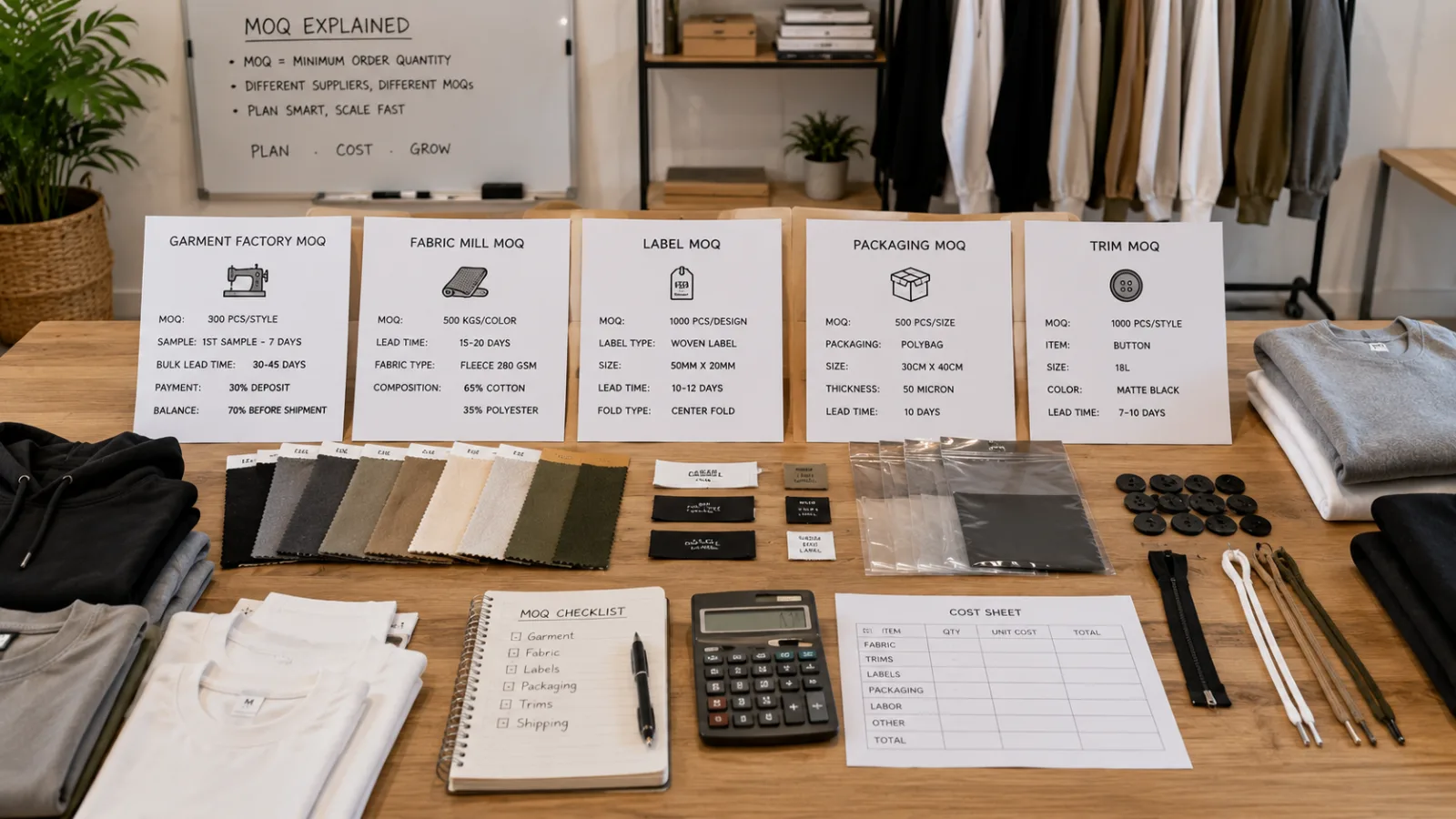
MOQ means minimum order quantity. It is the minimum number of products, pieces, units, yards, meters, kilograms, labels, trims, or packaging items a supplier is willing to produce or sell. In clothing manufacturing, MOQ can apply to many things. A garment factory may require 300 pieces per style. A fabric mill may require 500 meters of fabric. A label supplier may require 1,000 woven labels. A packaging supplier may require 2,000 custom polybags. A dye house may require a certain amount of fabric for custom color development.
This is why MOQ is not only a factory issue. It is a full supply chain issue.
For example, a clothing manufacturer may say they can produce 200 hoodies. But the fleece fabric supplier may require enough fabric for 500 hoodies. The rib supplier may require a minimum roll. The zipper supplier may require 1,000 custom zippers. The packaging supplier may require 3,000 branded bags. Suddenly, the real MOQ becomes much more complicated than the garment factory’s minimum.
MOQ in Simple Terms
MOQ answers one question: What is the smallest order the supplier will accept?
If the MOQ is 100 pieces, you cannot place an order for 25 pieces unless the supplier agrees to an exception. If the MOQ is 500 pieces per color, ordering three colors may mean 1,500 pieces total. If the MOQ is 300 pieces per style, you may be able to mix sizes within that quantity, but not always mix colors.
Why MOQ Matters for Fashion Brands
MOQ matters because it determines how much money you need before production begins. It also affects how much inventory you must store, sell, and manage. For new brands, MOQ can decide whether a collection is realistic or too risky.
A brand may want to launch 10 styles in 5 colors, but MOQ may make that impossible. Understanding MOQ early helps brands reduce collection complexity, protect cash flow, and avoid overproduction.
Why Do Suppliers Set MOQ?
Suppliers set MOQ because production has setup costs, labor requirements, material minimums, machine preparation, and business efficiency needs. Making one garment or ten garments is often not profitable for a factory because the time required to prepare production is too high compared to the order value.
A garment order involves many steps before sewing begins. The supplier may need to review the tech pack, source fabric, order trims, create patterns, make samples, adjust fit, prepare cutting markers, set up machines, assign workers, inspect quality, pack garments, and prepare shipment. These steps take time whether the order is small or large. If the order quantity is too low, the supplier may lose money.
Main Reasons Suppliers Set MOQ
- Production Setup: Machines, workers, cutting tables, patterns, and production lines need setup time.
- Material Minimums: Fabric mills, trim suppliers, dye houses, and packaging vendors often have their own MOQs.
- Labor Efficiency: Factories need enough pieces to make production time worthwhile.
- Cost Control: Larger quantities spread fixed costs across more units, reducing cost per piece.
- Supplier Profitability: Suppliers need orders large enough to cover overhead and make profit.
- Quality Consistency: Producing a batch together can help maintain color, fabric, and construction consistency.
Why MOQ Can Be Higher for Custom Products
Custom products usually have higher MOQ than ready-made blanks because they require new development. Custom fabric, custom dyeing, custom labels, special trims, printing, embroidery, and unique construction all increase setup work.
A plain stock T-shirt may have a lower MOQ because the supplier already has fabric, pattern, and production process ready. A custom oversized hoodie with heavyweight fleece, custom rib, embroidery, woven labels, and branded packaging will likely require a higher MOQ.
Different Types of MOQ in Apparel Manufacturing
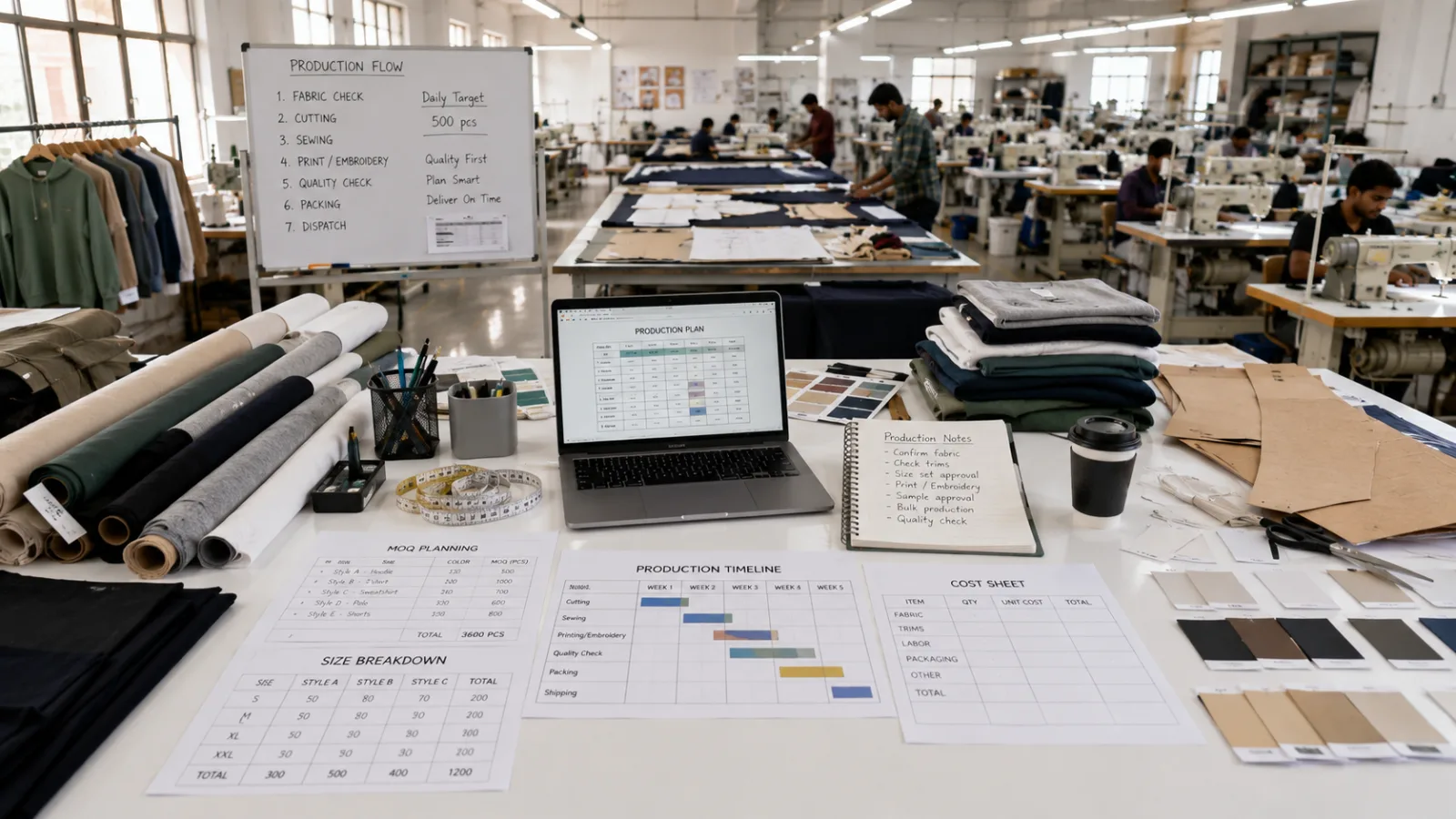
MOQ is not always one simple number. Clothing brands need to understand the different types of MOQ that can appear during production.
1. Style MOQ
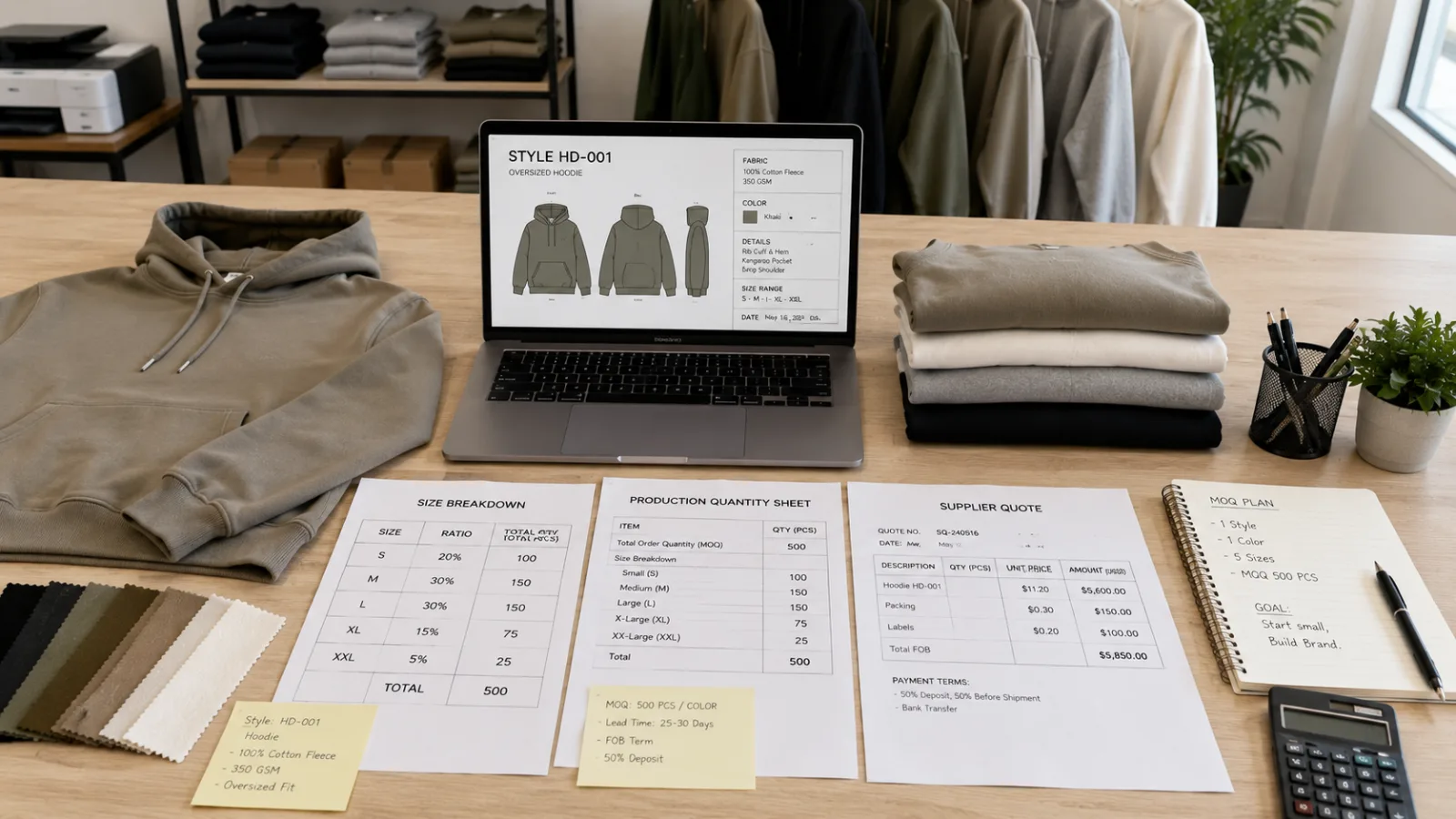
Style MOQ means the minimum quantity required for one design or product style. For example, a manufacturer may require 300 pieces for one hoodie style.
2. Color MOQ
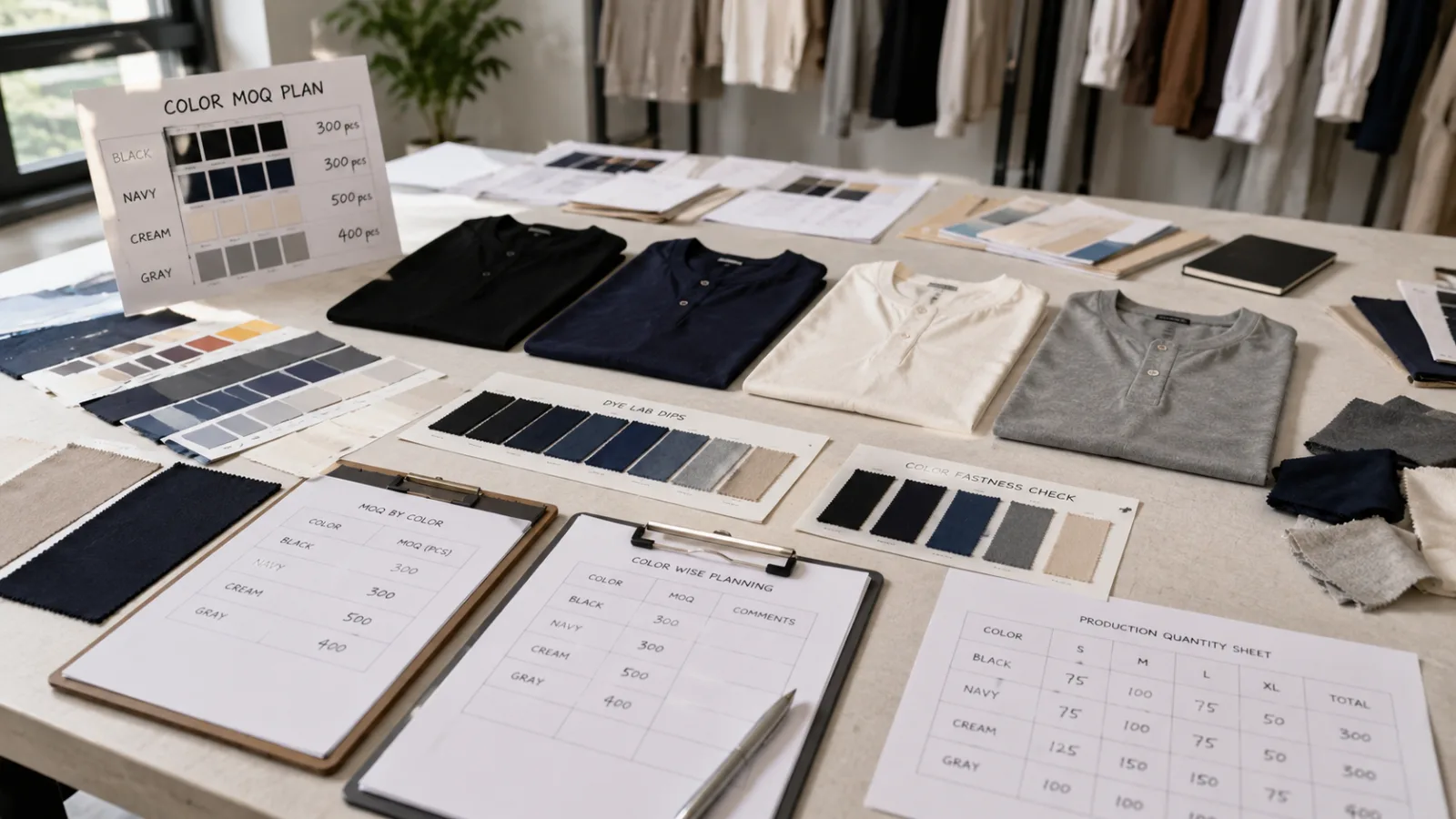
Color MOQ means the minimum quantity required for each color. A factory may accept 300 pieces total, but a fabric dye house may require 300 pieces per color. This matters if you want several colorways.
For example, if MOQ is 300 pieces per color and you choose black, navy, and cream, your total order may become 900 pieces.
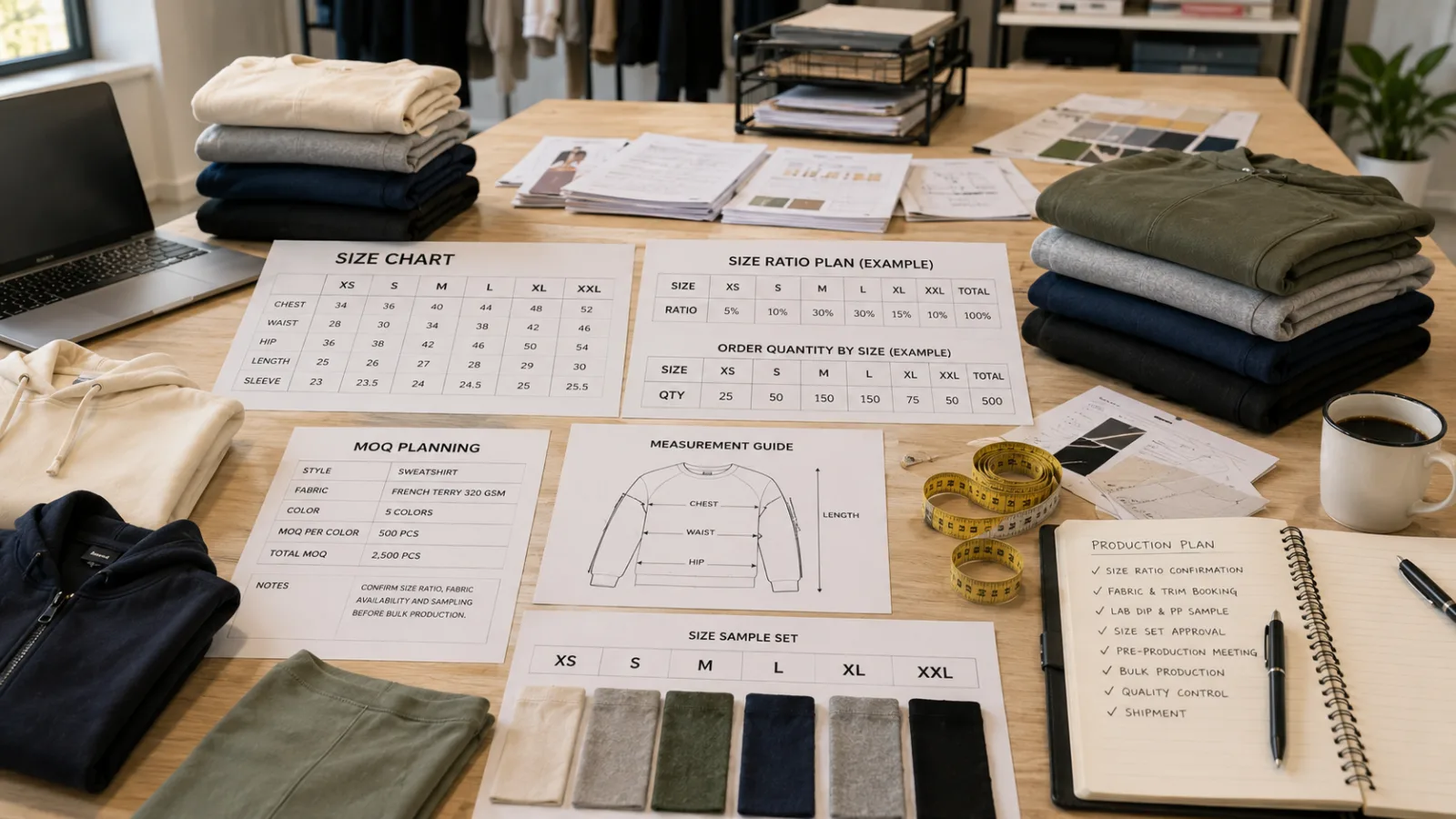
3. Size MOQ
Size MOQ means the minimum quantity for each size or size range. Some suppliers allow flexible size breakdowns, while others may require minimums per size. This is important for brands offering wide size ranges.
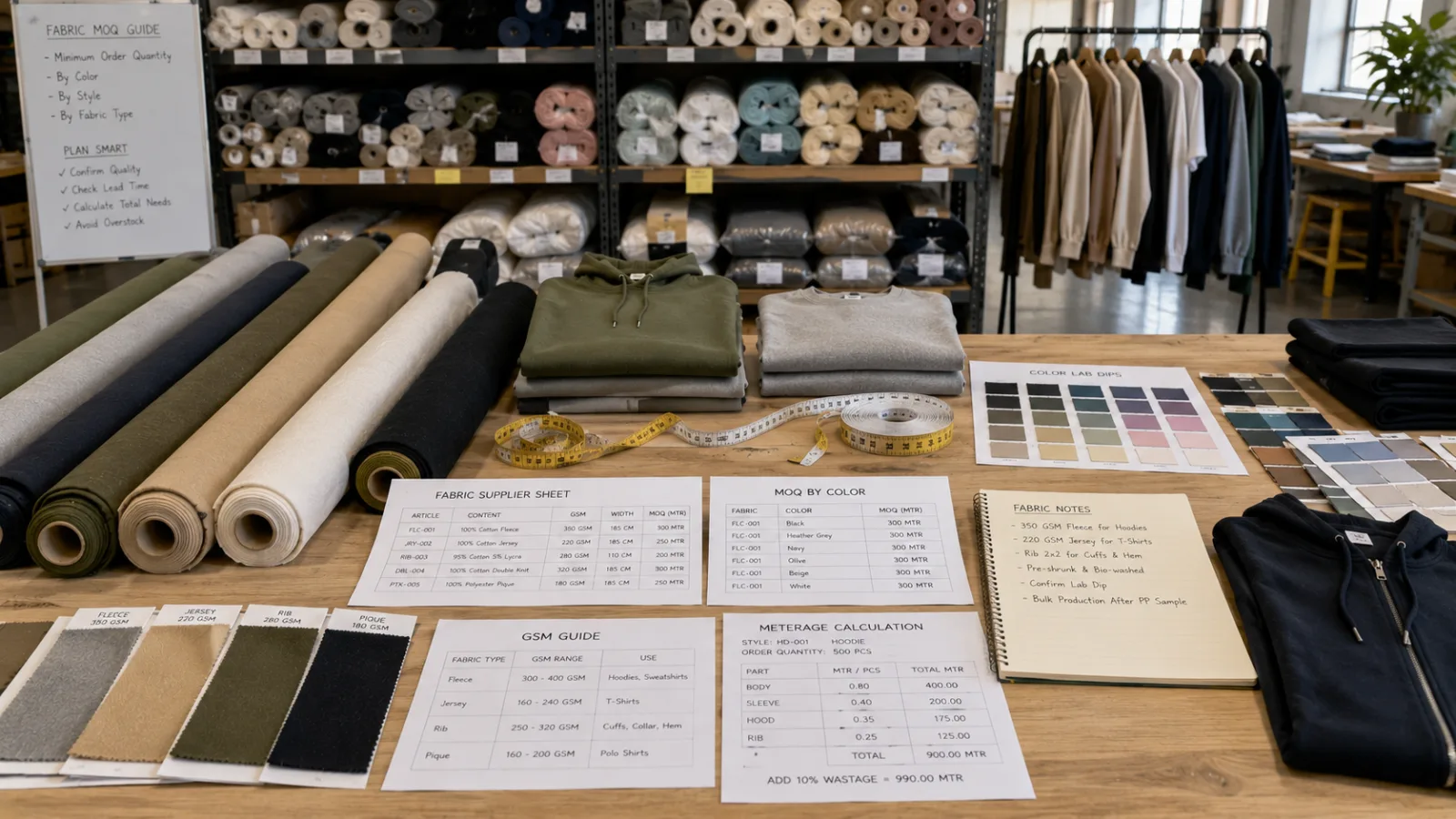
4. Fabric MOQ
Fabric MOQ is set by fabric suppliers or mills. It may be measured in meters, yards, kilograms, rolls, or dye lots. Fabric MOQ can become a major issue for custom materials.
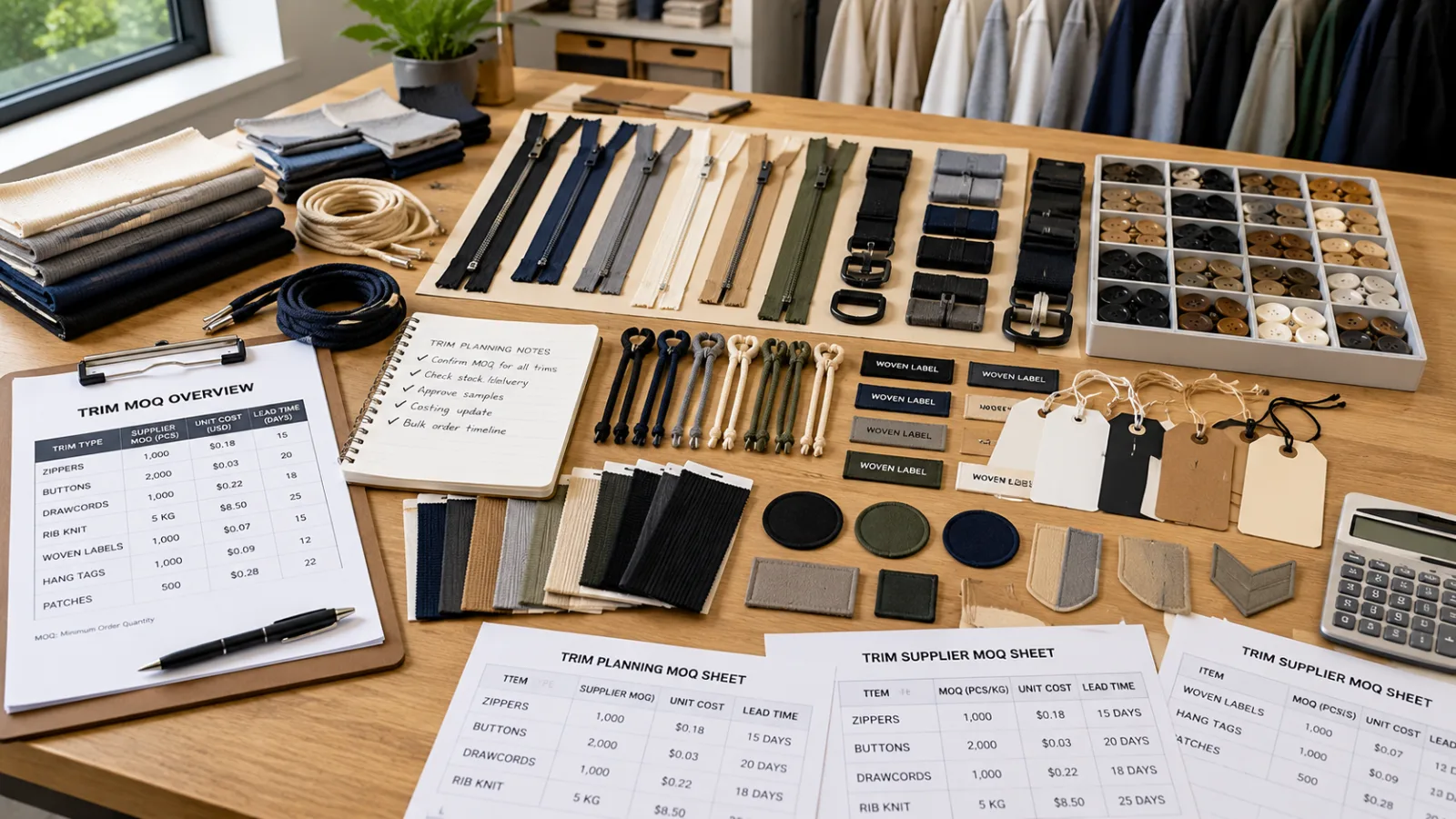
5. Trim MOQ
Trim MOQ applies to zippers, buttons, drawcords, elastic, rib, labels, hang tags, patches, snaps, and packaging details. Custom trims often have higher MOQ than standard trims.
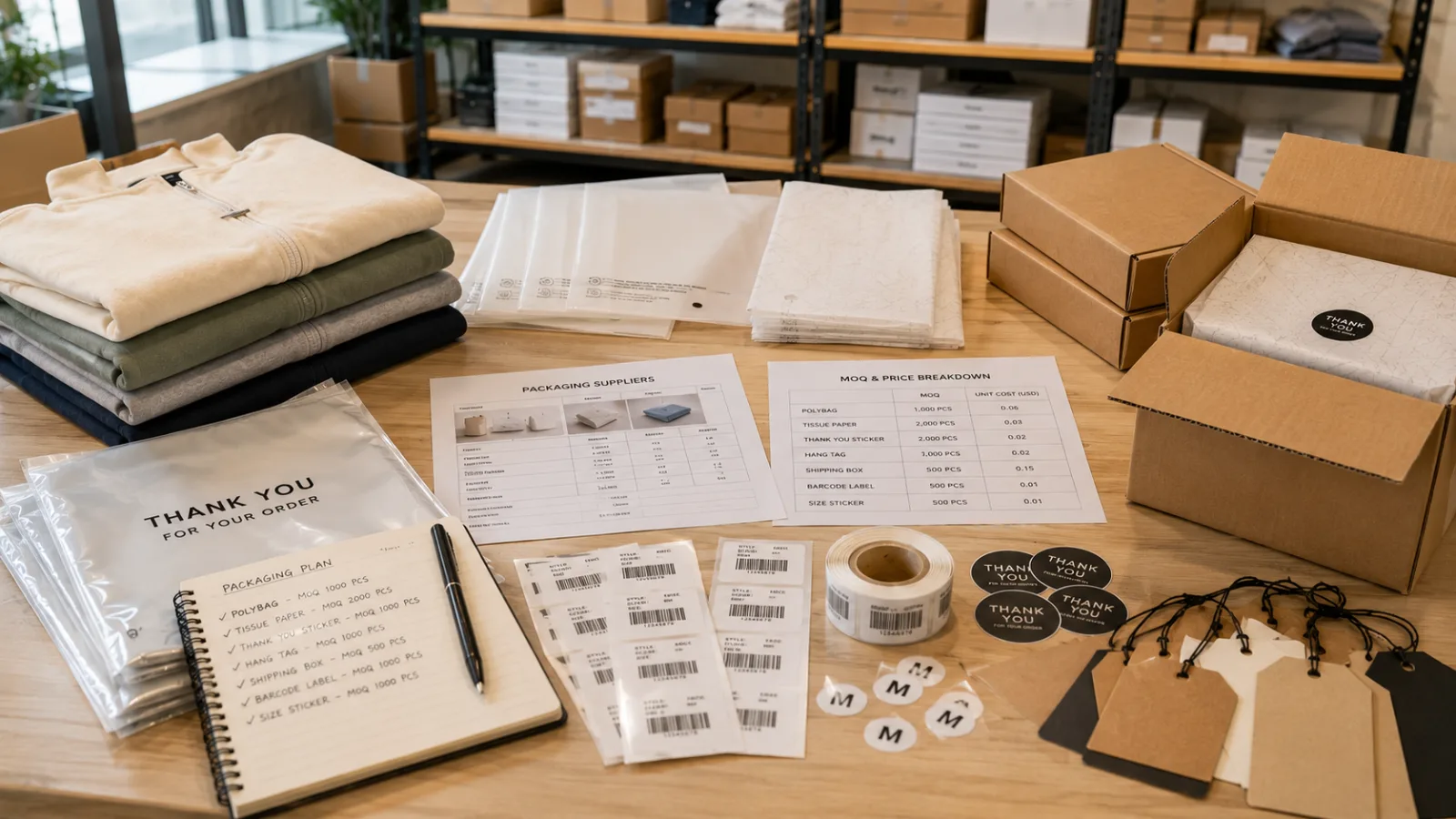
6. Packaging MOQ
Packaging MOQ applies to polybags, boxes, tissue paper, mailers, stickers, barcode labels, and branded packaging. Custom packaging can create large minimums.
How MOQ Affects Clothing Brand Budgets
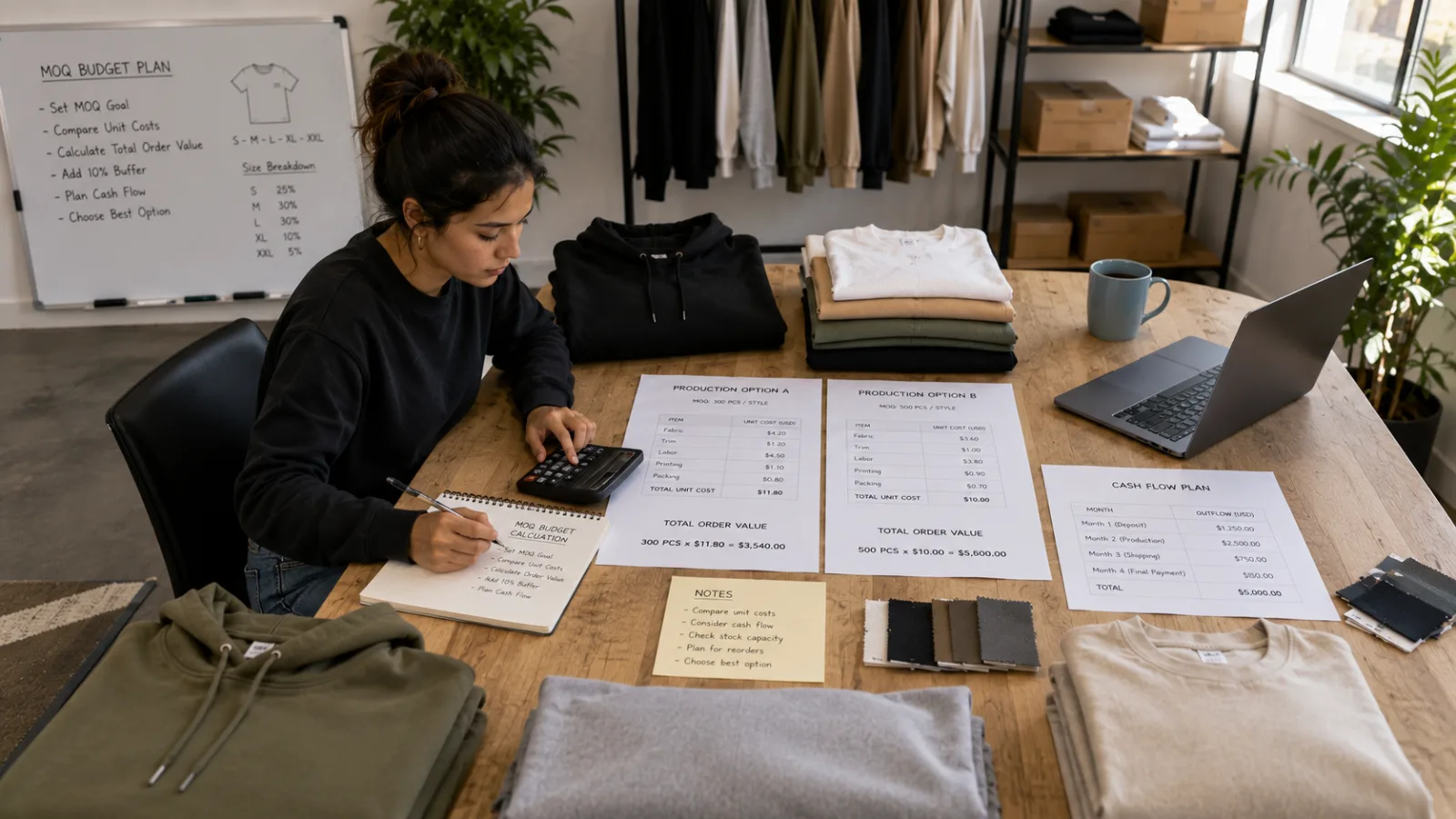
MOQ directly affects your production budget. The higher the MOQ, the more money you need upfront. Even if the unit cost is lower, the total investment may be too high for your brand.
For example, a supplier may offer two options:
Option A: $9 per unit at 500 pieces
Option B: $12 per unit at 150 pieces
At first, Option A looks cheaper because the unit price is lower. But the total production cost is $4,500. Option B costs $1,800 total. For a startup, Option B may be safer even though the unit price is higher.
Unit Cost vs Total Investment
Many new brands focus too much on unit cost and not enough on total investment. A low unit cost does not help if you cannot afford the total order or if you cannot sell the inventory.
You need to calculate:
- Unit cost
- Total production cost
- Packaging cost
- Shipping cost
- Duties and taxes
- Storage cost
- Marketing budget
- Expected selling price
- Expected sell-through rate
- Cash needed for next production
MOQ should fit your business model, not just your price goal.
MOQ and Cash Flow
High MOQ can create cash flow pressure. You may spend most of your budget on inventory before you have sales. If the products sell slowly, your money stays trapped in stock. This can prevent you from launching new designs, running marketing campaigns, or reordering best sellers.
MOQ and Overproduction
High MOQ can also create overproduction. If you order more than customers want, you may end up with deadstock. Deadstock creates storage costs, markdowns, liquidation pressure, and waste.
MOQ and Pricing: Why Lower Unit Cost Is Not Always Better
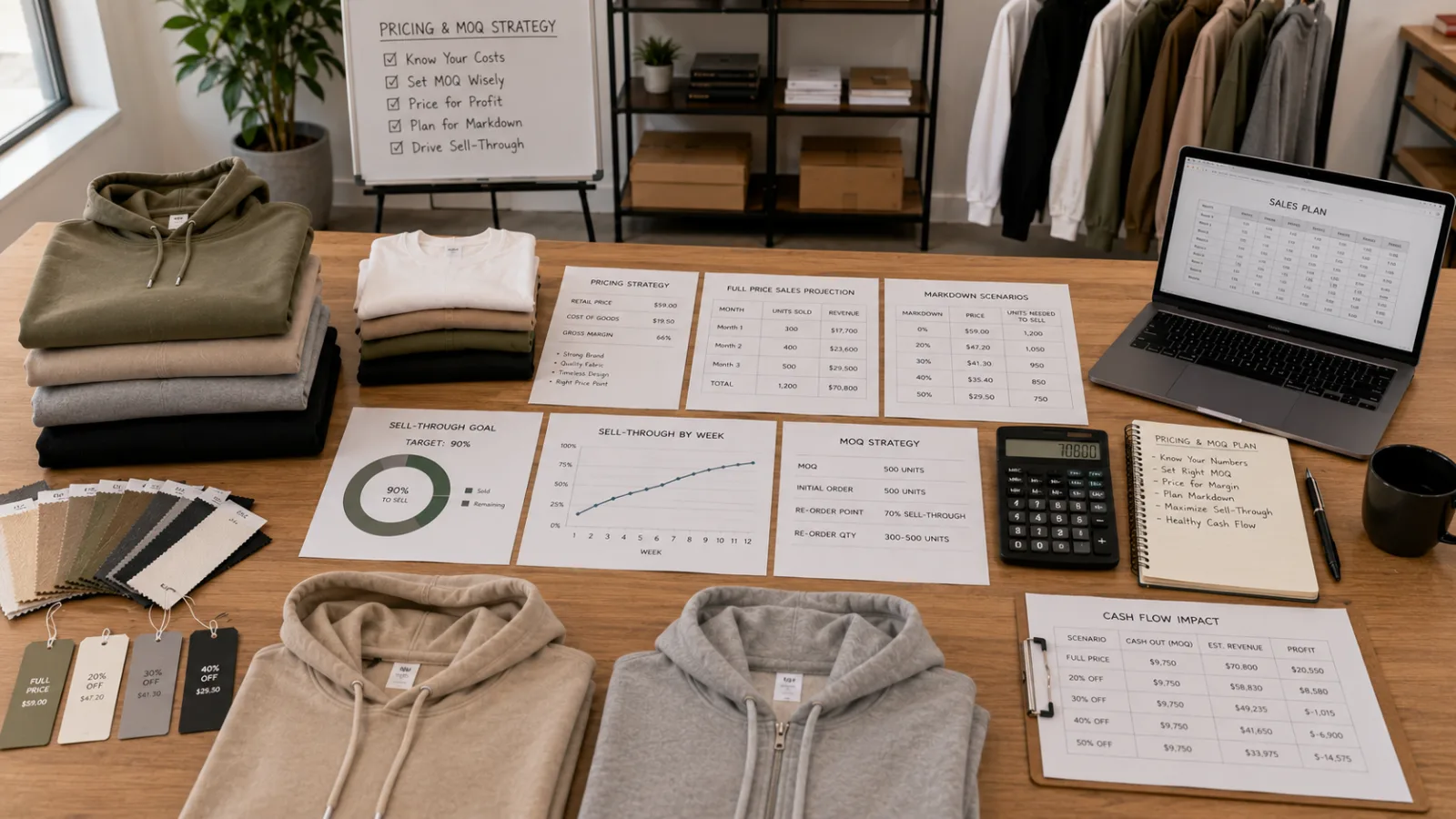
A lower unit cost can improve profit margin, but only if you can sell the quantity. Many brands accept high MOQ to get lower pricing, then struggle with unsold inventory.
For example, ordering 1,000 T-shirts at $6 each may seem better than ordering 250 T-shirts at $9 each. But if only 300 sell at full price and the rest need discounts, the lower unit cost may not actually create better profit.
True Profit Depends on Sell-Through
Sell-through means how much inventory sells within a certain period. A high MOQ only works if demand is strong enough. If sell-through is slow, inventory becomes a burden.
A smaller order with a higher unit cost can be better if it sells quickly and allows you to test demand. Once you know the product works, you can increase quantity in the next production run.
MOQ and Markdown Risk
Higher MOQ increases markdown risk because you have more units to sell. If the product is seasonal or trend-based, leftover stock may need to be discounted. Discounts reduce profit.
This is especially important for fashion categories such as holiday clothing, swimwear, winter coats, trend colors, event-based styles, and seasonal prints.
Smart Pricing Strategy
When evaluating MOQ, calculate pricing at different order quantities. Ask yourself:
- What is the profit if everything sells at full price?
- What is the profit if 30 percent sells at discount?
- What happens if half the inventory is slow-moving?
- Can I afford to hold this stock?
- Can I run ads and still make profit?
- Can I sell wholesale at this cost?
A smart brand chooses MOQ based on real demand, not only lower unit price.
MOQ and Inventory Risk
MOQ creates inventory risk because every unit you produce must eventually be sold, stored, discounted, donated, or liquidated. The more inventory you produce, the more risk you carry.
Inventory risk is especially high for new brands because they do not have enough sales history. They may not know which sizes will sell, which colors customers prefer, which product photos will convert, or which price point will work.
Common Inventory Problems Caused by MOQ
- Too many units in unpopular colors.
- Too much stock in slow-moving sizes.
- Too many styles with weak demand.
- Seasonal products arriving too late.
- Large orders based on untested designs.
- Cash trapped in products that sell slowly.
- Heavy discounts needed to clear stock.
- MOQ is not bad, but it must be managed carefully.
How to Reduce Inventory Risk
- Start with fewer styles.
- Use fewer colors.
- Choose core products first.
- Test demand before large production.
- Use stock fabric where possible.
- Avoid overly trend-based large orders.
- Plan size ratios carefully.
- Track sales data from the first launch.
- Reorder based on proven demand.
- Negotiate smaller trial runs.
Small Collection Strategy
For a new fashion brand, a focused collection is often better than a large launch. Instead of producing 12 styles in multiple colors, consider 3 to 5 strong products. This allows better quality control, better photography, better storytelling, and lower inventory risk.
How to Negotiate MOQ With Suppliers
MOQ is often negotiable, especially if you approach the conversation professionally. Suppliers set MOQ for business reasons, but many are willing to discuss options if they believe your brand is serious and the order can still make sense.
1. Ask for a Trial Order
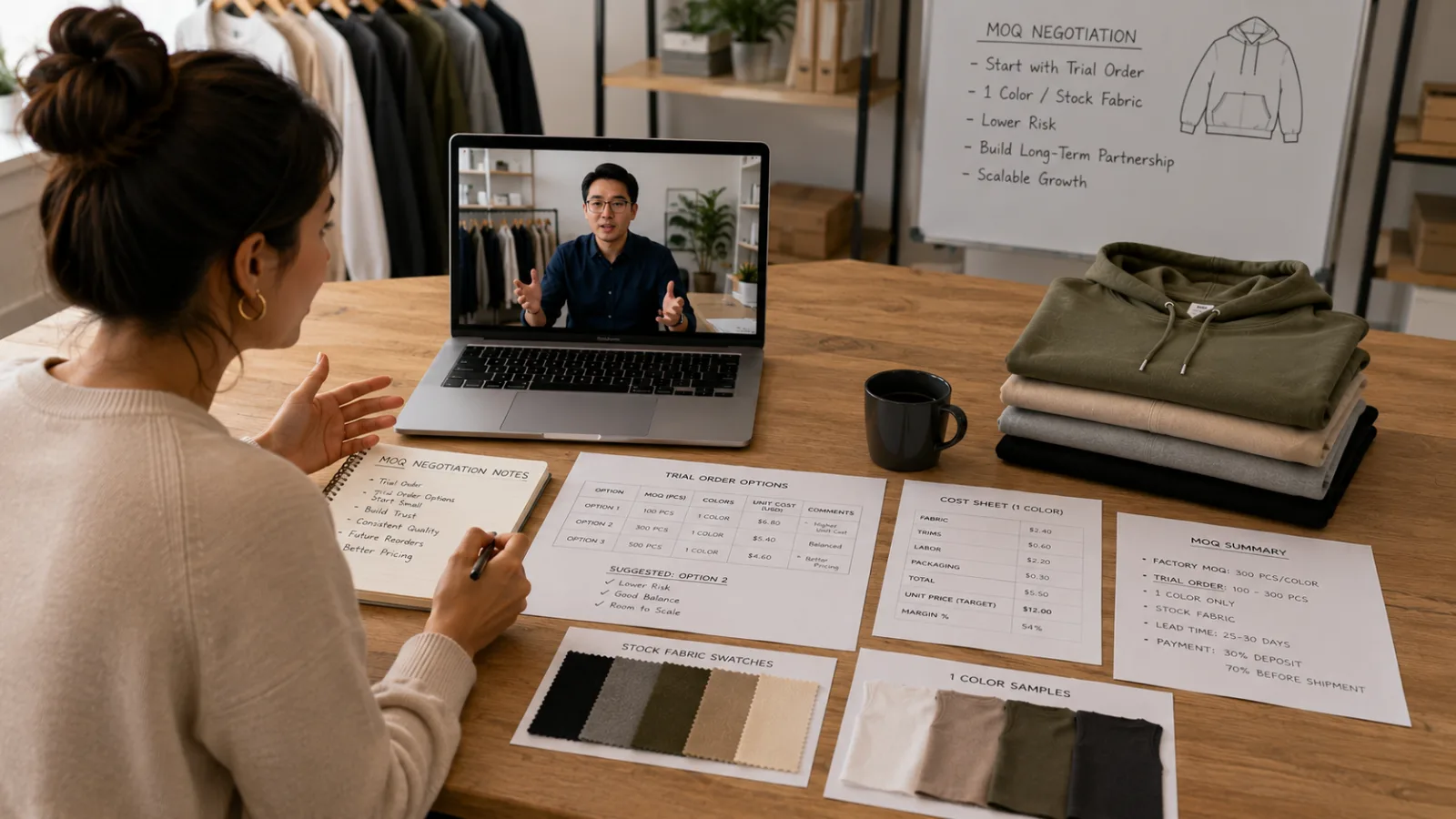
A trial order is a smaller first production run used to test quality and demand. You may need to accept a higher unit price, but it reduces inventory risk.
2. Use Stock Fabric
Stock fabric usually has lower MOQ than custom fabric. If you are flexible with fabric or color, suppliers may reduce garment MOQ.
3. Reduce Color Options
Color MOQ can increase total quantity quickly. Starting with one or two colors makes production easier and more affordable.
4. Simplify the Design
Complex construction, special trims, custom dyeing, and detailed embroidery can increase MOQ. A simpler design may be easier to produce in smaller quantities.
5. Offer a Higher Unit Price
Suppliers may accept lower MOQ if the unit price is higher. This can be a good trade-off for startups.
6. Build a Long-Term Plan
Tell the supplier your growth plan. If they believe future orders are likely, they may be more flexible with the first order.
7. Combine Styles With Shared Materials
If multiple styles use the same fabric, trims, labels, or packaging, the supplier may be able to meet material MOQ more easily.
8. Ask About Mixed Sizes
Confirm whether sizes can be mixed within the MOQ. Most apparel orders require size flexibility, but you should clarify this early.
Sample MOQ Negotiation Message
Hello,
We are interested in producing this style and would like to start with a smaller first run to test quality and customer demand. Your MOQ is 300 pieces, but would you consider 150 pieces for the first order if we use stock fabric and keep the design to one color? We are open to a slightly higher unit price for the trial order. If the product performs well, we plan to reorder at a larger quantity.
Thank you.
Low MOQ vs High MOQ: Which Is Better?
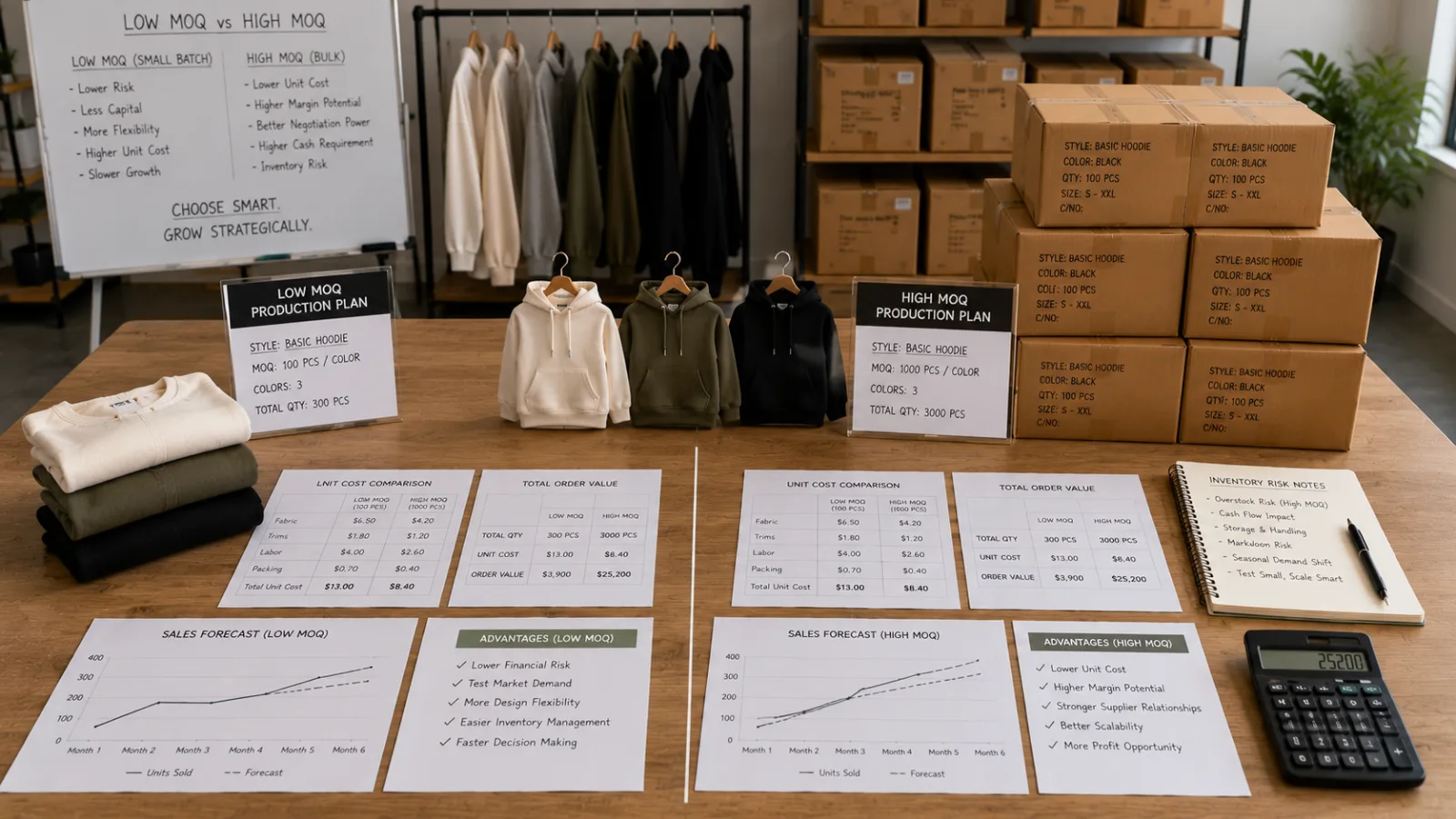
Low MOQ and high MOQ both have advantages and disadvantages. The right choice depends on your brand stage, budget, demand, and product type.
Low MOQ Benefits
- Lower upfront investment
- Lower inventory risk
- Better for startups
- Easier to test products
- More flexibility
- Less storage pressure
- Better for limited drops
- Easier to adjust after feedback
Low MOQ Drawbacks
- Higher unit cost
- Fewer customization options
- Limited fabric choices
- Less supplier priority
- Lower margin
- Possible production limitations
High MOQ Benefits
- Lower unit cost
- Better margin potential
- More customization options
- Better factory efficiency
- More supplier interest
- Useful for proven products
- Better for wholesale orders
High MOQ Drawbacks
- Higher cash requirement
- Greater overstock risk
- More storage cost
- Harder to change direction
- Higher markdown risk
- More pressure to sell quickly
Best Approach
Use low MOQ for testing new products and high MOQ for proven best sellers. Start small, learn from customer response, then scale carefully.
MOQ Questions to Ask Clothing Manufacturers
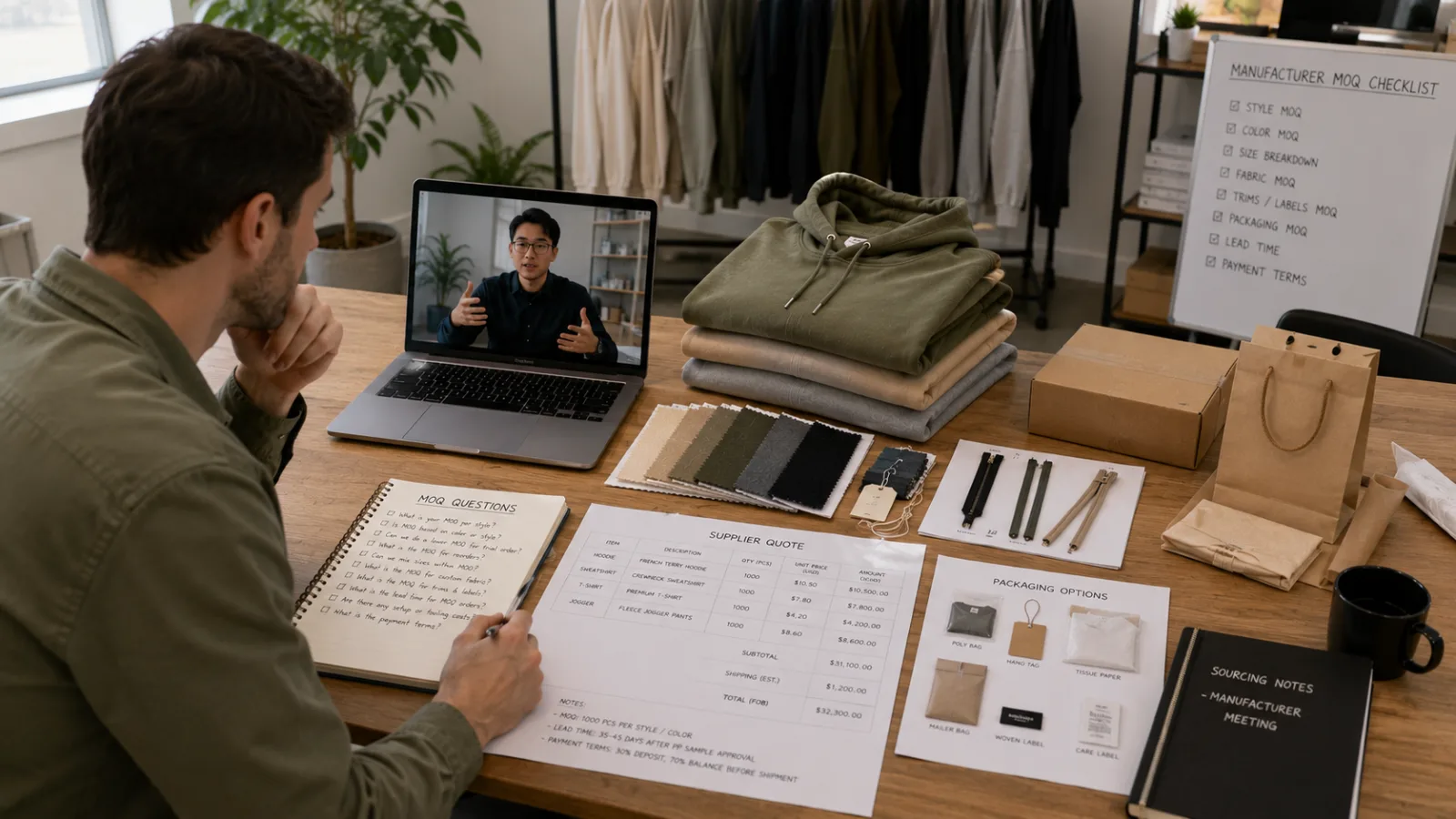
Before choosing a manufacturer, ask detailed MOQ questions. This prevents surprises later.
Important MOQ Questions
- What is your MOQ per style?
- Is the MOQ per color or total order?
- Can I mix sizes within the MOQ?
- Can I mix colors within the MOQ?
- What is the MOQ for stock fabric?
- What is the MOQ for custom fabric?
- What is the MOQ for custom dyeing?
- What is the MOQ for labels and trims?
- What is the MOQ for packaging?
- Do you offer lower MOQ for first orders?
- Can I pay a higher unit price for lower MOQ?
- Do you offer sample runs?
- Can I reorder smaller quantities later?
- How does MOQ affect unit cost?
- What happens if fabric MOQ is higher than garment MOQ?
Why These Questions Matter
These questions help you understand the real minimum investment. Many brands misunderstand MOQ because they only ask one general question. Always break it down by style, color, size, fabric, trims, and packaging.
Common MOQ Mistakes New Clothing Brands Make
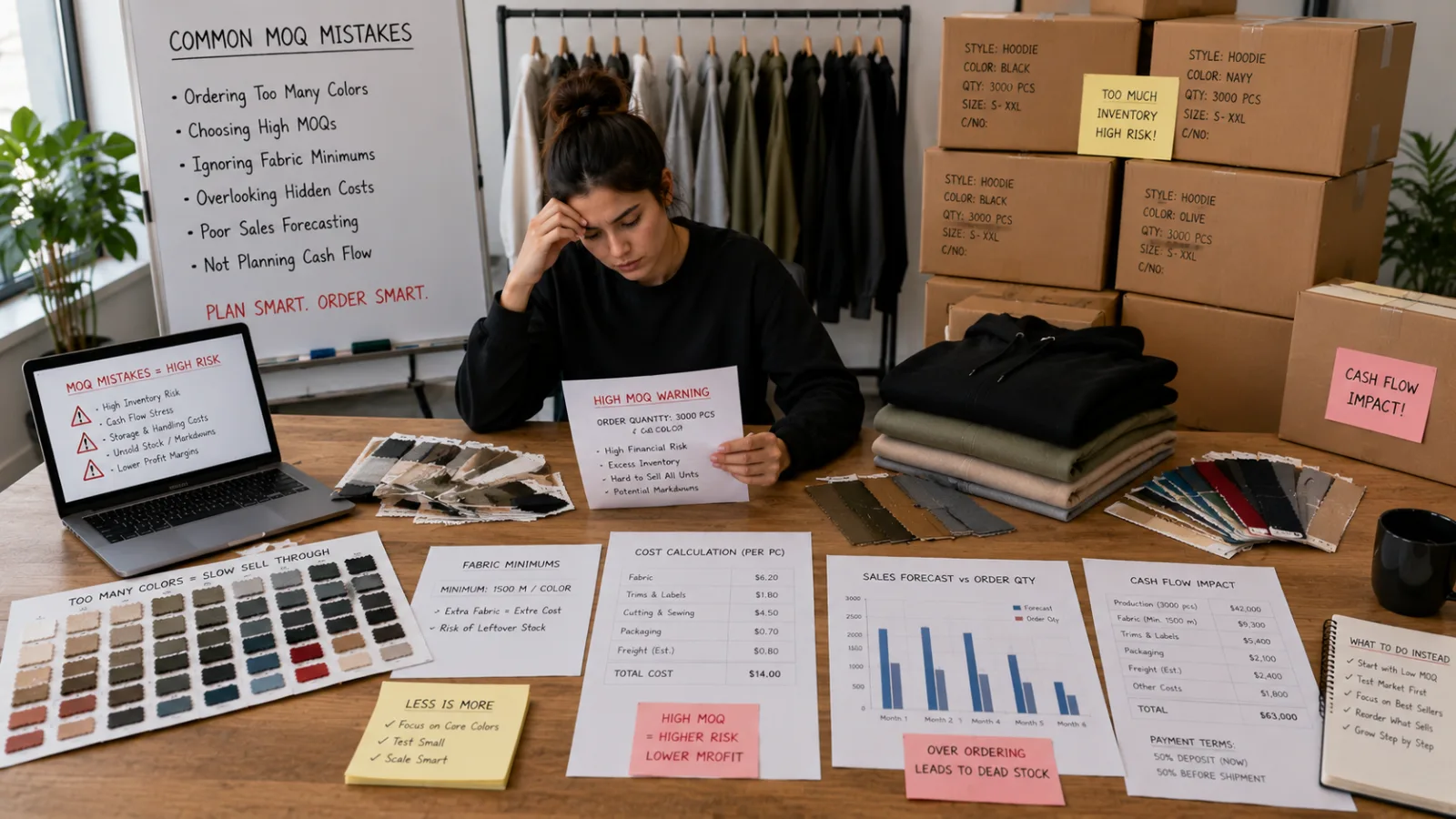
MOQ mistakes can create serious financial pressure. Here are the most common mistakes to avoid.
Mistake 1: Choosing Too Many Styles
Every style may have its own MOQ. Too many styles can make the collection too expensive.
Mistake 2: Choosing Too Many Colors
Color MOQ can multiply your order quantity quickly. Start with proven colors.
Mistake 3: Ignoring Fabric MOQ
Fabric MOQ can be higher than garment MOQ. Always confirm material minimums.
Mistake 4: Chasing the Lowest Unit Cost
A low unit cost with high MOQ can create overstock and cash flow problems.
Mistake 5: Not Calculating Total Investment
MOQ should be evaluated by total cost, not unit cost alone.
Mistake 6: Not Testing Demand
Large orders are risky when customer demand is unproven.
Mistake 7: Forgetting Storage and Fulfillment
More inventory means more storage, handling, and fulfillment planning.
Mistake 8: Not Negotiating
Some brands accept MOQ without asking for trial order options.
How MOQ Affects Private Label and Custom Clothing
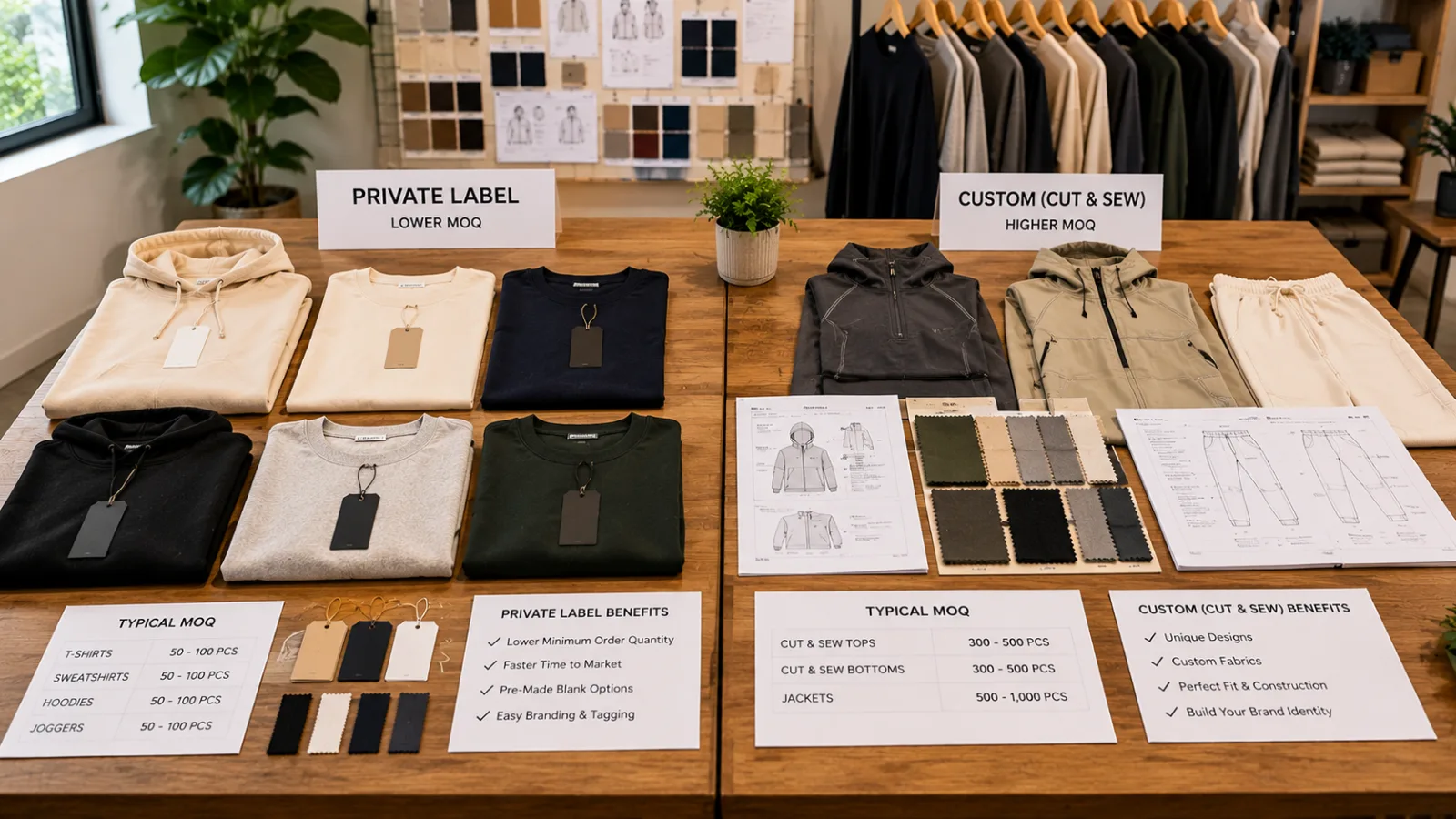
MOQ works differently depending on whether you are producing private label or custom clothing.
Private Label MOQ
Private label products often have lower MOQ because the supplier already has the base product. You may only need to add your label, hang tag, or packaging. This can be a good option for startups that want faster launch and lower development cost.
However, private label products are less unique. Other brands may sell similar items.
Custom Clothing MOQ
Custom clothing usually has higher MOQ because the supplier must develop patterns, source fabric, create samples, order trims, and set up production specifically for your design.
Custom production gives you more control over fit, fabric, construction, branding, and uniqueness, but it also requires more planning and budget.
Which One Should You Choose?
Choose private label if you want a faster, lower-risk launch. Choose custom production if brand uniqueness and product control are more important. Some brands start with private label, then move into custom production once demand is proven.
How MOQ Impacts Sustainability
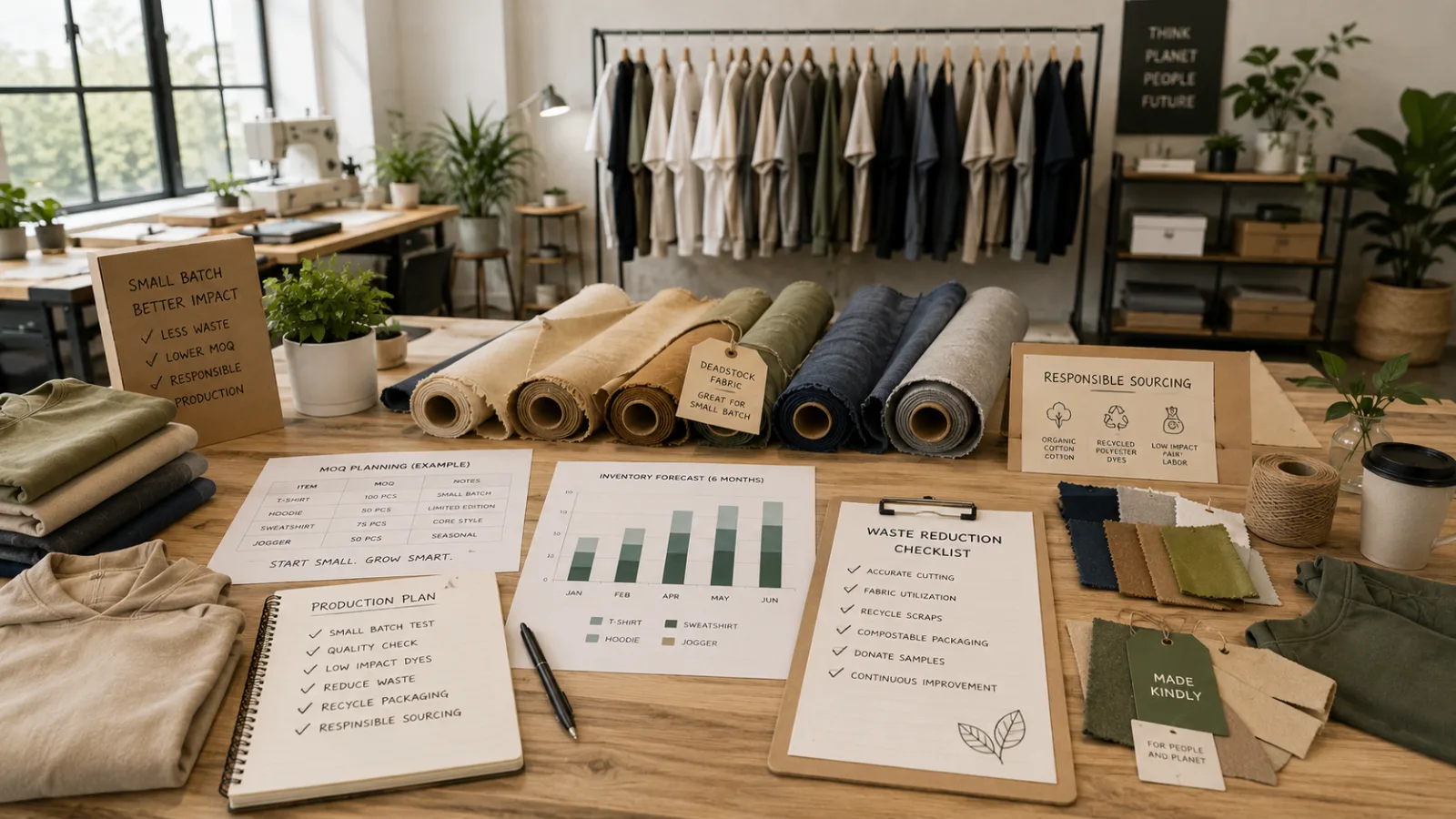
MOQ also affects sustainability. High MOQ can lead to overproduction if demand is not strong enough. Overproduction creates deadstock, markdowns, liquidation pressure, and textile waste.
Fashion brands that want to operate responsibly should think carefully about MOQ before placing large orders. Producing more than customers need is not sustainable, even if the fabric is eco-friendly.
Better MOQ Planning Supports Sustainability
Smaller test runs, better demand forecasting, pre-orders, core product planning, and thoughtful reorders can reduce waste. Brands can also use stock fabrics, deadstock materials, or shared trims to lower material waste.
Avoid Greenwashing
A brand should not claim sustainability only because it uses organic or recycled fabric. If the brand overproduces and liquidates most inventory, the business model still has waste issues. MOQ planning is part of responsible production.
ApparGlobal Internal Link Section
For apparel brands, understanding MOQ becomes much easier when product development, sourcing, sampling, cost planning, and quality control are organized from the beginning. MOQ is not just a supplier number. It affects fabric selection, trim planning, packaging decisions, production budget, inventory risk, cash flow, and retail pricing.
Many clothing brands struggle because they agree to MOQ before understanding the full production impact. A garment factory may offer one minimum, but fabric mills, dye houses, trim vendors, label suppliers, and packaging suppliers may all have separate minimums. Without clear planning, the total order requirement can become much larger than expected.
Companies such as ApparGlobal help clothing brands align product development, fabric sourcing, vendor coordination, sample review, MOQ planning, production timelines, quality control, and scalable manufacturing workflows. For brands developing T-shirts, hoodies, activewear, kidswear, streetwear, uniforms, private label apparel, or custom collections, this kind of production-focused support can make MOQ decisions more practical and reliable.
When brands work with a partner that understands tech packs, fabric behavior, trim standardization, supplier communication, cost breakdowns, quality checkpoints, and bulk production requirements, they can manage MOQ more confidently and move from idea to finished product with less risk.
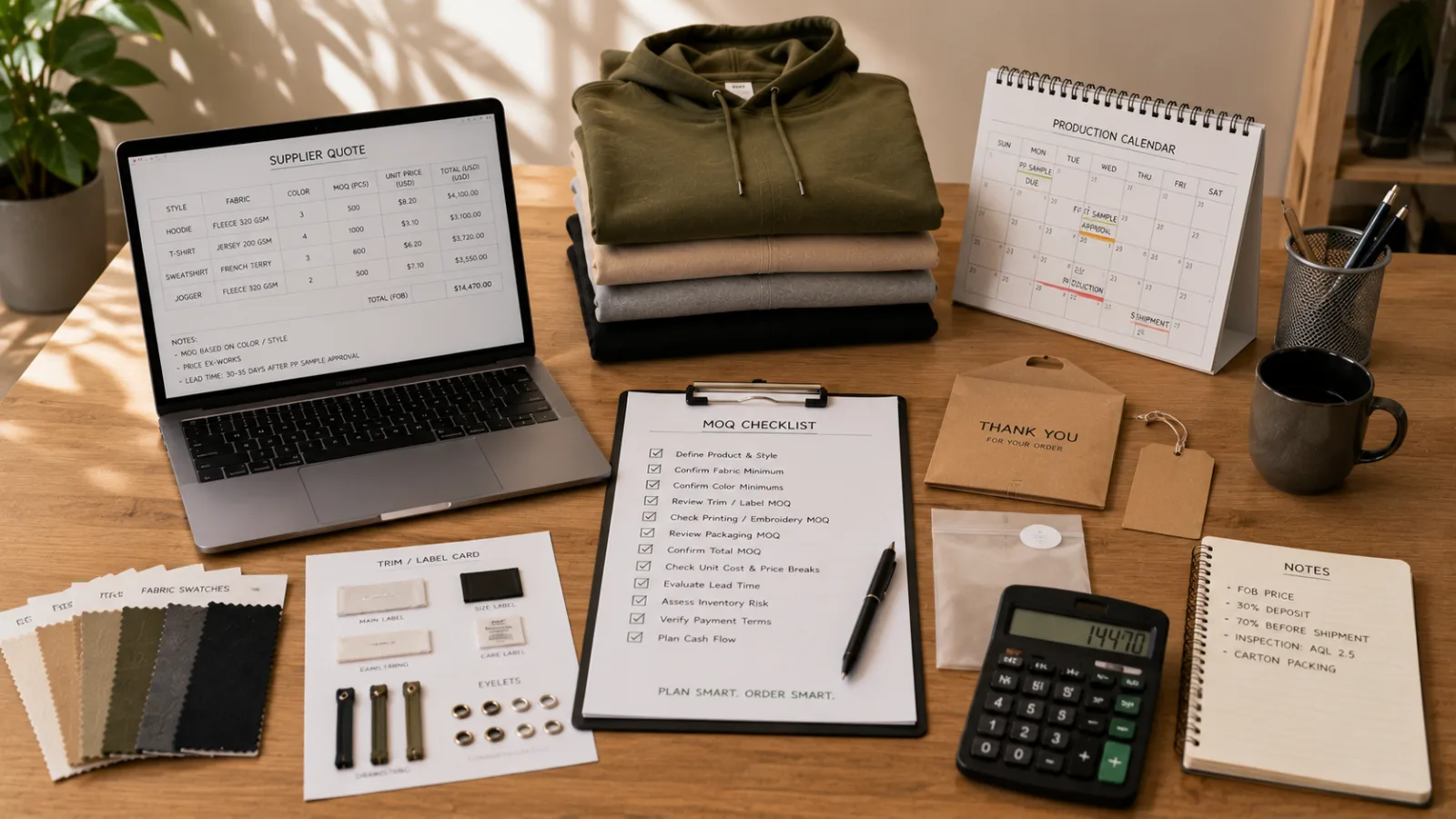
MOQ Checklist for Clothing Brands
Use this checklist before approving any production order:
- Do I know the MOQ per style?
- Do I know the MOQ per color?
- Can I mix sizes within the MOQ?
- Have I checked fabric MOQ?
- Have I checked trim MOQ?
- Have I checked packaging MOQ?
- Do I know the total order value?
- Can I afford the production cost?
- Can I sell this quantity?
- Have I calculated storage needs?
- Have I considered markdown risk?
- Can I start with fewer colors?
- Can I use stock fabric?
- Can I negotiate a trial order?
- Have I compared low MOQ and high MOQ options?
- Does this MOQ fit my launch plan?
- Do I have enough cash for marketing after production?
- Have I kept all supplier terms in writing?
This checklist helps brands make MOQ decisions with more confidence and less guesswork
Final Thoughts
Understanding MOQ is essential for every clothing brand. MOQ affects your production budget, unit cost, inventory risk, cash flow, pricing, sustainability, supplier selection, and growth strategy. If you ignore MOQ or misunderstand it, you may end up producing too much inventory, spending more money than planned, or launching products that are difficult to sell profitably.
The most important lesson is that MOQ is not only about the factory. Fabric suppliers, trim vendors, label makers, packaging suppliers, dye houses, and printers may all have their own minimums. A smart brand looks at the full production picture before approving an order.
Low MOQ is useful for testing, small launches, limited drops, and startup brands. High MOQ can be useful for proven products, lower unit costs, wholesale orders, and scaling. Neither option is automatically better. The right MOQ depends on demand, budget, product type, and business stage.
Before agreeing to MOQ, ask detailed questions. Confirm whether the minimum applies per style, color, size, fabric, trim, or packaging. Calculate total investment, not just unit cost. Review cash flow, storage, markdown risk, and sell-through expectations. Negotiate where possible, especially for first orders.
A strong MOQ strategy helps you produce smarter. It protects your budget, reduces waste, improves inventory control, and gives your fashion brand more room to grow. When you understand MOQ clearly, you can make production decisions that are not only creative, but also financially realistic and business-ready.