
A tech pack is one of the most important working documents in clothing development. In apparel manufacturing, one of the fastest ways to create delays, quality issues, and expensive mistakes is to send a factory an incomplete idea. A sketch alone is not enough. A mood board is not enough. A photo reference is not enough. Even a sample garment is often not enough if the construction details, measurements, fabric requirements, and labeling instructions are unclear. That is exactly why a tech pack matters so much.
It turns a clothing idea into a production-ready instruction file that factories, pattern makers, sample rooms, merchandisers, and quality teams can actually use. Without it, everyone involved in the process is forced to guess. And in apparel, guessing usually leads to costly errors.
For new fashion brands, tech packs are especially important because they help reduce confusion at the exact stage where confusion hurts the most: product development. A strong tech pack improves communication, speeds up sampling, supports accurate costing, and makes it easier to maintain quality consistency from sample stage to bulk production. It also helps clothing brands look more professional when dealing with manufacturers, because it shows that the product is being developed with structure rather than improvisation.
This guide explains what a tech pack is and why it is important in a clear, beginner-friendly way. It covers what goes inside a tech pack, how it helps apparel production, why factories depend on it, what mistakes brands make when building one, and how a strong tech pack can save time, money, and product quality in the long run.
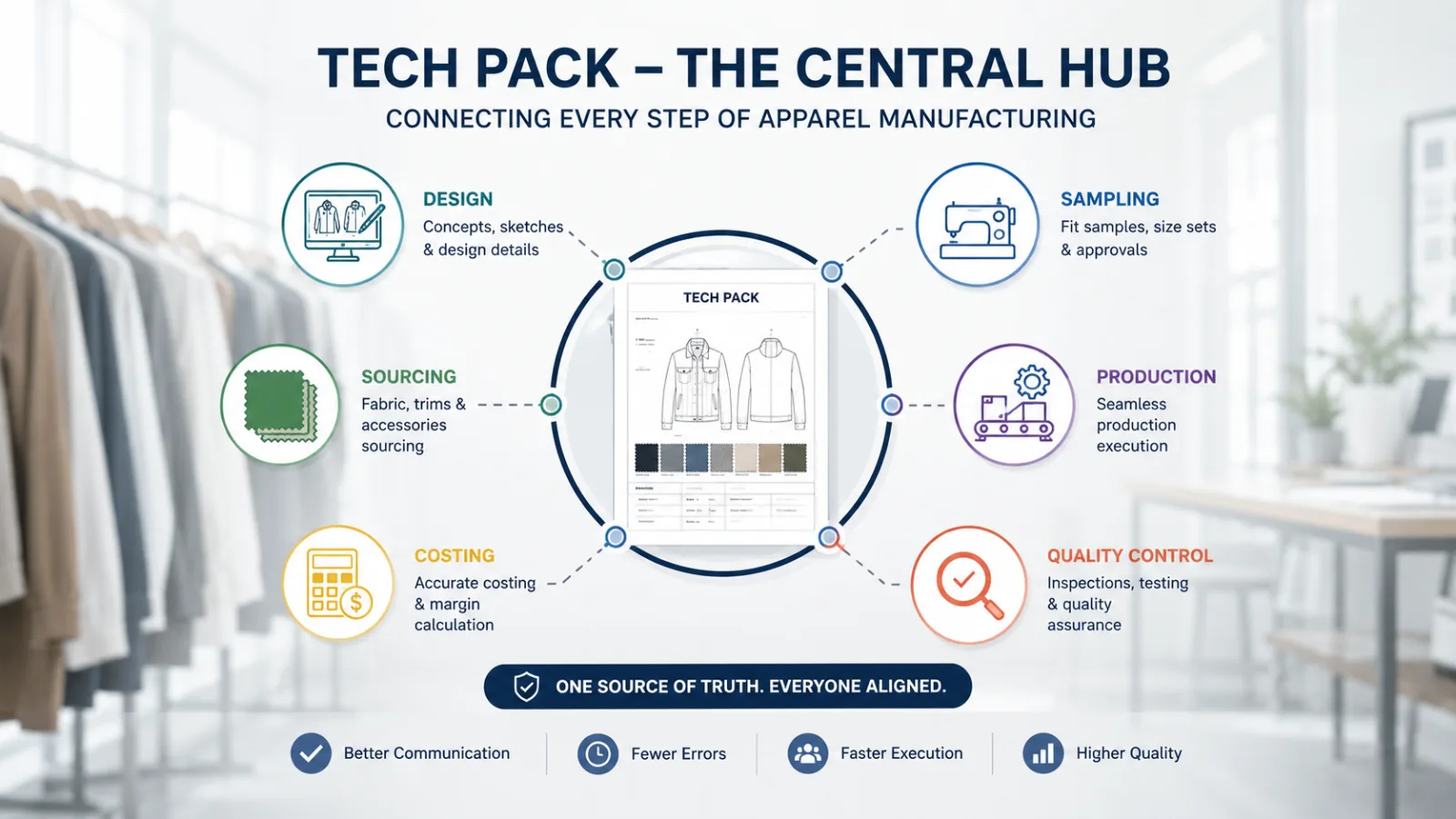
The Role of Tech Packs in the Global Apparel Industry
The global apparel industry produces more than 100 billion garments annually, involving complex supply chains across multiple countries. Because clothing production often involves designers, manufacturers, pattern makers, and quality inspectors, clear documentation such as tech packs, plays a crucial role in maintaining product consistency and manufacturing efficiency.
What Is a Tech Pack?
A tech pack, short for technical package, is a document or set of documents that explains exactly how a garment should be made. It is the product blueprint used by manufacturers and development teams to understand the design, construction, measurements, materials, trims, labels, and finishing details of a clothing item.
In simple terms, a tech pack answers the question:
“What exactly are we making, and how should it be made?”
A professional tech pack usually includes visual information, written specifications, measurement details, material references, and production instructions. It tells the factory not only what the garment should look like, but also how it should fit, which fabric to use, where labels go, what trims are needed, how the seams should be sewn, and what packaging details may apply.
A tech pack is not only for large fashion companies. Small clothing brands, startups, private label businesses, and independent designers all benefit from using one because it reduces guesswork and improves consistency.
Without a tech pack, the product lives mostly in the founder’s head. With a tech pack, the product becomes something the production team can actually build with accuracy.
Why is a Tech Pack Important?
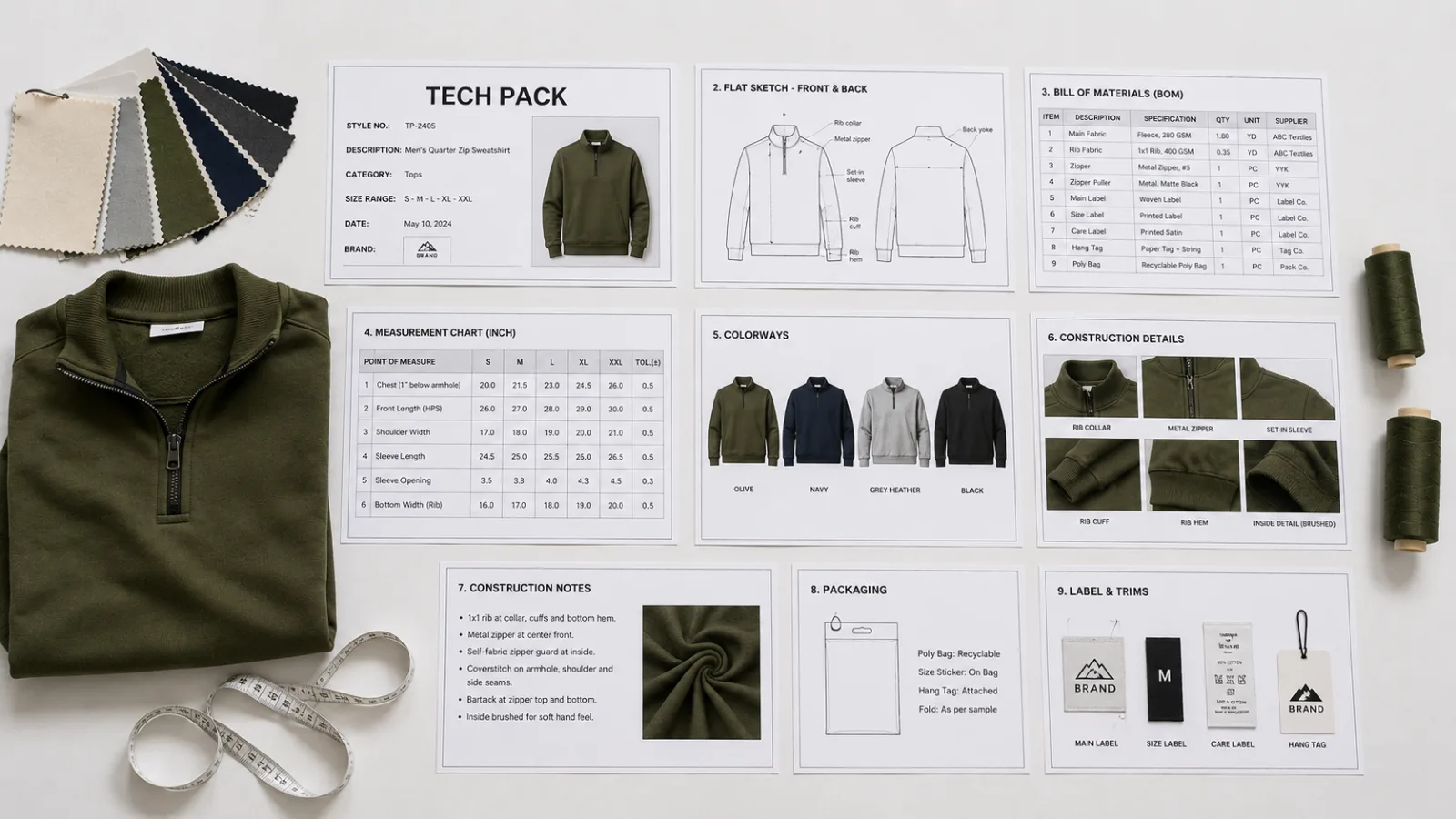
A tech pack is a comprehensive tool in the fashion industry that helps fashion designers create a tech pack and make a tech pack to ensure a final product matches the initial design. A comprehensive tech pack or clear tech pack includes measurements and construction details, points of measurement, reference images, and elements of a tech pack like construction methods and the back of the garment specs so designers and manufacturers can produce the garment and produce a garment with fewer costly mistakes.
When you think of a tech pack as a comprehensive guide, making tech packs with tech pack software or Adobe Illustrator helps bring ideas to life and minimize discrepancy between concept and reality. A detailed tech pack or detailed tech file provides every detail and the detail needed for accurate rounds of sampling, smoother rounds of sampling, and scalable bulk manufacturing, so the tech pack becomes the bridge from design process to finished fashion product.
Why Tech Packs Matter So Much in Apparel Manufacturing
A clothing product passes through many hands before it reaches the customer. Designers, pattern makers, sample makers, fabric suppliers, merchandisers, cutters, sewing operators, finishers, and quality control teams may all interact with the same style. If the instructions are vague, the chance of error rises at every step.
That is why tech packs are so important. They create a shared language between the brand and the factory. Instead of relying on assumptions, everyone works from the same reference point.
A good tech pack helps with:
- clearer communication
- faster sample development
- more accurate cost estimates
- fewer revisions caused by avoidable misunderstandings
- better quality control during production
- stronger consistency across repeat orders
- easier onboarding of new factories or suppliers
In many cases, the tech pack is the difference between a product development process that feels controlled and one that feels chaotic. When a founder says, “This sample is not what I asked for,” the real issue is often not the factory’s skill. It is that the instructions were too loose.
A strong tech pack does not guarantee a perfect product by itself, but it gives the production process a much stronger foundation. In apparel, strong foundations reduce expensive surprises.
What Is the Difference Between A Tech Pack And A Spec Sheet?
Tech pack: A tech pack is a comprehensive document used in product development that communicates design intent, materials, construction details, measurements, and often multiple technical drawings or flat sketches; it may include bill of materials, trim and label specifications, grading rules, and fit notes so manufacturers can accurately produce a sample and final garment.
Spec sheet: A spec sheet (specification sheet) is more focused and concise, typically listing exact measurements, tolerances, and technical specifications for a single style or size in a standardized format used for quality control and fit verification.
In practice, the tech pack provides the full contextual and visual guide for production while the spec sheet delivers the numerical and inspection-ready data; both work together to ensure design fidelity, correct sizing, and consistent manufacturing.
A Tech Pack Is the Blueprint of the Garment
The easiest way to understand a tech pack is to compare it to a blueprint in construction. If you wanted to build a house, you would not give the builder a photo and say, “Make something like this.” You would provide measurements, layout plans, materials, structure details, and finishing instructions.
The same logic applies to clothing. A dress, hoodie, t-shirt, jacket, or pair of trousers needs a production blueprint too. That blueprint is the tech pack.
It tells the manufacturer things such as:
- the shape of the garment
- the intended fit
- where seams go
- what the measurements should be
- which fabric should be used
- what trims are required
- what labels and artwork apply
- how the garment should be finished and packed
This matters because clothing products are more technical than many beginners realize. A garment may look simple on the outside, but it still includes decisions around stitch type, seam construction, tolerances, pocket placement, waistband structure, neck shape, placket details, zipper length, and label positioning. If these decisions are not documented clearly, the result may differ from what the brand expected. A tech pack turns creative intention into manufacturing instructions.
What Information Is Usually Included in a Tech Pack?
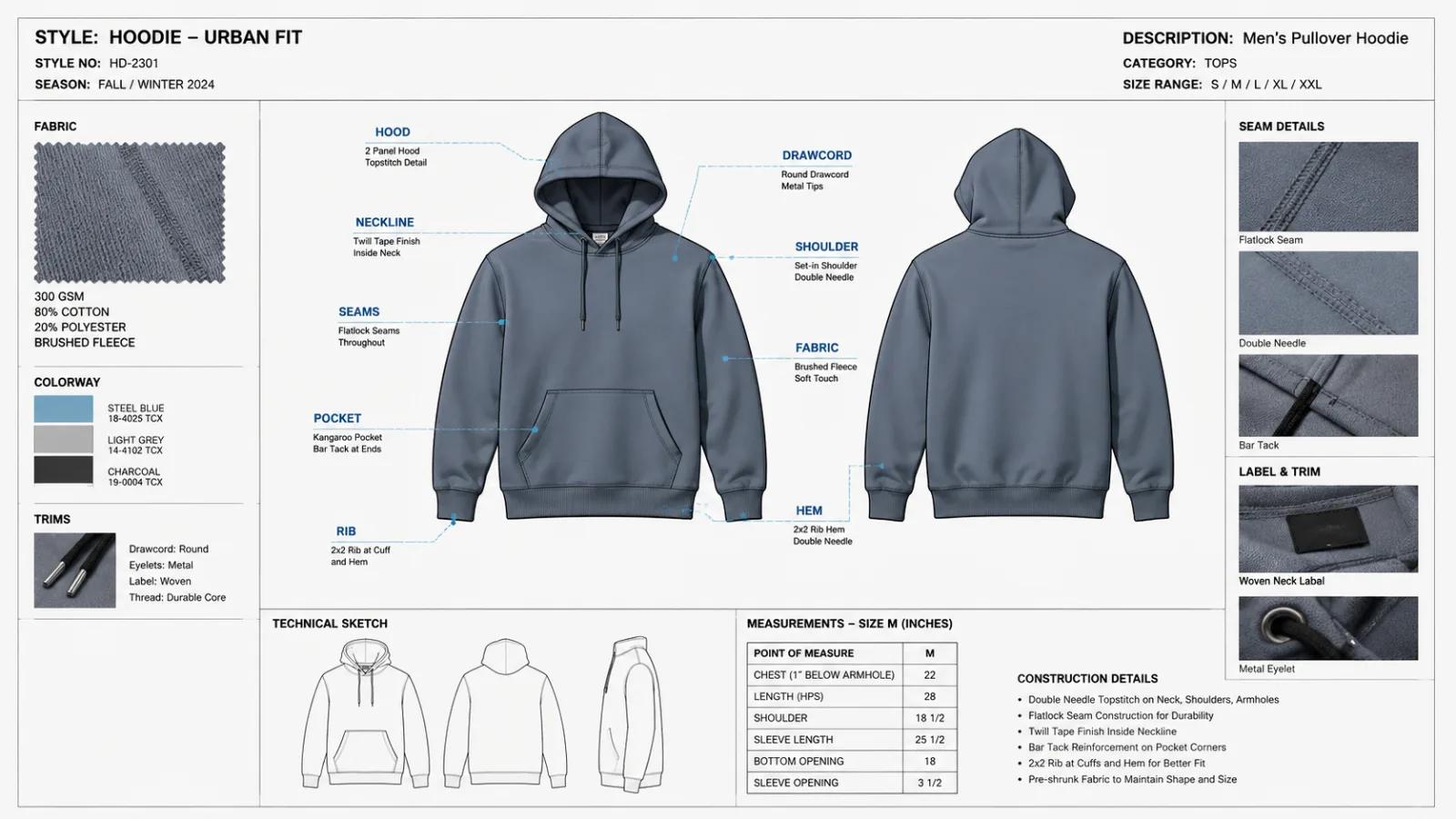
A professional tech pack can vary depending on the brand, product category, and manufacturer, but most strong tech packs include several core sections. These sections work together to describe the garment fully.
Technical Sketches
These are usually front and back flat sketches of the garment. They show the design in a clean, technical way without depending on artistic fashion illustration. Technical sketches help the factory see the product shape and construction clearly.
Style Information
This includes things like style name, style number, season, category, target gender, and sometimes collection reference. It helps organize the product internally and with suppliers.
Measurement Spec Sheet
This section includes garment points of measure such as chest width, body length, sleeve length, inseam, waist, hem opening, or shoulder width. It also often includes measurement tolerances.
Bill of Materials (BOM)
The BOM lists all materials and trims needed to make the garment, including fabric, labels, zippers, buttons, elastics, threads, drawcords, packaging items, and more.
Construction Details
This includes seam type, stitch count, topstitching placement, finishing methods, edge treatment, and special sewing instructions.
Colorways and Artwork
If the garment comes in multiple colors, prints, or graphic placements, those details are usually documented here. Placement of logos, prints, embroidery, or wash effects should be specified clearly.
Labeling and Packaging Instructions
This section explains main labels, care labels, size labels, hangtags, barcode stickers, folding methods, bagging, and carton or packaging details when relevant.
Notes and Revision History
Many brands also include development notes, approvals, and updated revision history so teams know which version of the tech pack is current.
Together, these sections create a much fuller picture of the garment than a sketch or sample alone ever could.
How Tech Packs Save Time and Money
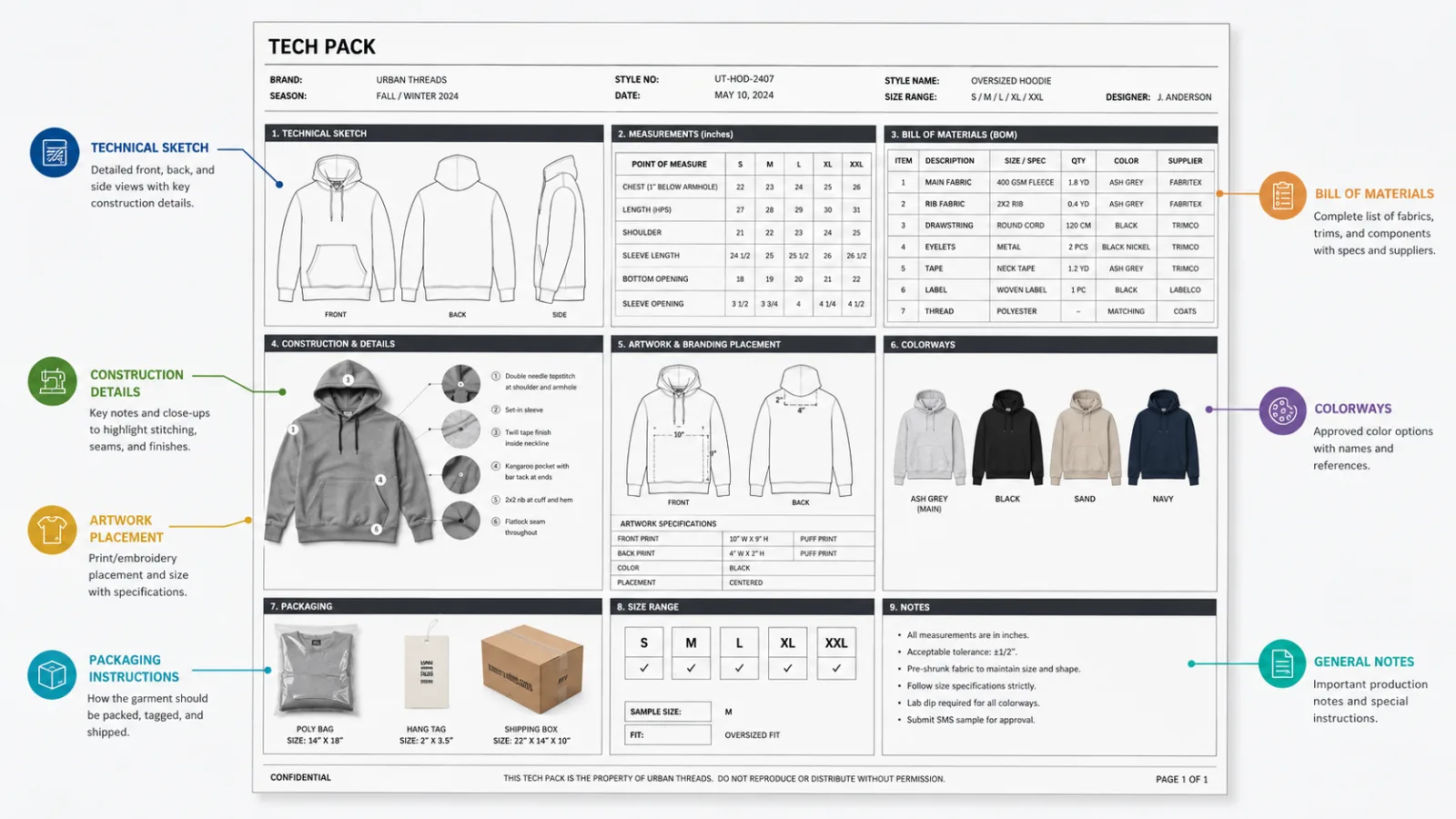
In the design process of the fashion industry, a template helps fashion designers make a tech pack quickly; tech packs are used as a comprehensive guide so designers and manufacturers can agree on each elements of a tech pack. When making tech packs with modern tech pack software, teams create a comprehensive tech pack that includes flat sketches, measurements, and notes for the back of the garment and other details to produce a garment.
A clear tech pack reduces miscommunication from initial design to bulk manufacturing, cutting costly rounds of sampling and rework. Think of it this way: the tech pack serves as a contract that tells a factory exactly how to produce the garment; a tech pack is a comprehensive roadmap for any fashion product, including customized tech specs, so tech packs ensure the final garment to ensure consistency and savings.
The Role of Technical Sketches in a Tech Pack
Technical sketches are one of the most visible parts of a tech pack, but they are often misunderstood. These are not meant to be dramatic fashion illustrations. They are meant to be clear, practical, and easy for the factory to interpret.
A good technical sketch usually shows:
- front view
- back view
- important design lines
- seam placements
- collars, cuffs, plackets, waistbands, or closures
- pocket positions
- any visible trim or panel details
Sometimes side views, close-up callouts, or internal views are also included if the style has more complexity. For example, a jacket with hidden pockets, an inner facing, or special lining details may need additional drawings.
Technical sketches matter because they give the factory a visual map of the garment. Even when the written notes are strong, visual clarity still helps prevent mistakes. In many cases, the sketch is the first thing a manufacturer uses to understand whether the style matches its capabilities.
If the sketch is too vague, the garment may be interpreted differently. If it is clear, the whole product discussion becomes easier.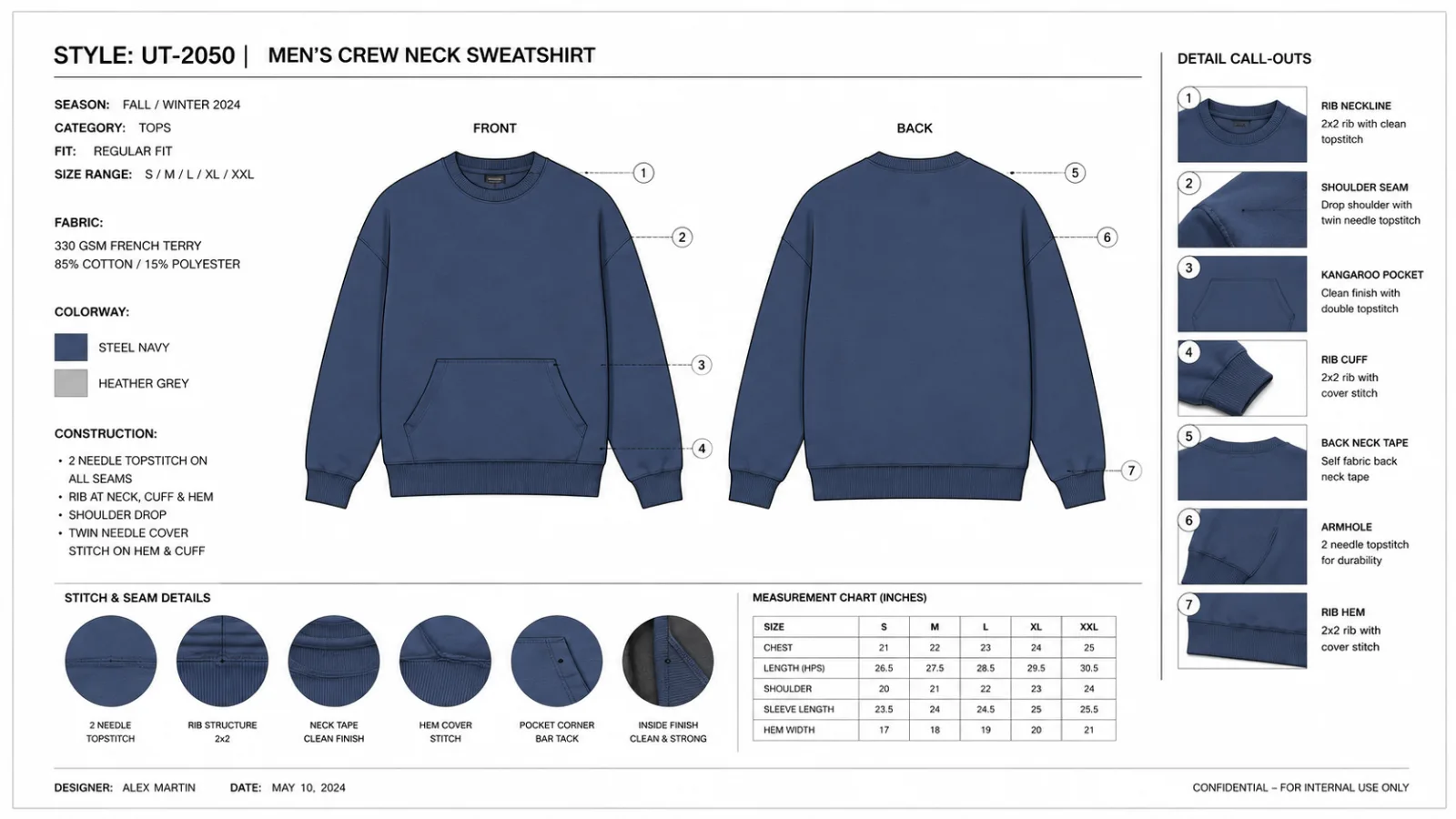
Why the Measurement Spec Sheet Is So Important
Fit is one of the most sensitive parts of clothing development. Customers may forgive a small packaging issue or a delayed delivery, but poor fit quickly damages trust. That is why the measurement spec sheet inside a tech pack is one of the most important sections.
A measurement spec sheet tells the factory exactly what dimensions the garment should have. This may include key points of measure such as:
- chest or bust
- body length
- shoulder width
- sleeve length
- neck opening
- waist width
- hip width
- inseam
- thigh width
- leg opening
This section often includes one base size, and sometimes a grading chart for other sizes as well. It may also include tolerances, which define how much variation is acceptable in production.
Without a proper measurement sheet, sampling becomes unpredictable. A factory may make something that looks visually close to the design, but the fit can still be wrong. And if the fit is wrong in sample stage, that often creates more revision rounds, higher development cost, and slower launch timelines. Strong apparel brands know that fit consistency starts with better specs, not just better hope.
Bill of Materials: The Hidden Power Section of the Tech Pack
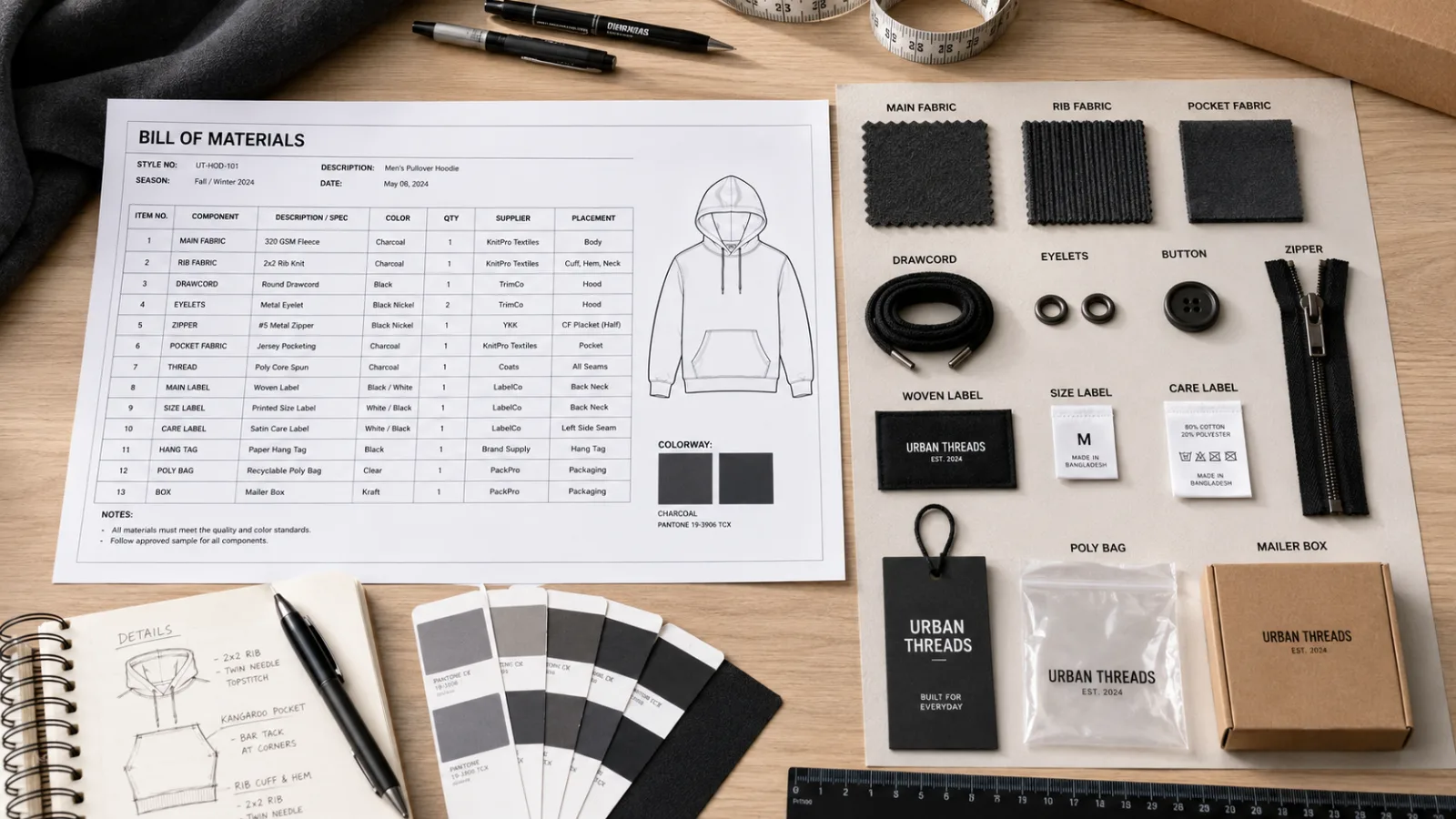
The Bill of Materials, or BOM, is often one of the most commercially important parts of the tech pack because it defines everything needed to physically build the product.
A strong BOM may include:
- main fabric
- lining or pocketing
- rib or waistband material
- zipper type and length
- button or snap details
- elastic width
- drawcord type
- thread color
- main label
- care label
- size label
- hangtag
- polybag or packaging details
This section matters because many product mistakes happen not from sewing skill, but from material confusion. A zipper may be the wrong color. A label may be missing. A rib fabric may be different from the approved sample. A thread may be mismatched. A missing BOM or weak BOM makes these errors much more likely.
It also matters for costing. Factories and sourcing teams use BOM information to estimate materials and build price calculations. If the BOM is incomplete, the quote may also be unreliable. A strong BOM gives the production process more accuracy and the costing process more realism.
How Tech Packs Help With Sampling
Sampling is where many new clothing brands lose time and money. They send a vague idea to the factory, receive a sample that feels wrong, send confusing corrections, and repeat the cycle multiple times. In many cases, the problem is not only the factory. It is weak documentation.
A tech pack improves sampling by giving the sample room stronger guidance from the beginning. Instead of guessing the intended measurements, trim details, or construction, the factory can work from a clearer instruction set.
This usually helps with:
- fewer avoidable sample mistakes
- faster turnaround
- more useful comments between rounds
- easier comparison between revisions
- smoother fit correction process
A sample does not always come out perfect on the first try, even with a strong tech pack. But the revisions tend to be more productive because everyone is working from a more exact reference point.
When founders say sampling feels chaotic, it is often because too much of the product still exists only in conversation rather than in documentation. A tech pack helps move the product from vague idea into structured development.
Tech Pack vs Sample: Key Differences
Element Tech Pack Physical Sample Purpose Technical documentation Physical prototype Usage Guides production instructionsTests fit and fabric behavior Format Digital or document-basedActual garment Importance Ensures manufacturing accuracyValidates design and fit
How Tech Packs Help Factories Give Better Costing
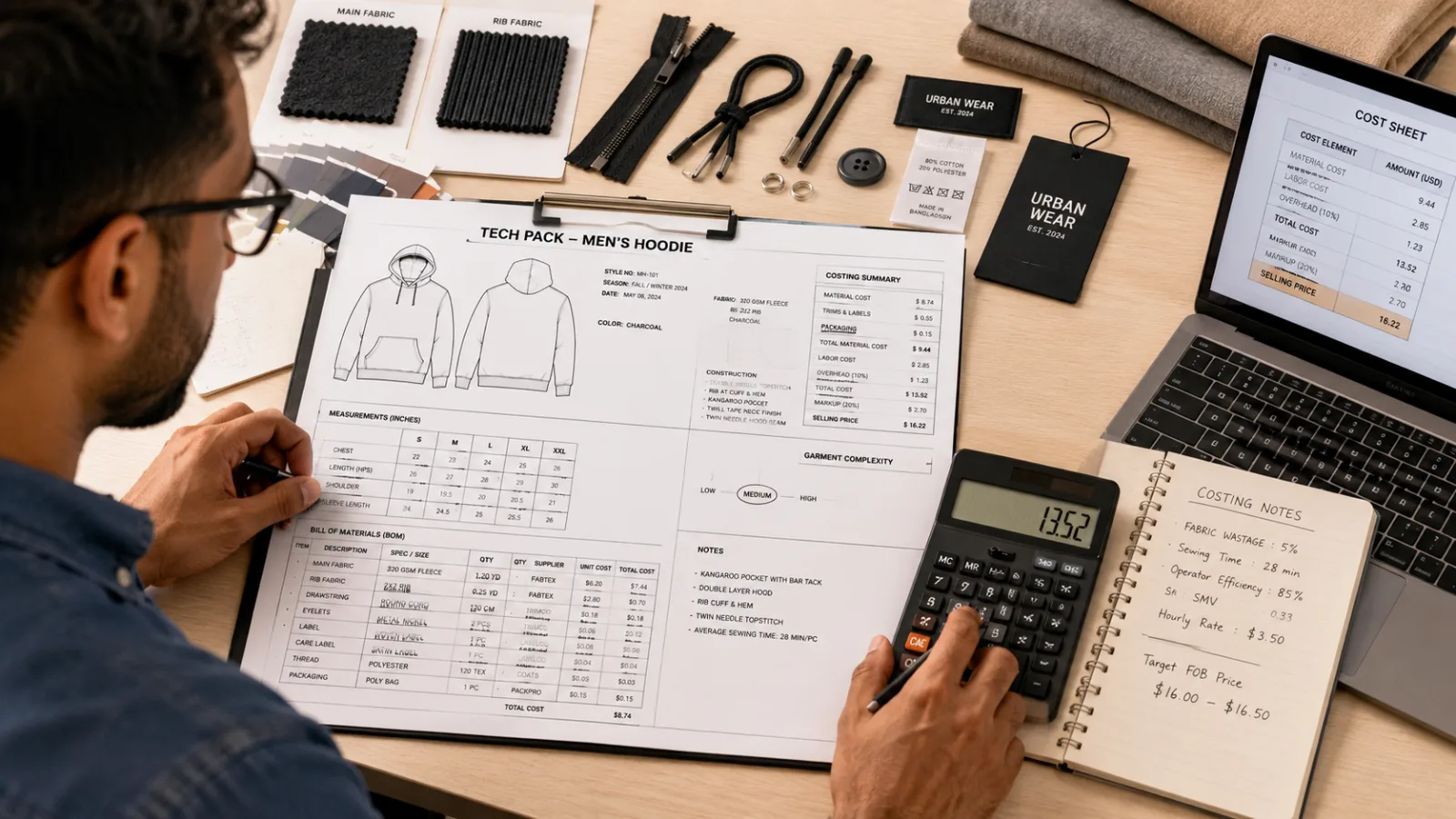
Factories cannot quote accurately if the product information is incomplete. If they do not know the fabric type, trim package, construction complexity, or packaging requirements, the costing they provide may be too rough to rely on.
A strong tech pack helps costing because it clarifies:
- fabric type and usage
- trim count
- construction complexity
- stitch and finishing details
- print or embroidery placements
- packaging requirements
- possible wash or special process needs
This makes cost estimation more realistic. It also reduces the chance that the factory gives an attractive quote early and then later says the price has changed once more details appear. That kind of re-costing is often frustrating for founders, but it usually happens because the original product information was not complete enough. A better tech pack creates better costing conversations, which makes pricing strategy more stable for the brand.
Why Tech Packs Improve Communication With Manufacturers
One of the biggest benefits of a tech pack is communication. In apparel production, brands and factories often work across different countries, languages, time zones, and working styles. That creates many opportunities for misunderstanding.
A tech pack improves communication because it reduces reliance on memory, verbal descriptions, or scattered email messages. Instead of saying, “Make the neckline a bit tighter and use the label from last time,” the brand can point to a document that shows the exact requirement more clearly.
Good communication matters at every stage:
- factory sourcing
- sample development
- fit correction
- costing
- production approval
- quality control
- repeat orders
It also helps when team members change. If the merchandiser leaves, the founder changes, or a new factory is brought in, the product still has a clear record. Without a strong tech pack, knowledge sits too much in people’s heads and email threads. With a strong tech pack, knowledge sits in a document the team can actually use. That makes the brand more organized and the manufacturing process more resilient.
Tech Packs Help Protect Product Consistency in Bulk Production
A product may look correct in sample stage but still change during bulk production if technical standards are not documented clearly enough. This is another reason tech packs are so important. They do not only help the first sample. They help maintain consistency when many units are being made.
In production, a tech pack helps guide:
- measurement consistency
- material matching
- label placement
- stitch and seam details
- trim application
- artwork positioning
- packaging execution
This becomes especially important when:
- the order volume is large
- multiple production lines are involved
- multiple suppliers are used
- the style is reordered later
- the brand changes manufacturers
A strong tech pack makes repeat production more stable because the style’s technical details are already documented. That reduces the risk that the second order feels different from the first or that one production run differs too much from the approved sample.
For growing brands, this kind of consistency is essential. Without it, scale usually creates more problems instead of more success.
Tech Packs Support Quality Control and Inspection
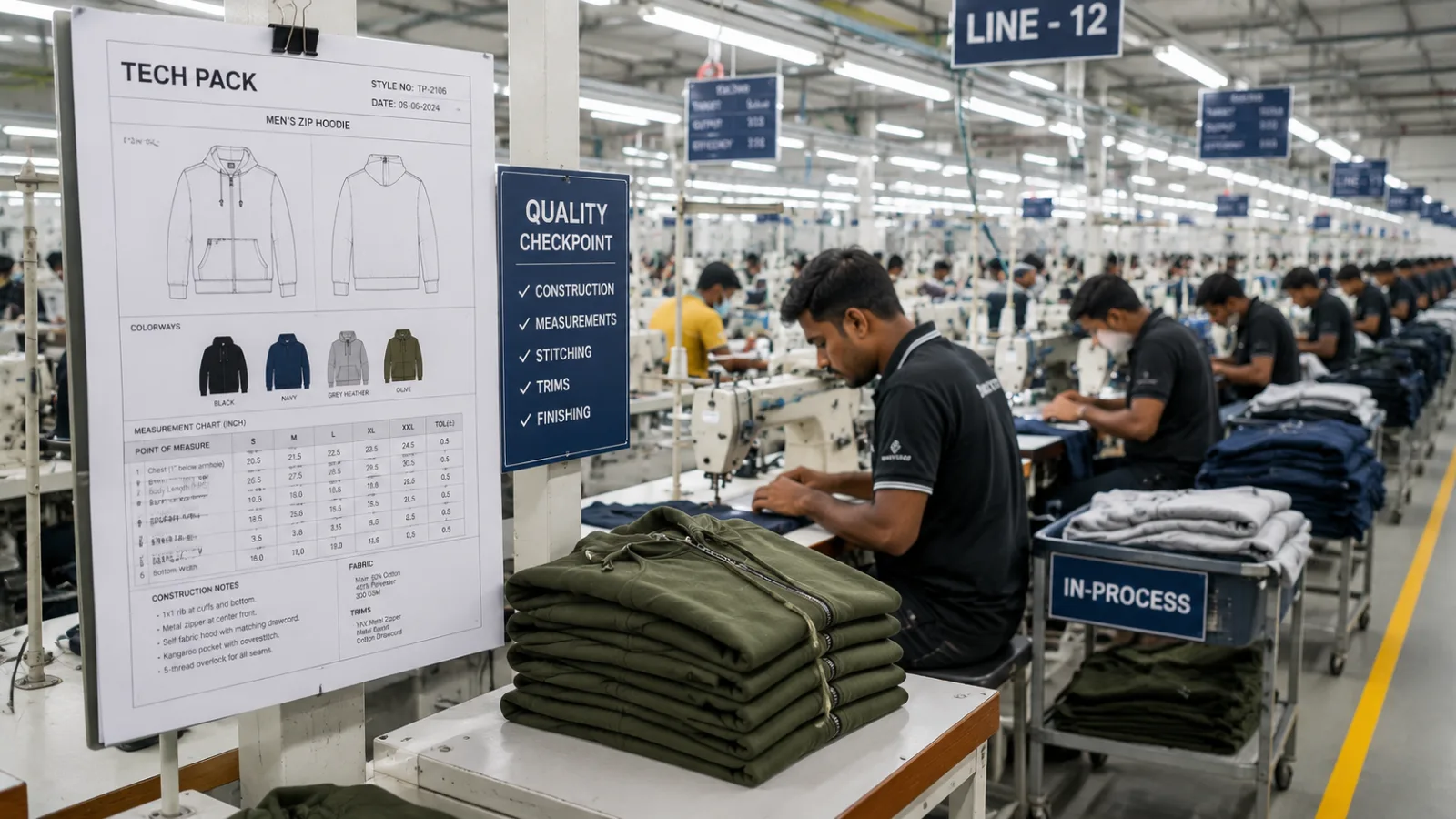
Quality control teams need clear standards. They cannot judge whether a garment is “correct” unless the product standards are defined somewhere. The tech pack is often one of the most important references for that.
Quality teams may use the tech pack to check:
- measurements against the spec sheet
- construction details against the approved design
- trim types and positions
- artwork placement
- labeling correctness
- packaging and folding standards
This helps turn quality control into something measurable instead of subjective. Rather than saying “this looks wrong,” the QC team can say “this label placement does not match the approved tech pack,” or “the sleeve length is outside tolerance.”
That clarity makes inspections more useful and reduces argument later between brand and factory. It also improves accountability because the approved expectations were documented.
A strong tech pack gives the QC process something concrete to protect.
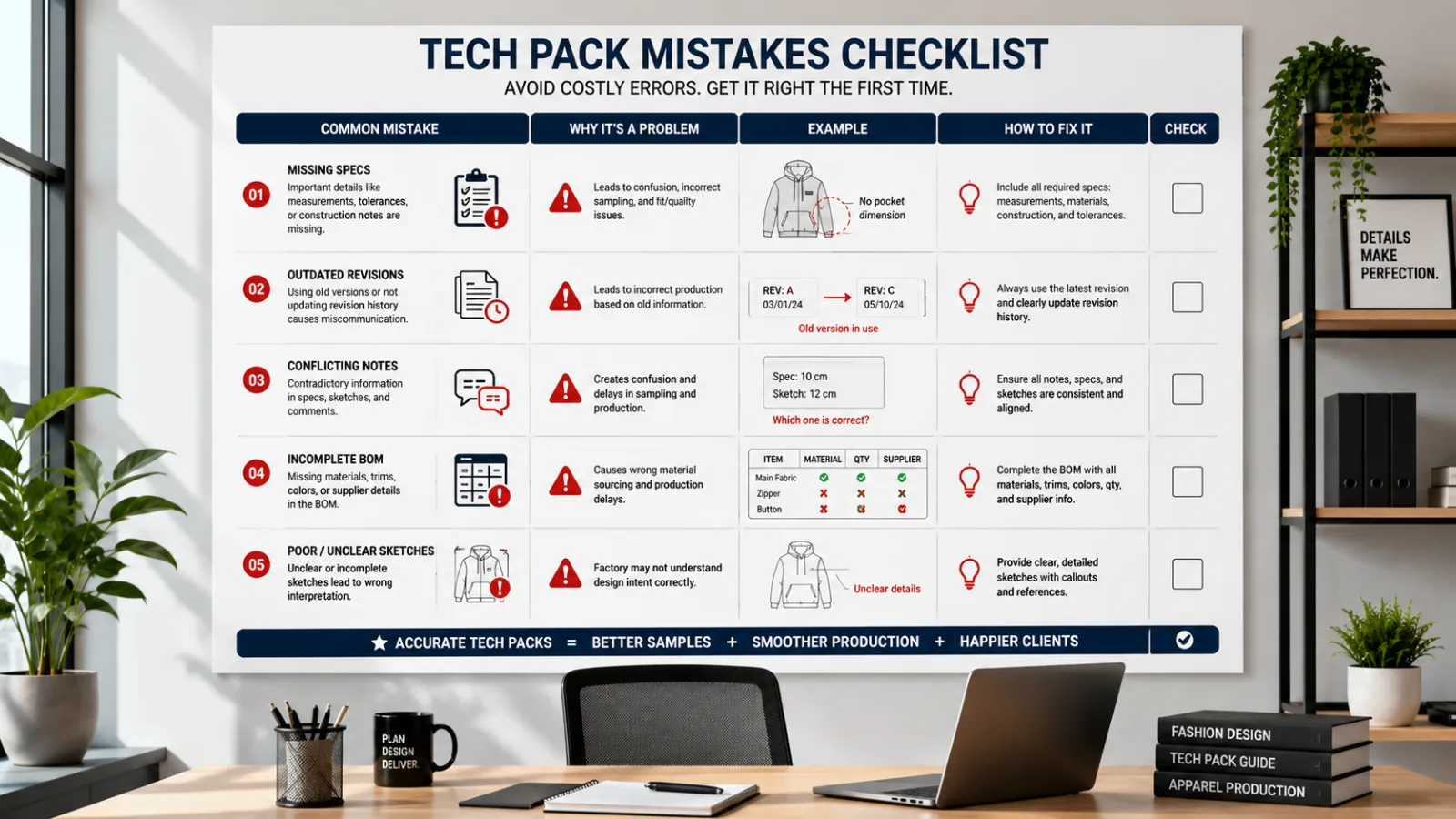
Common Mistakes Brands Make With Tech Packs
Many clothing brands use tech packs, but not all of them use them well. Some common mistakes reduce their value significantly.
Making the Tech Pack Too Vague
A sketch and a few notes are not enough for many products. If measurements, trims, or construction details are unclear, the factory still has to guess.
Making the Tech Pack Too Complicated Too Early
Some founders overload the document with unnecessary complexity before the product is even stable. This can create confusion instead of clarity. The tech pack should be detailed, but still structured logically.
Not Updating Revisions Properly
If changes happen during sampling but the tech pack is not updated, the factory may follow an older version. This creates avoidable errors.
Using Multiple Conflicting Documents
If the tech pack says one thing, the email says another, and the sample comments say something else, the process becomes chaotic. A good tech pack should remain the main source of truth.
Leaving Out Packaging and Label Details
Many founders focus only on the garment body and forget that labels, folding, packaging, and artwork details also matter in production.
Thinking the Tech Pack Replaces Sample Review
The tech pack is essential, but it does not replace real sample approval, fit review, or wash testing. It supports those processes rather than replacing them.
Avoiding these mistakes makes the document much more useful.
Tech Pack vs Sample: Why You Usually Need Both
Some beginners ask whether a tech pack is necessary if they already have a physical sample. Others ask whether a sample is necessary if the tech pack is detailed. In most cases, the best answer is that both are important.
A sample shows the garment physically.
A tech pack explains the garment technically.
A sample helps the factory feel and see the product more directly. A tech pack helps the factory understand the exact construction, measurements, trims, and expectations behind it. One without the other can leave gaps.
For example:
- A sample may show general style but not clearly communicate exact measurements or materials.
- A tech pack may explain the garment well, but the sample may still reveal fit, handfeel, and silhouette behavior more clearly.
Strong brands usually use both. The tech pack provides the structured blueprint, and the approved sample provides the physical benchmark.
This combination makes development and bulk production much safer than relying on either one alone.
Do Small Clothing Brands Really Need Tech Packs?
Yes, small clothing brands often need tech packs even more than larger ones. Bigger companies may have internal product development teams, pattern archives, or stronger supplier relationships that compensate for weak documentation to some extent. Smaller brands usually do not have that safety net.
For a startup or small label, a tech pack helps by:
- making the brand look more professional
- reducing misunderstandings with suppliers
- keeping development more organized
- protecting limited budgets from repeated avoidable sample errors
- making factory communication easier
A small brand may not need a huge enterprise-level tech pack system on day one, but it does need enough structure to explain the garment properly. A simple, clear, well-built tech pack is much better than a vague document or scattered message chain.
The smaller the brand, the more expensive each development mistake usually feels. That is exactly why stronger documentation matters.
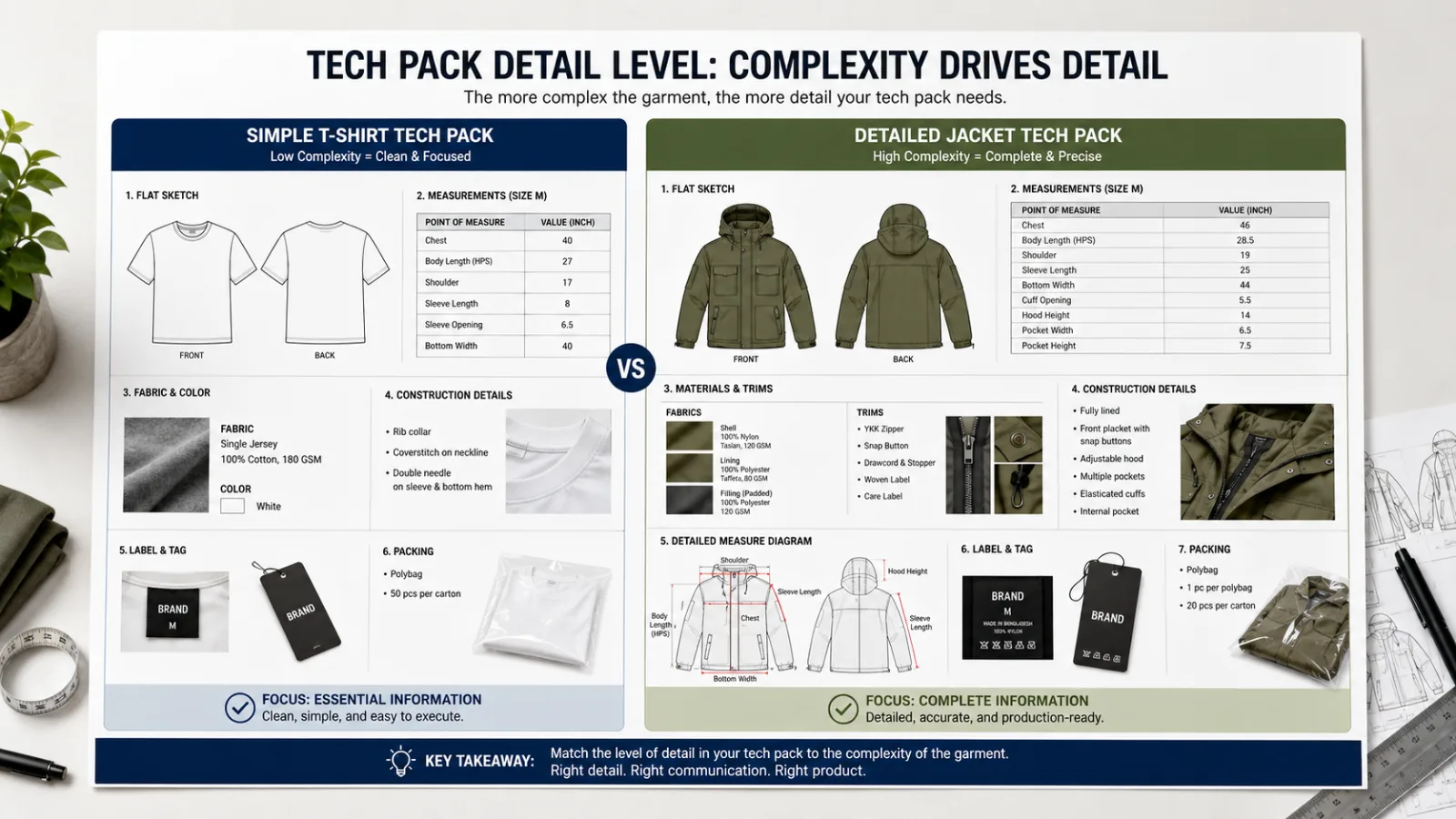
How Detailed Should a Tech Pack Be?
A tech pack should be detailed enough that the manufacturer does not need to guess important product information. But it should also stay clear and usable. More pages do not automatically mean a better tech pack. The goal is clarity, not unnecessary complexity.
The level of detail depends partly on the garment. A simple oversized t-shirt needs less documentation than a technical jacket, tailored blazer, or washed denim style. But even simple products still need enough detail to avoid confusion.
A good rule is this: if a missing detail could change fit, quality, cost, or production outcome, it should probably be in the tech pack.
That may include:
- exact point of measure
- trim type
- seam specification
- print placement
- label location
- artwork size
- fold method
- wash treatment note
A weak tech pack often leaves out details that seem “obvious” to the founder but are not obvious to the factory. That is where mistakes begin.
Elements of a Tech Pack
A clear technical sketch, flat drawings and multiple views form the visual foundation, while detailed measurements and grading charts ensure consistent sizing across runs. Accurate fabric and trim specifications, including composition and supplier codes, are essential to reproduce the intended look and performance.
Construction instructions, seam and stitch types, placement of labels and packaging notes guide the factory through production. Tolerances, quality checkpoints and testing requirements are explicitly stated within the tech pack to prevent misunderstandings and reduce costly revisions during sampling and bulk production.
The bill of materials, cost breakdowns and colorways complete the file, enabling procurement and costing teams to source components efficiently. Together, these elements form a single reference that aligns designers, developers and manufacturers, speeding time to market and maintaining product integrity.
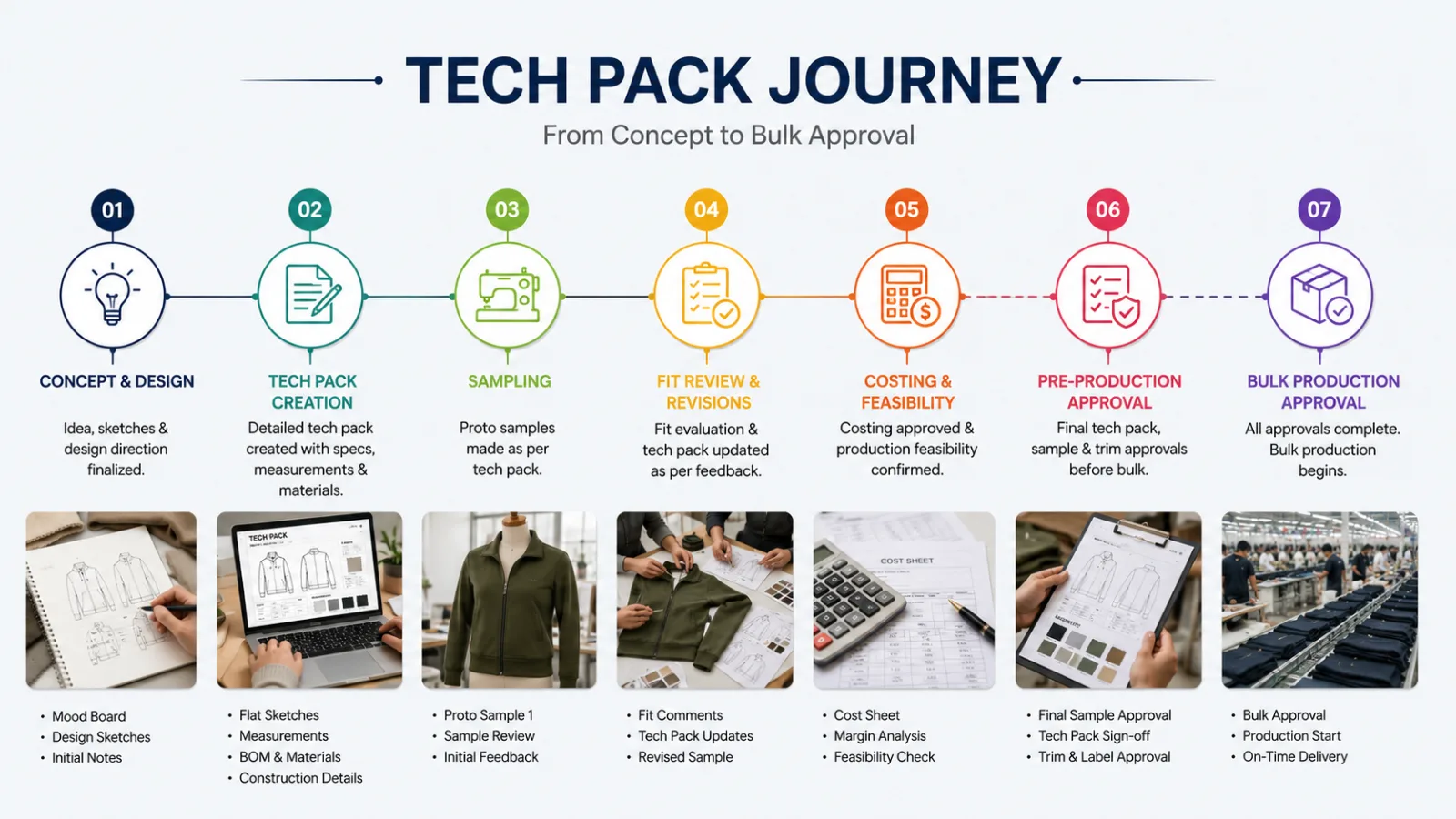
When in the Development Process Should a Tech Pack Be Made?
Ideally, the tech pack should be created before sampling begins. The earlier the product is documented clearly, the easier it is for the factory to cost, source, and sample accurately.
A typical flow may look like this:
- concept and product planning
- technical sketch and key design decisions
- tech pack creation
- supplier communication and costing
- sample development
- fit comments and revisions
- updated tech pack approval
- bulk production preparation
In reality, tech packs often evolve through the development process. That is normal. The first version may begin with the core design and measurements, and later versions may include updated fit comments, revised trims, packaging notes, or construction changes.
The important thing is that the tech pack stays current. It should develop with the product rather than remain frozen at an early stage.
A tech pack is not just a one-time file. It is often a living product document until the style is fully approved.
Tech Packs Make Reorders and Future Development Easier
One of the hidden long-term benefits of a tech pack is that it creates a product record the brand can reuse later. This is especially valuable when the product becomes successful.
If a style needs to be reordered, the tech pack helps the team remember:
- approved measurements
- construction details
- exact trims
- labels used
- artwork sizes
- packaging method
- previous revisions and corrections
This reduces dependence on memory and makes it easier to maintain continuity. It also helps when building future product families. A successful t-shirt tech pack may inform the long-sleeve version. A hoodie tech pack may become the base for a zip version. A dress fit block may support future shapes in the same line.
For growing brands, organized product documentation becomes a real asset. It improves speed, consistency, and team alignment over time.
The Role of Tech Packs in the Fashion Industry
The role of tech packs in fashion design cannot be overstated: they act as a detailed instruction manual that communicates all specifications from patternmakers to production. Within each file, sketches should include all construction notes and measurements, and designers often create artwork like adobe illustrator to illustrate trims and colorways. A robust tech pack eliminates confusion — the document tech pack eliminates costly guesswork and helps teams avoid costly mistakes by ensuring that garments are produced to spec.
Every stage, whether development or production, depends on clear documentation; therefore every brand knows a complete tech pack should include technical sketches, material callouts, and size charts that include the graded measurements. Changes are made transparently so everyone involved in production can act quickly, and the inclusion of construction details to ensure fit and finish keeps projects on time and on budget.
Improving Fashion Design with Tech Pack Software
Using Tech Pack Software transforms fashion design by centralizing measurements, material choices, and visual references into a single, editable file that reduces errors and speeds production. Designers can create accurate specs and detailed tech drawings that communicate intent clearly to pattern makers and manufacturers, cutting revisions and costly misinterpretations.
Real-time updates and version control improve collaboration across teams, allowing sampling, costing, and feedback loops to run smoothly so that prototypes match the original concept faster. Integrated libraries for trims and fabrics, plus automated spec calculations, streamline the workflow and free designers to focus on creativity.
By enabling precise tracking of materials and processes, Tech Pack Software also supports transparency and sustainability goals, helping brands reduce waste and make better sourcing decisions while accelerating time-to-market and enhancing product quality.
The Fashion Tech Pack serves as an essential production document that clarifies manufacturing processes, materials, and expectations to ensure everyone is following one source of truth.
A Beginner-Friendly Tech Pack Mindset
For beginners, tech packs can seem intimidating because they feel technical and formal. But the most useful mindset is simple:
A tech pack is not there to impress people. It is there to reduce mistakes.
You do not need to create the world’s most advanced tech pack on your first try. You need a document that communicates the product clearly enough for the manufacturer to sample and produce it accurately.
That means focusing on:
- clear sketches
- accurate measurements
- material detail
- trim detail
- label and artwork clarity
- version control
- practical instructions
As your brand grows, your tech packs can grow too. But even at the earliest stage, better technical communication usually leads to better products.
The goal is not perfection on day one. The goal is fewer misunderstandings and stronger execution.

Step-by-Step Guide to Creating a Tech Pack
Creating a tech pack can feel complicated at first, especially for new clothing brands. But once you break it into steps, it becomes much easier to manage. The goal is not to create a perfect corporate document on day one. The goal is to give your manufacturer enough accurate information to develop the garment correctly.
Start with the garment concept
Before you open a spreadsheet or design file, get clear on the garment itself. Decide exactly what you are making and what role it plays in the collection. A hoodie, t-shirt, dress, trouser, or jacket will all need different technical details, so your first step is defining the product clearly.
At this stage, you should know:
- the garment category
- the intended fit
- the target customer
- the key design details
- the fabric direction
- the product purpose
This first step matters because weak product clarity usually creates weak tech packs.
Create front and back technical sketches
Once the design is clear, create flat technical sketches of the garment. These should show the product in a clean, production-friendly way rather than as a fashion illustration. The factory needs to see the actual construction and proportions clearly.
Your sketches should usually include:
- front view
- back view
- important seam lines
- pocket placement
- neckline or collar shape
- cuffs, waistband, or hem details
- visible trims or closures
If the garment has hidden details or complex construction, add close-up callouts for those sections.
Add garment measurements
The next step is building the measurement spec sheet. This tells the factory how big the garment should be at specific points. It is one of the most important parts of the tech pack because fit problems often begin here.
Depending on the garment, you may include:
- chest width
- body length
- shoulder width
- sleeve length
- waist width
- hip width
- inseam
- thigh width
- bottom opening
Also include the base size and, where possible, tolerances. Clear measurements reduce guesswork during sample development and bulk production.
Define fabric details
After measurements, add fabric information. This should explain what the main fabric is and any supporting materials used in the garment. Do not just write “cotton” or “polyester.” Be more specific.
Include details such as:
- fiber content
- fabric type
- GSM or weight
- knit or woven structure
- color reference
- finish, if important
- stretch requirement, if relevant
This helps the manufacturer understand what kind of fabric is expected and reduces the chance of incorrect sourcing or substitution.
Build the bill of materials
Now list every trim and component required to make the style. This is the BOM, or Bill of Materials. It is essential for both costing and production accuracy.
Typical BOM items include:
- main fabric
- rib fabric
- lining
- zippers
- buttons
- elastic
- drawcords
- threads
- labels
- hangtags
- polybags
A complete BOM helps prevent missing trim issues and supports more accurate quotations.
Add construction details
Construction details explain how the garment should be sewn and finished. This is where you communicate technical expectations that may not be obvious from the sketch alone.
You may include:
- seam type
- stitch type
- topstitching details
- hem finish
- binding details
- reinforcement points
- bartacks
- placket construction
- pocket construction
This section is especially important for garments where quality, durability, or brand identity depends on specific finishing methods.
Include artwork and branding placement
If the garment includes a logo, print, embroidery, patch, or any branded artwork, show exactly where it should go. Do not leave this to verbal explanation.
Include:
- artwork size
- artwork placement
- distance from seams or neckline
- print color reference
- embroidery size and thread color
- branding location
This helps the factory avoid misplacement and gives the sample room a much clearer target.
Add label and packaging instructions
A strong tech pack should also explain what happens after the garment is sewn. This includes label placement and packaging instructions, especially if the product is going into retail or ecommerce.
You may want to include:
- main label position
- size label position
- care label content and location
- hangtag attachment
- folding method
- polybag requirement
- barcode sticker placement
- carton packing notes
This section often gets overlooked by new brands, but it matters a lot in production.
Review and update the document after each sample round
A tech pack should not stay frozen if the product changes. After each sample round, update the file to reflect approved revisions. If you change the neckline, fabric, trim, or measurements, the tech pack should show the latest approved version.
This is important because outdated tech packs often cause bulk production mistakes. A clear revision history also helps the factory know which version is current.
Use the tech pack as the main product reference
Once the tech pack is complete, use it as the central reference during costing, sampling, and production. It should not be treated like a file you make once and forget. It should become the working document behind the product.
That means the brand, factory, merchandiser, sample room, and QC team should all be working from the same updated version.
ApparGlobal
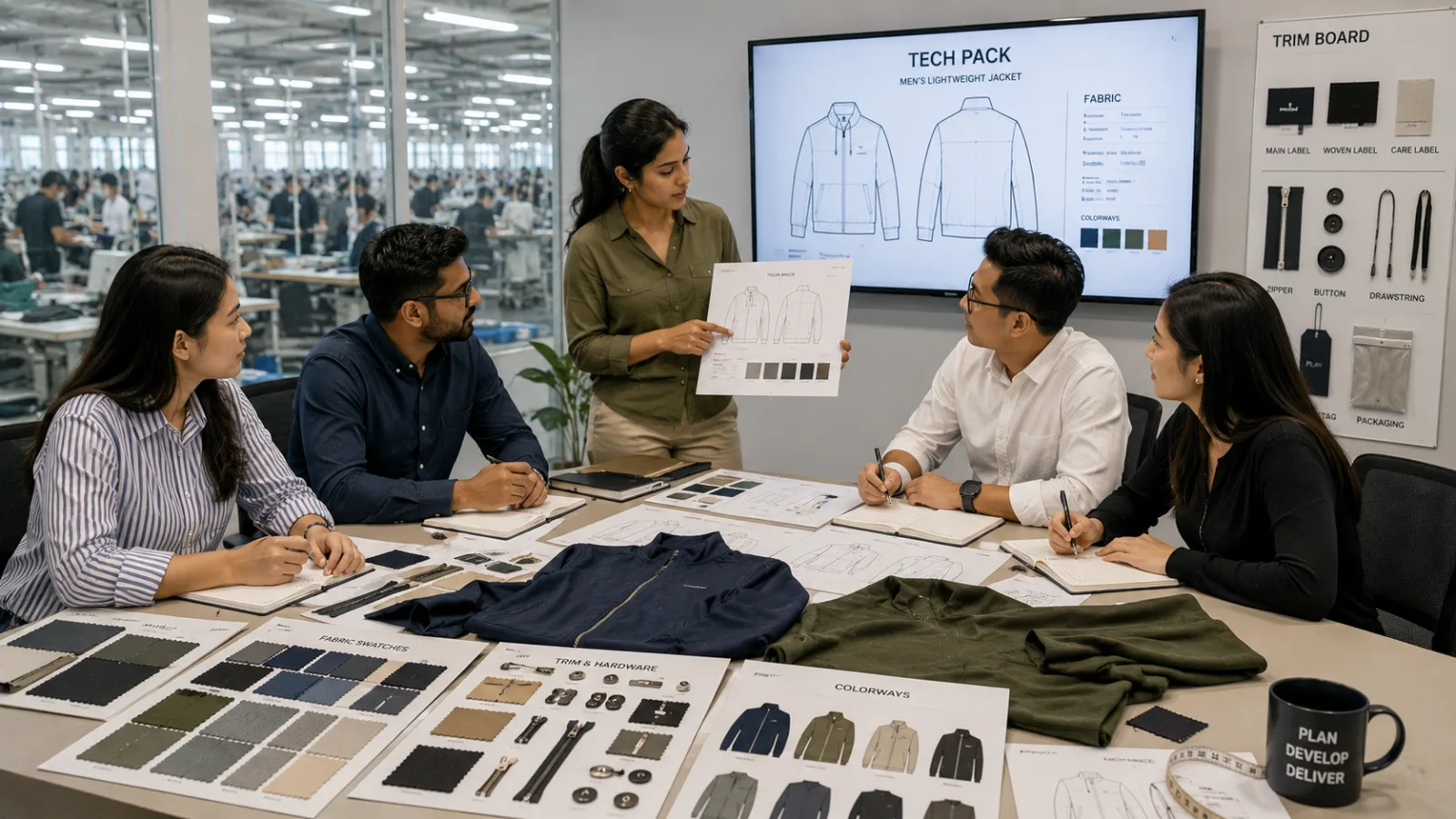
Many clothing brands improve product development when they work with manufacturing partners that understand tech packs, sample development, fabric sourcing, fit approval, and production consistency. Companies such as ApparGlobal help apparel brands align garment specifications, material choices, trim details, and manufacturing workflows so development becomes more organized, more accurate, and more scalable from the beginning.
Tech Pack Creation Checklist for Clothing Brands
Before sending a tech pack to a manufacturer, confirm that it includes:
- clear front and back technical sketches
- complete measurement specifications
- fabric and trim details
- artwork placement and colorways
- labeling and packaging instructions
A complete tech pack helps reduce development mistakes and speeds up communication with manufacturers.
Conclusion
So, what is a tech pack and why is it important? A tech pack is the technical blueprint of a garment. It translates a clothing idea into a working product document that manufacturers, sample rooms, sourcing teams, and quality control staff can actually use. It includes the information needed to make the product accurately, from sketches and measurements to trims, labels, construction, and packaging details.
Its importance is simple but powerful. A strong tech pack reduces confusion, improves sampling, supports better costing, helps protect quality, and creates more consistency from development through bulk production. Without it, too much of the product depends on memory, assumptions, and guesswork. In apparel, those things usually become expensive.
For small brands, startups, and growing labels, tech packs are not just technical paperwork. They are one of the clearest signs that the brand is taking product development seriously. And when product development is handled seriously, better results usually follow.