
Digital PR campaigns rarely fail because a team lacks ideas. More often, they fail because the idea does not have a clear purpose or because it is presented in a way that creates too much work for the audience. A campaign may contain valuable research, expert insight, or an original story, but it will struggle to earn attention when journalists cannot identify the news angle, readers cannot understand the main point, or publishers cannot use the available assets. At the same time, an attractive campaign can still produce weak results when its design is not supported by meaningful research, audience relevance, or a clear reason for publication.
This is why intent and design are two of the most important foundations of effective digital PR. Intent defines what the campaign is trying to achieve, who it needs to reach, why the story matters, and what action the audience should take. Design determines how that strategy is transformed into a clear, engaging, accessible, and publishable experience. When these elements work together, digital PR becomes more than outreach. It becomes a structured system for creating useful stories, earning media coverage, attracting authoritative links, improving brand visibility, and building trust. In this guide, we will explore why intent and design are important in digital PR, how they influence campaign performance, and how brands can use both to create stronger earned-media strategies.

What Is Digital PR?
Digital PR is the practice of building brand visibility, credibility, authority, and online mentions through newsworthy content and relationships with digital publishers.
It combines principles from:
- Public relations
- Content marketing
- Search engine optimization
- Media relations
- Brand storytelling
- Data analysis
- Creative design
- Link acquisition
- Social media distribution
- Reputation management
Traditional PR often focuses on newspapers, magazines, television, radio, and offline events. Digital PR expands this work across online news websites, industry publications, blogs, newsletters, podcasts, creator platforms, social media, and search results.
A digital PR campaign may use:
- Original research
- Industry surveys
- Data studies
- Interactive tools
- Expert commentary
- Trend analysis
- Visual explainers
- Newsjacking
- Maps
- Rankings
- Reports
- Guides
- Case studies
- Public-interest resources
The purpose is not simply to place the brand name in an article. A successful campaign gives journalists and audiences a genuine reason to mention, cite, discuss, or link to the brand.
That reason begins with intent.
What Does Intent Mean in Digital PR?
Intent is the underlying purpose behind a campaign. It explains why the campaign exists, who it is designed for, what problem it addresses, and what outcome it should create.
Digital PR intent operates at several levels.
Business Intent
Business intent defines what the organization wants to achieve.
Possible goals include:
- Increasing brand awareness
- Earning high-quality backlinks
- Improving search visibility
- Building authority in a specific industry
- Supporting a product launch
- Changing brand perception
- Generating referral traffic
- Attracting potential customers
- Establishing executives as experts
- Supporting reputation management
A campaign designed to earn national press coverage may look very different from one intended to build links from specialist industry websites.
Without a clearly defined business goal, teams may celebrate coverage that does not contribute meaningfully to the brand.
Audience Intent
Audience intent focuses on what readers want to know, understand, compare, solve, or discuss.
For example, people may be looking for:
- An explanation of a confusing issue
- Evidence supporting a decision
- New statistics about an industry
- A comparison between several options
- Practical advice
- A local perspective
- Insight into a current trend
- An expert reaction to breaking news
A campaign becomes more useful when it addresses a real information need instead of simply promoting the company.
Search Intent
Search intent describes what someone is trying to accomplish when entering a query into a search engine.
Common categories include:
- Informational intent: The person wants to learn something.
- Commercial intent: The person is comparing products, services, or approaches.
- Navigational intent: The person is trying to find a particular organization or resource.
- Transactional intent: The person is preparing to complete an action.
- Local intent: The person needs information connected to a specific place.
Digital PR campaigns often perform best when they combine newsworthiness with ongoing search demand.
For example, a report about rising home-renovation costs may attract journalists during a period of economic discussion while also answering long-term questions from homeowners.

Journalist Intent
Journalists, editors, and content creators have their own objectives.
They need stories that:
- Fit their publication
- Match their subject area
- Interest their readers
- Contain reliable evidence
- Offer a clear angle
- Arrive at the right time
- Can be verified
- Are easy to explain
- Add something new to an existing conversation
A campaign may be relevant to the public but unsuitable for a particular journalist. Understanding editorial intent helps PR teams identify the right publications, writers, and angles.
Reference Intent
Some users are searching for material they can cite, quote, or use as evidence.
They may need:
- Statistics
- Definitions
- Expert explanations
- Charts
- Methodologies
- Historical comparisons
- Industry benchmarks
- Regional data
Campaigns designed around reference intent can continue attracting links after the active outreach period ends.
Why Intent Matters in Digital PR
Intent gives every part of a campaign direction. It helps teams make better decisions about the idea, research, format, outreach, landing page, and measurement plan.
Intent Prevents Generic Campaigns
Generic campaigns often begin with a broad topic and no clear editorial purpose.
Examples include:
- “The Future of Marketing”
- “The State of Sustainability”
- “Top Technology Trends”
- “Why Customer Service Matters”
These themes may be relevant, but they are too broad to create a distinctive news story on their own.
Intent forces the team to ask more useful questions:
- What has changed?
- Who is affected?
- What evidence can we provide?
- Why does this matter now?
- What will surprise the audience?
- What can a journalist report that has not already been covered?
A focused campaign may examine how delivery expectations differ across age groups, which cities face the greatest increase in rental costs, or which industries are adopting a particular technology fastest.
Specific intent creates stronger stories.
Intent Improves Media Relevance
A journalist covering retail trends has different needs from a writer covering environmental policy. Sending the same pitch to both reduces relevance.
Intent helps teams segment outreach by:
- Publication type
- Journalist beat
- Reader interest
- Location
- Industry
- Campaign angle
- Story format
- Publication schedule
One campaign can support several angles without using the same generic message for every contact.
For example, a study about remote work may offer:
- A productivity angle for business publications
- A property-market angle for real estate writers
- A workplace-wellbeing angle for HR publications
- A regional angle for local news outlets
- A technology angle for software publications
The underlying data remains the same, but the intent of each pitch changes.
Intent Helps Select the Right Format
Not every campaign needs an interactive tool or a 40-page report.
The best format depends on what the audience needs to do.
Use a:
- Report when readers need detailed findings and methodology.
- Interactive tool when users need personalized results.
- Map when location is central to the story.
- Chart when comparison is the main point.
- Calculator when the audience wants to estimate an outcome.
- Expert article when interpretation is more valuable than raw data.
- Survey when public opinion is the news.
- Guide when the audience needs practical instruction.
- Timeline when change over time is central.
Intent should determine the format. The format should not be selected simply because it looks impressive.
Intent Creates Better Measurement
A campaign cannot be evaluated properly without a defined objective.
If the goal is brand awareness, useful metrics may include:
- Media mentions
- Publication reach
- Branded searches
- Social discussion
- Message inclusion
If the goal is SEO authority, the team may focus on:
- Referring domains
- Link relevance
- Link quality
- Organic visibility
- Rankings for related topics
- Ongoing link acquisition
If the goal is thought leadership, measurement may include:
- Expert quotations
- Speaking invitations
- Newsletter mentions
- Industry citations
- Executive profile growth
Clear intent prevents teams from judging every campaign by the same metric.

What Does Design Mean in Digital PR?
Design in digital PR is often misunderstood as graphic decoration. In reality, it includes the full structure through which a campaign communicates its story.
Digital PR design includes:
- Campaign architecture
- Information hierarchy
- Research presentation
- Visual storytelling
- Landing-page experience
- Mobile usability
- Media assets
- Accessibility
- Brand presentation
- Outreach materials
- Distribution planning
A designer’s job is not simply to make a report look attractive. Good design helps the audience find, understand, trust, and share the information.
Why Design Matters in Digital PR
Design Makes Complex Information Easier to Understand
Digital PR campaigns frequently use survey results, public data, industry statistics, or technical research. Raw information can be difficult to understand without structure.
Design can transform a complicated dataset into:
- A clear chart
- A comparison table
- A regional map
- A simple timeline
- A ranked list
- A visual summary
- A short methodology panel
The goal is not to simplify information until it loses meaning. The goal is to remove unnecessary friction.
A reader should be able to identify the main finding quickly and explore the supporting detail when needed.
Design Helps Journalists Find the Story
Journalists often review campaign pages while working under tight deadlines. They should not have to search through long introductions to identify the news.
A well-designed campaign page should make the following information easy to find:
- Main headline
- Strongest finding
- Supporting statistics
- Methodology
- Data source
- Publication date
- Expert comment
- Downloadable assets
- Brand contact information
Good design respects the journalist’s time.
Design Builds Credibility
Presentation influences how people judge information.
A page with inconsistent formatting, unclear charts, missing sources, and poor mobile usability may make valuable research feel unreliable.
Credible design uses:
- Clear typography
- Consistent spacing
- Accurate labels
- Source notes
- Methodology
- Restrained branding
- Logical navigation
- Professional visuals
Design should make the evidence feel transparent, not hide weaknesses behind decoration.
Design Increases Shareability
Journalists, marketers, and social media users often need assets they can share quickly.
Useful campaign assets may include:
- Individual charts
- Quote graphics
- Data cards
- Maps
- Short animations
- Social images
- Embeddable graphics
- Downloadable spreadsheets
- Press-ready photographs
A campaign becomes easier to distribute when its assets are modular.
Instead of forcing every publisher to use one large infographic, provide several focused visuals that support different story angles.
Design Supports Accessibility
Digital PR content should work for people with different abilities and different ways of accessing information.
Accessible design may include:
- Descriptive alternative text
- Clear color contrast
- Readable font sizes
- Keyboard-friendly interaction
- Text explanations for charts
- Proper heading structure
- Captions for video
- Meaningful link text
- Avoiding essential information presented only through color
Accessibility is not an optional design extra. It improves the experience for a broader audience and makes important information available in multiple forms.
Design Supports Search Visibility
Visual design and SEO should work together.
Important practices include:
- Descriptive page titles
- Clear headings
- Relevant image filenames
- Useful alternative text
- Supporting written explanations
- Fast-loading images
- Mobile-friendly layouts
- Crawlable links
- Indexable text
- Structured content
A graphic should support the written story rather than replace it completely. Search engines and users both need text that explains the information represented visually.
Intent and Design Must Work Together
Intent without design can produce a valuable story that is difficult to understand or publish.
Design without intent can produce an attractive campaign that has no strong news angle or audience value.
The relationship can be summarized simply:
- Intent determines why the campaign should exist.
- Design determines how people experience it.
- Research gives the campaign substance.
- Outreach connects the campaign with relevant publishers.
- Measurement shows whether the strategy worked.
Consider two campaign examples.
Campaign A: Attractive but Unfocused
A company publishes a beautifully designed infographic titled “The Future of Sustainable Fashion.”
The page includes stylish illustrations and broad statements, but it offers no original data, expert analysis, or specific news angle.
Journalists may find it visually appealing, but they have little reason to report it.
Campaign B: Intentional and Well Designed
The company analyzes the repair, return, recycling, and material-transparency policies of 100 clothing retailers.
The campaign identifies measurable gaps, explains the methodology, publishes a searchable comparison table, and provides charts for different industry angles.
The intent is clear: help consumers and journalists understand how fashion brands differ in their circularity policies.
The design makes the evidence easy to review and reuse. Campaign B has a stronger opportunity to earn coverage, links, discussion, and long-term search traffic because intent and design support each other.
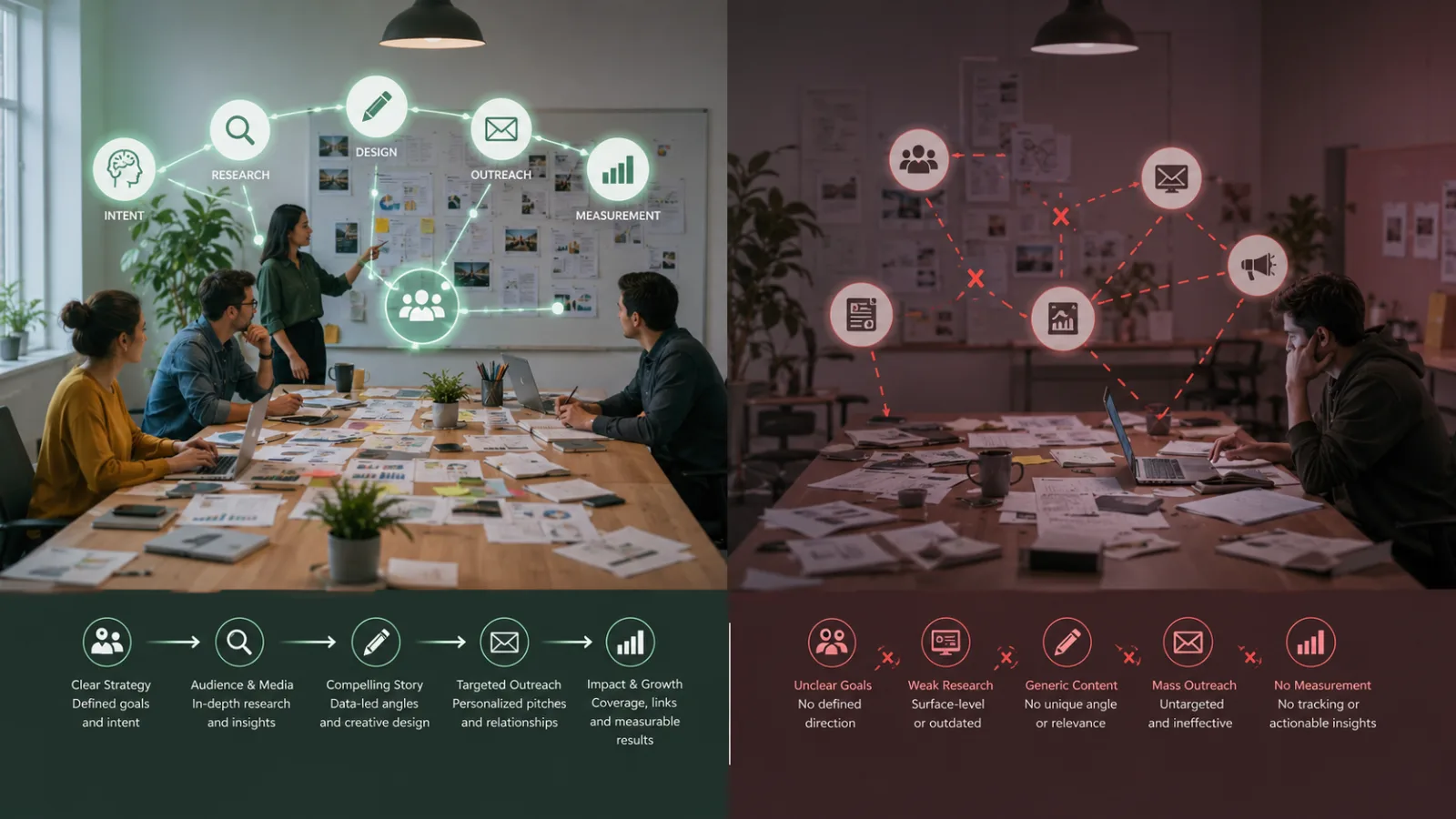
A Practical Intent-First Digital PR Process
1. Define the Business Outcome
Start with one primary goal.
Examples include:
- Earn relevant links
- Build industry authority
- Support a product category
- Increase brand recognition
- Enter a new market
- Strengthen executive credibility
Secondary benefits may follow, but the campaign needs one main strategic direction.
2. Identify the Real Audience
Separate the audiences involved:
- Journalists
- Editors
- Creators
- Customers
- Industry professionals
- Researchers
- Local communities
- Search users
Ask what each audience already knows and what new value the campaign can provide.
3. Study the Media Conversation
Review recent coverage to understand:
- Which topics are receiving attention
- Which questions remain unanswered
- Which data is repeatedly cited
- Which angles are becoming repetitive
- Which journalists cover the subject
- How publications frame the issue
This prevents the team from producing a campaign that enters the conversation too late or repeats information already available.
4. Find the Information Gap
Strong digital PR often fills a gap.
The campaign might provide:
- New data
- A new comparison
- A local breakdown
- An expert interpretation
- A historical trend
- A practical tool
- A consumer perspective
- A previously unavailable dataset
The information gap becomes the campaign’s reason to exist.

5. Develop the Main Story
Write the central finding in one clear sentence.
If the team cannot explain the story simply, the idea may still be too broad.
A useful framework is:
We discovered that [finding], which matters to [audience] because [consequence].
This sentence should guide the headline, visuals, outreach, and landing page.
6. Choose the Right Content Format
Match the format to the information.
Do not build an interactive tool when a table would communicate the story more clearly. Do not publish a long report when journalists only need five well-supported findings.
The simplest effective format is usually the best choice.
7. Build Evidence and Methodology
A campaign needs enough transparency for publishers to trust it.
Include:
- Data sources
- Collection dates
- Sample size
- Definitions
- Calculation methods
- Limitations
- Update schedule where relevant
Methodology should be understandable without requiring specialist knowledge.
8. Create a Clear Narrative Structure
A strong landing page usually follows this sequence:
- Headline
- Short explanation
- Main finding
- Key statistics
- Supporting evidence
- Visual breakdown
- Expert interpretation
- Methodology
- Data sources
- Media contact
Readers should be able to scan the page or explore it deeply.
9. Design Modular Media Assets
Prepare individual assets for different publications.
These may include:
- National data
- Regional findings
- Industry-specific charts
- Demographic comparisons
- Expert quotes
- Short summaries
- Downloadable images
- Raw data files
Modular assets allow outreach teams to create more relevant pitches.
10. Match Outreach to Editorial Intent
Personalization should go beyond inserting a journalist’s name.
A relevant pitch should explain:
- Why the story fits the publication
- Which finding matters to its readers
- Why the subject is timely
- What original evidence is available
- Which assets can be used
- Where the methodology can be reviewed
A short, relevant pitch is usually more useful than a long brand introduction.

Design Principles for High-Performing Digital PR Campaigns
Put Clarity Before Decoration
Every design choice should help the audience understand the story.
Avoid decorative elements that distract from the evidence.
Make the Main Finding Immediately Visible
The first screen should communicate what happened and why it matters.
Do not begin with a long company history.
Use Strong Visual Hierarchy
Headings, spacing, typography, and color should guide readers through the page naturally.
Design for Mobile Users
Journalists and readers may first open the campaign from an email or social platform on a phone.
Tables, charts, images, and interactive elements must remain usable on smaller screens.
Keep Branding Controlled
The page should clearly identify the brand, but excessive logos, promotional calls to action, and product advertising can weaken editorial credibility.
Explain Every Visual
A chart should include:
- A descriptive title
- Clearly labeled values
- Units
- Source information
- A short explanation
- Accessible text support
Make Assets Easy to Download
Publishers should not need to take screenshots from a webpage. Provide high-quality files with clear usage information.
Protect Page Performance
Large images, animations, scripts, and interactive elements can slow the page.
Visual sophistication should not make the campaign frustrating to use.
Common Intent and Design Mistakes in Digital PR
Starting With a Format Instead of a Story
“We should make an interactive map” is not a campaign idea.
The team should first identify the useful information, then decide whether a map is the best way to communicate it.
Targeting Everyone
A campaign designed for every possible audience often becomes relevant to none of them.
Choose a clear primary audience and build outward.
Prioritizing Search Volume Over News Value
Search demand can support campaign planning, but a keyword alone does not create a media story.
Digital PR needs an original or timely angle.
Hiding the Main Finding
Do not make journalists scroll through background information before revealing the result.
Publishing a Data Dump
More data does not automatically create more value.
Curate the most meaningful findings and make the complete dataset available separately.
Designing Only for Desktop
A campaign that breaks on mobile loses readers, journalists, and sharing opportunities.
Adding Design at the End
Designers should be involved while the research and story are being planned. Early collaboration can identify better ways to collect, structure, and present data.
Measuring Only Link Quantity
A large number of irrelevant links may provide less value than a smaller number of authoritative, topically relevant mentions.
Measurement should reflect the campaign’s original intent.

How to Measure Intent and Design in Digital PR
The strongest measurement plan combines media, SEO, audience, and business signals.
Media Metrics
- Number of earned mentions
- Quality of publications
- Journalist response rate
- Message inclusion
- Coverage relevance
- Geographic reach
- Expert quotations
SEO Metrics
- Referring domains
- Link authority
- Topical relevance
- Organic traffic
- Keyword visibility
- Branded search growth
- Long-term link acquisition
Engagement Metrics
- Time on page
- Scroll depth
- Asset downloads
- Tool usage
- Data interactions
- Social sharing
- Newsletter signups
Business Metrics
- Referral conversions
- Assisted conversions
- Qualified enquiries
- Category-page visits
- Brand recall
- Sales influence
- Partnership opportunities
Design-Specific Signals
Design effectiveness may be reflected in:
- Mobile engagement
- Visual asset usage
- Chart downloads
- Reduced page abandonment
- Interactive completion
- Accessibility feedback
- Media reuse of supplied assets
No single metric explains campaign success. The measurement framework should match the intent defined at the beginning.
Why Intent and Design Matter for Smaller Brands
Smaller businesses may assume that successful digital PR requires a large budget, advanced interactive tools, or nationwide surveys.
In reality, clear intent and thoughtful design can help smaller brands compete more effectively.
A focused campaign based on useful local data, customer insight, specialist expertise, or a well-researched industry issue can outperform a more expensive but generic idea.
Smaller brands can focus on:
- Niche industry knowledge
- Regional data
- Founder expertise
- Customer behavior
- Original internal data
- Practical calculators
- Transparent case studies
- Specialist guides
The design does not need to be complex. It needs to be clear, trustworthy, accessible, and easy to use.
Frequently Asked Questions
What is intent in digital PR?
Intent is the purpose behind a digital PR campaign. It defines the audience, business goal, editorial value, information need, and desired outcome.
Why is design important in digital PR?
Design helps audiences understand information, gives journalists usable assets, improves credibility, supports accessibility, and makes campaign content easier to share and reference.
Is digital PR only used for link building?
No. Digital PR can support brand awareness, reputation, thought leadership, media coverage, referral traffic, search authority, product launches, and customer trust.

How does search intent support digital PR?
Search intent helps teams understand what people want to learn or accomplish. It can identify long-term audience questions that a newsworthy campaign can answer with original information.
What makes a digital PR campaign newsworthy?
Newsworthy campaigns usually contain original findings, timely relevance, public interest, credible evidence, a clear consequence, or a new perspective on an existing issue.
Does every digital PR campaign need original data?
No. Campaigns can also use expert commentary, practical resources, creative analysis, public data, news reactions, case studies, or interactive tools. However, the content must add genuine value.
What should a digital PR landing page include?
A strong campaign page should include a clear headline, main findings, supporting evidence, visuals, expert interpretation, methodology, data sources, publication date, and media contact information.
How can design improve digital PR outreach?
Design provides clear charts, maps, images, summaries, and downloadable assets that journalists can understand and use quickly. It also helps outreach teams adapt the campaign to different editorial angles.
Should digital PR content be designed for mobile devices?
Yes. Journalists, creators, and readers frequently open pitches and campaign pages on mobile devices. The content should remain clear, fast, and usable on smaller screens.
How do you measure a digital PR campaign?
Measurement may include media mentions, relevant backlinks, referral traffic, organic visibility, branded searches, audience engagement, message inclusion, asset usage, and business conversions.
Conclusion
Digital PR works best when every campaign begins with a clear reason to exist and is designed around the needs of the people expected to use it. Intent determines the objective, audience, story, timing, and value. It helps brands move beyond generic content and create campaigns that answer real questions, contribute original evidence, and fit relevant editorial conversations. Design transforms that intent into an effective experience. It gives structure to research, highlights the main story, improves understanding, supports accessibility, and provides journalists with practical assets they can publish or reference.
Neither element is strong enough on its own.
A visually impressive campaign without meaningful intent may attract brief attention but fail to earn serious coverage. A well-researched campaign with weak design may contain valuable findings that remain hidden behind a confusing page or unusable data. The strongest digital PR strategies bring intent, research, design, outreach, and measurement together from the beginning.