
For many apparel brands, especially startups and growing labels, apparel price negotiation feels uncomfortable. Some founders worry that asking for a lower price will damage the relationship. Others push too hard, only to receive poor quality, delayed production, or hidden costs later, which can signal instability in finding a manufacturer. The truth is that negotiating with a clothing manufacturer is not about forcing the lowest price. It is about building a pricing structure that works for both sides while protecting quality, timeline, and long-term profitability.
A strong negotiation process helps you understand what drives garment costs, where flexibility exists, and how to reduce production expenses without creating risk in your supply chain. The best buyers do not negotiate blindly. They prepare cost targets, understand material impact, compare production models, and ask the right questions before discussing final pricing.
In this guide, you will learn how to negotiate prices with a clothing manufacturer in a professional way, what mistakes to avoid, how to discuss MOQ, payment terms, sampling charges, and production costs, and how to create better pricing outcomes without damaging trust. Whether you are sourcing from Bangladesh, China, Vietnam, India, Turkey, or Portugal, the same core principles apply.
A clothing manufacturer's price negotiation is the process of discussing garment production costs, terms, and commercial conditions with a factory to reach an agreement that balances unit price, quality, lead time, and order requirements. In apparel manufacturing, smart negotiation is not only about lowering the unit price. It is also about controlling hidden costs, improving efficiency, and building a stable sourcing relationship.
Negotiating prices with a clothing manufacturer involves discussing garment production costs, order quantities, materials, and commercial terms to reach an agreement that supports both product quality and business profitability.
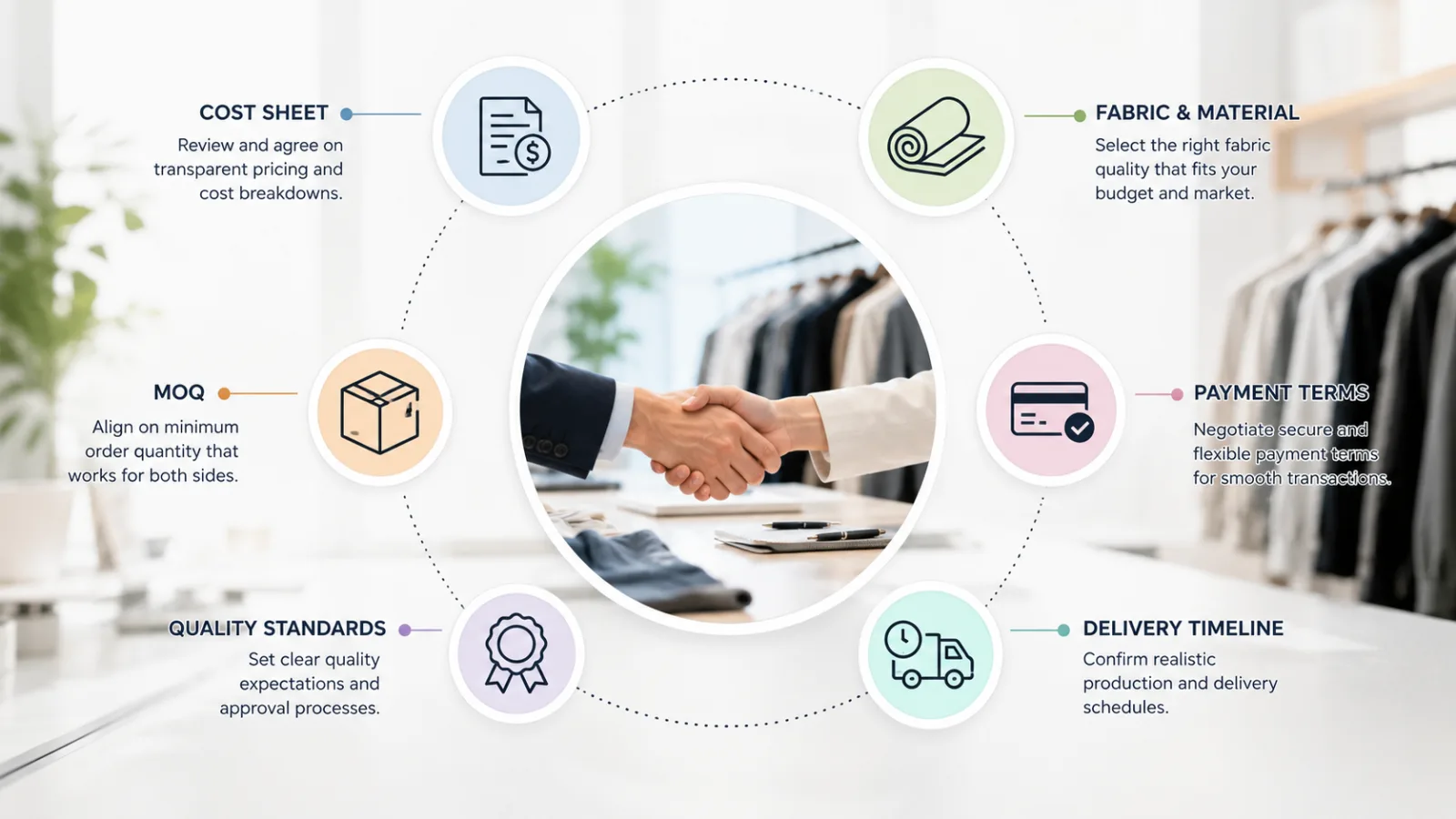
Global Apparel Manufacturing and Pricing Dynamics
The global apparel industry produces over 100 billion garments every year, making clothing manufacturing one of the largest consumer product industries in the world. Because of this scale, pricing negotiations between brands and manufacturers play a major role in supply chain management.
In many sourcing markets such as Bangladesh, China, Vietnam, and India, apparel factories compete internationally for production orders. As a result, brands that understand manufacturing cost structures and negotiate professionally are often able to improve production efficiency, reduce unnecessary costs, and build stronger long-term supplier relationships.
Why Price Negotiation Matters in Clothing Manufacturing
Negotiating with a manufacturer affects much more than your product margin. It also affects your launch timeline, reorder potential, and overall supply chain stability. If you negotiate well, you can improve cost control while keeping production quality consistent. If you negotiate poorly, you may end up with a lower quoted price but higher hidden costs later through defects, delays, rework, or packaging errors.
For clothing brands, the manufacturing quote influences retail pricing, wholesale margin, marketing budget, and inventory risk. A difference of even a small amount per piece becomes significant when you scale. On the other hand, pushing for unrealistic pricing can force the factory to cut corners in stitching quality, trim quality, finishing standards, or line allocation. That is why professional negotiation should focus on value, not just pressure.
The strongest negotiation outcome is a balanced agreement where the manufacturer understands your business potential and you understand the real cost structure behind the garment.
Understand What a Clothing Manufacturer Is Really Pricing
Before you negotiate, you need to know what the manufacturer is actually charging for. Many buyers try to lower prices without understanding the cost breakdown, and that weakens their position. In apparel production, the quoted price usually includes several cost layers, depending on whether the order is CMT, FOB, or full package.
For a basic FOB clothing order, the factory price may include fabric, trims, cutting, sewing, finishing, quality control, packaging, overhead, and profit margin. For a CMT order, the price may only cover labor and production services, while you provide the materials yourself. A full package quote may include development support, sourcing, production coordination, and export handling.
Common cost elements inside a clothing manufacturing price include fabric consumption, trim cost, labor minutes, wastage allowance, wash or print processes, packaging, overhead, compliance costs, and target margin. If you do not understand these elements, you will not know where there is room to negotiate.
This is why experienced buyers often ask for a rough cost breakdown before negotiating. Even if the factory will not share a detailed internal costing sheet, you can still learn which areas are driving the price.
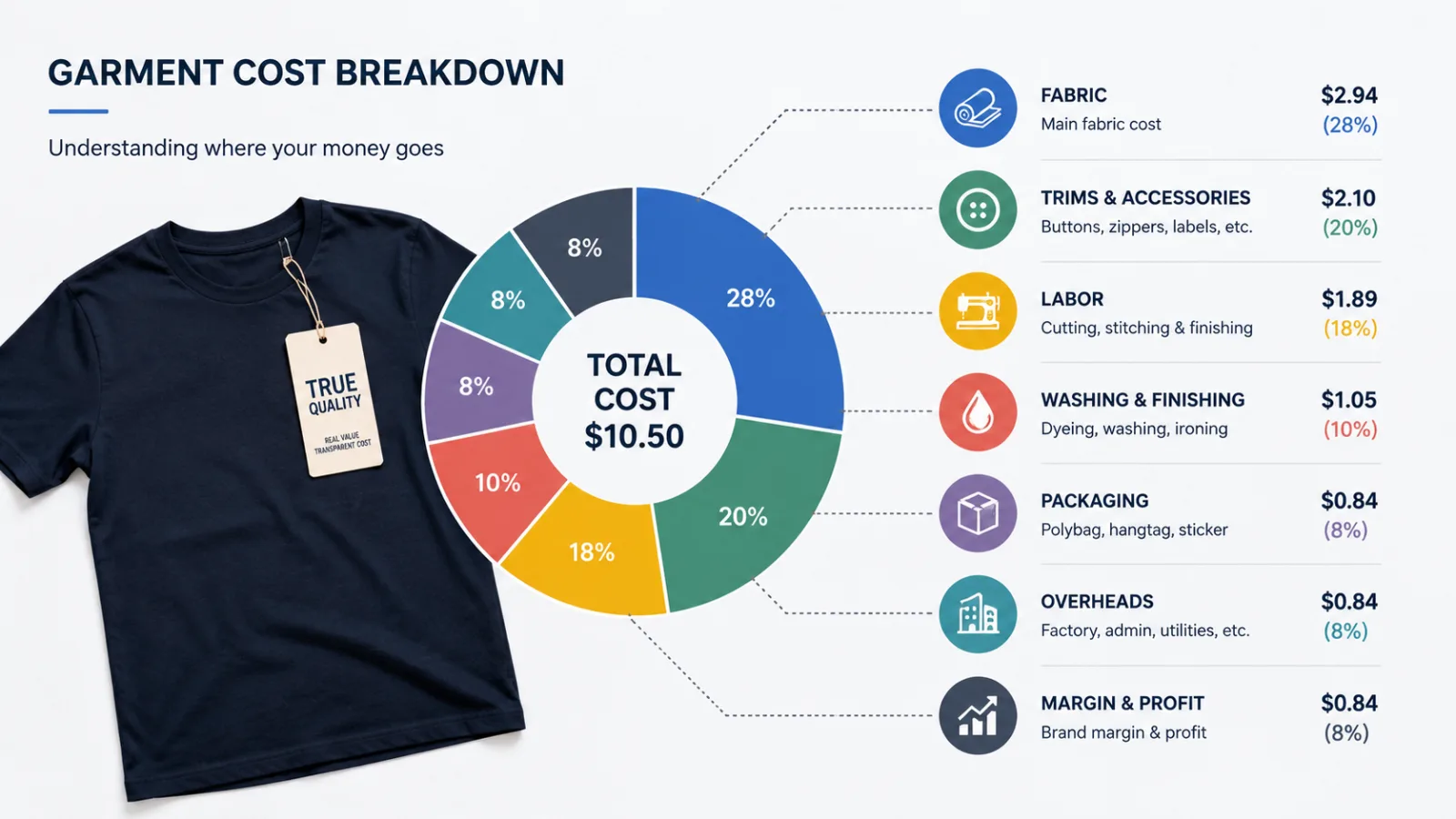
Typical Garment Cost Breakdown
Understanding how clothing manufacturers calculate garment costs can help you negotiate more effectively. While the exact numbers vary depending on the product type, production location, and order quantity, the table below shows a best way to negotiate for favorable terms. Typical cost distribution in apparel manufacturing.
or many apparel products, fabric is the largest cost driver, which is why experienced buyers often focus on fabric selection and material efficiency when negotiating with manufacturers. Even small adjustments in fabric weight, width, or sourcing location can significantly influence the final garment price.
Example Cost Breakdown for a Basic Garment
To better understand how manufacturing costs work in practice, the table below shows a simplified example of the cost structure for a basic cotton t-shirt produced at scale.
This simplified example illustrates why fabric and labor are usually the largest contributors to garment pricing. When negotiating with clothing manufacturers, many brands focus on improving efficiency in these areas by adjusting fabric choices, simplifying construction details, or increasing order quantities. Understanding the typical cost structure allows buyers to negotiate more effectively while ensuring that the final product maintains quality standards.
Start With the Right Goal: Negotiate for Value, Not Just the Lowest Price
One of the biggest mistakes in apparel sourcing is thinking that the best negotiation result is the cheapest quote. It is not. The best result is the most sustainable commercial structure for your brand.
A low price means little if the factory misses delivery dates, substitutes trims, changes stitching quality, or produces inconsistent sizing. In clothing manufacturing, price and quality are closely connected. That does not mean you should accept every quote. It means you should negotiate in a way that improves efficiency, simplifies production, and removes unnecessary cost rather than creating harmful pressure.
Value based negotiation means asking questions like these: Can we simplify construction to reduce labor minutes? Can we use stock fabric for the first run? Can we standardize trims across multiple styles? Can we increase quantity later through repeat orders for better pricing? Can we reduce packaging complexity? These are smarter negotiation moves than simply demanding a lower number.
Manufacturers usually respond better when they see that you understand the business side of garment production. It shows that you want a workable deal, not an unrealistic discount.
Prepare Before You Ask for a Better Price
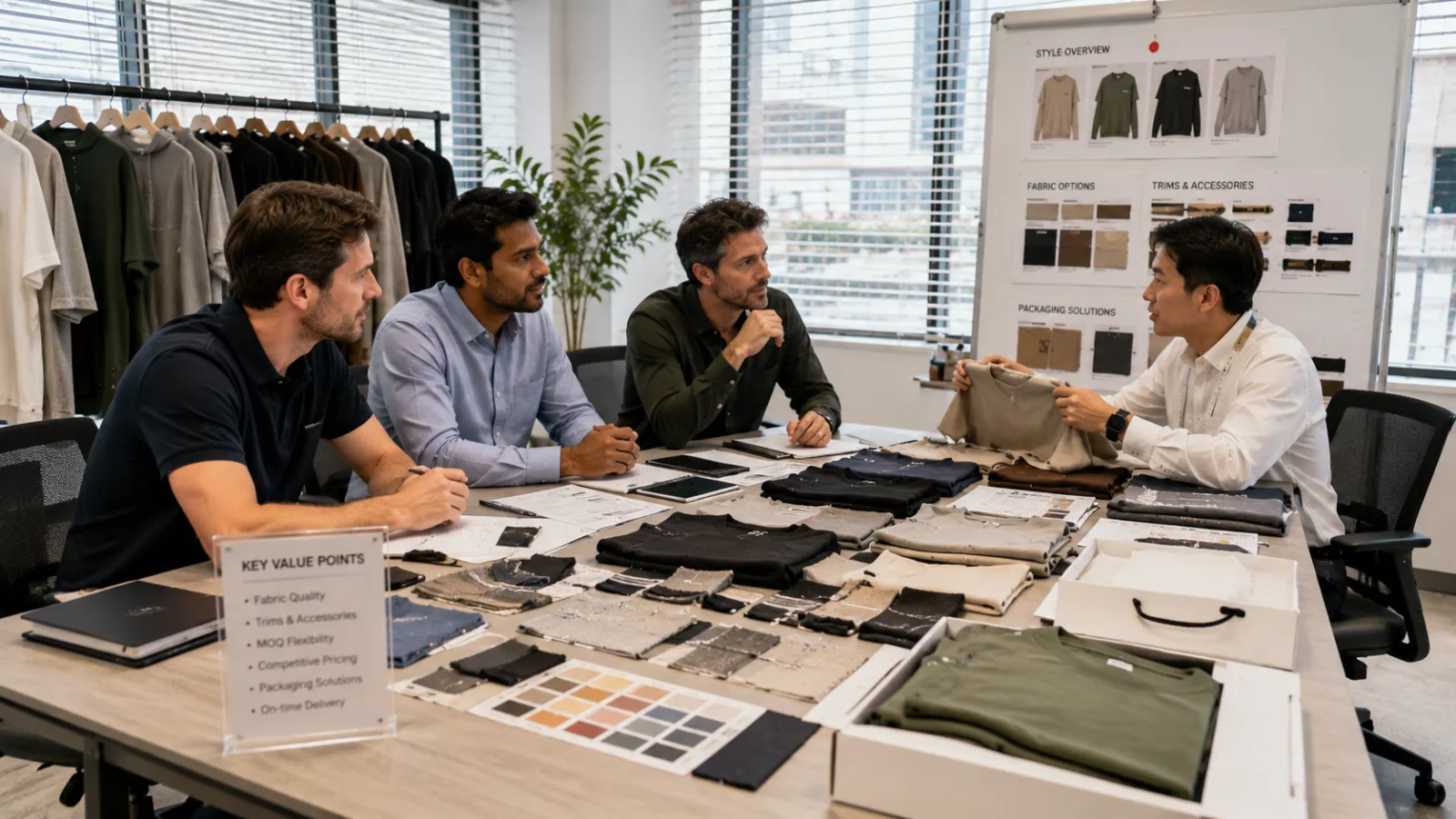
Good price negotiation begins long before the first email or meeting. Preparation gives you confidence and makes your arguments stronger. If you negotiate without preparation, you will either accept too much or ask for reductions that the factory cannot realistically support.
Before speaking with a clothing manufacturer, prepare your target price range, expected retail price, target gross margin, and clear product specs. You should also know your order quantity, timeline, quality level, and sourcing model. Factories quote more accurately when your tech pack, measurements, artwork, and packaging requirements are clear, which helps in finding a manufacturer. Vague briefs often lead to padded pricing because the supplier adds risk protection into the quote.
You should also compare multiple factories, but compare them intelligently. A lower quote may exclude packaging, washing, or compliance testing. Another quote may include better finishing and shorter lead time. Make sure you are comparing like for like.
Preparation also means understanding what parts of your product make it expensive. Is the cost driven by fabric? By printing? By labor heavy construction? By low quantity? By custom trims? Once you know the real driver, your negotiation becomes strategic.
Know the Main Factors That Affect Clothing Manufacturing Price
If you want to negotiate effectively, you must know what usually changes the price. Manufacturers calculate garment cost based on complexity, inputs, and risk. The more clearly you understand these drivers, the more intelligently you can respond.
Fabric is often the biggest cost component in apparel manufacturing. Fabric quality, composition, weight, width, finish, and sourcing country can all change the final price. Trims also matter, especially if you use custom branded labels, special zippers, metal hardware, or premium packaging. Labor cost depends on construction complexity, number of pattern pieces, seam type, and time required to finish one garment. Washing, printing, embroidery, and dyeing processes can add significant cost. Small orders usually cost more per piece because the setup effort is spread across fewer units.
Lead time also affects pricing. Urgent production often comes with extra cost because the factory may need overtime, special line planning, or faster logistics. Payment terms matter too. A manufacturer may offer a better price for more favorable cash flow conditions.
When you understand these price drivers, you can negotiate specific levers instead of making vague discount requests.
Ask for a Cost Breakdown Without Sounding Aggressive
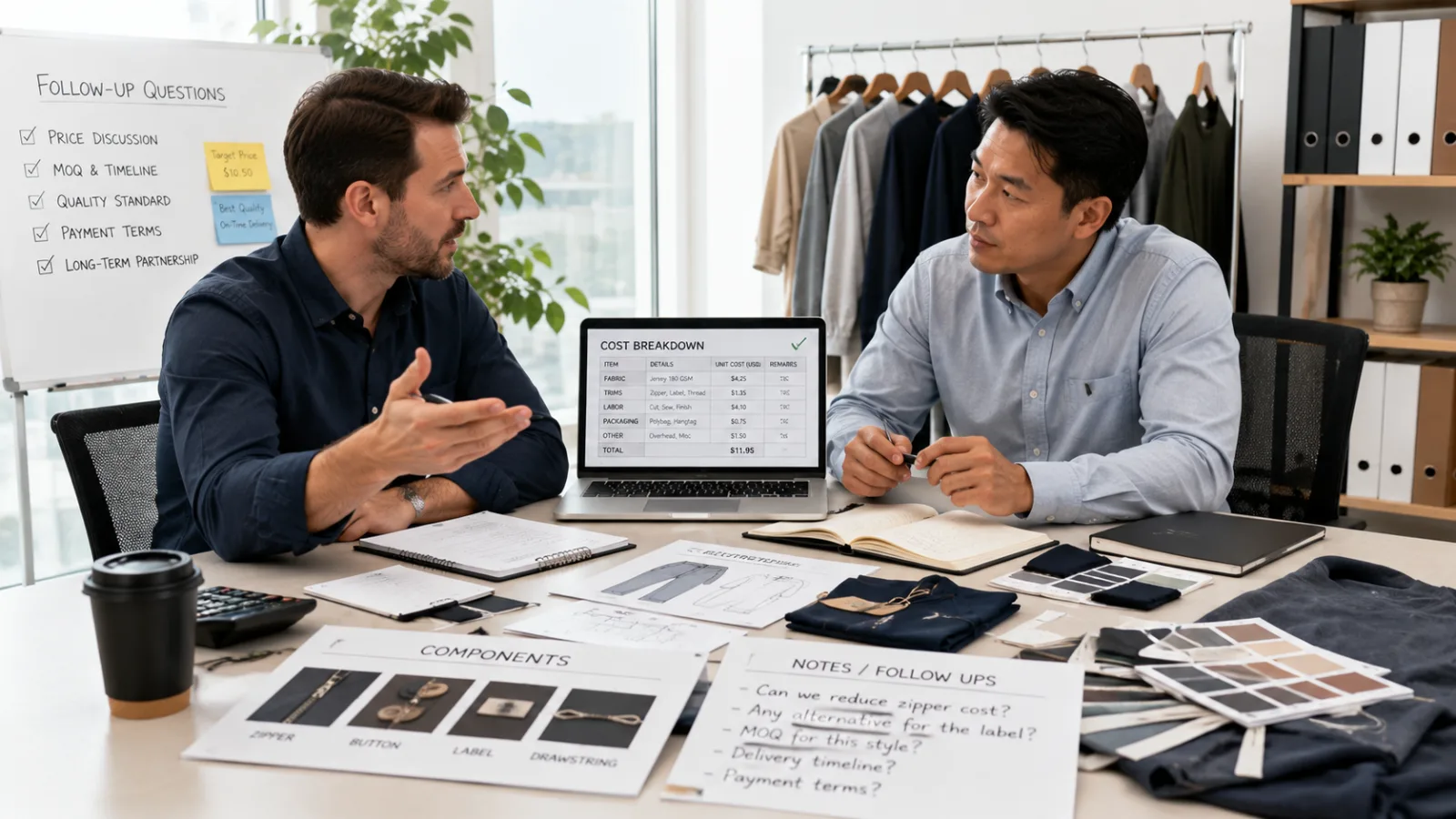
Some buyers hesitate to ask how a price was calculated because they do not want to appear confrontational. But asking for clarification is normal and professional. You do not need to demand a full internal costing sheet. Instead, ask for a broad explanation of the major cost drivers.
A smart way to ask is to say that you are reviewing the style for long term production and want to understand which components are contributing most to cost. This keeps the conversation cooperative. If the manufacturer says fabric is the main driver, you can explore alternate fabric options. If the factory says labor is high because the garment has many operations, you can review construction details. If MOQ is the issue, you can discuss future order planning or grouping styles.
This type of conversation creates much better negotiation conditions than saying, “Your price is too high, reduce it.” Specific questions lead to useful answers. Useful answers lead to real cost saving opportunities. The goal is not to expose the factory. The goal is to identify where adjustments can be made without harming the garment or the relationship.
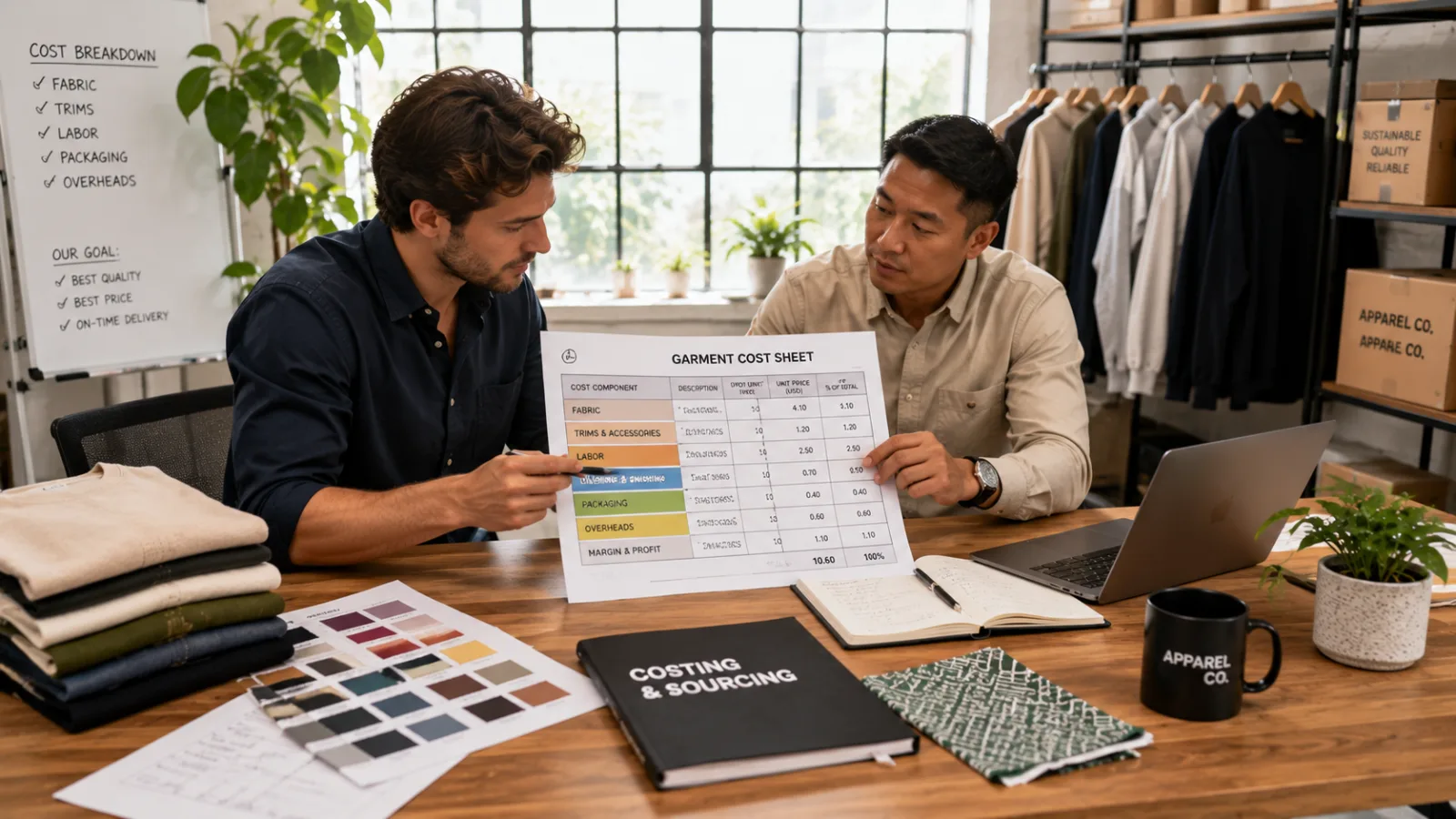
Compare Quotes the Right Way
One of the most powerful negotiation tools is comparison, but only if you do it properly. Many apparel brands get three quotes and assume the lowest price is the best deal. That is risky. Quotes are only useful when the specification, quality expectation, and terms are identical.
When comparing quotes, confirm whether each manufacturer included the same fabric quality, trim quality, print method, packaging, testing requirements, and shipping term. Also confirm whether the MOQ is the same. A factory quoting a lower price on a higher quantity is not directly comparable to a factory quoting a smaller run.
It is also important to compare communication quality and production confidence. If one manufacturer gives a slightly higher quote but clearly explains pricing, lead time, and quality process, that may be a stronger long term partner than the cheapest option.
You can use quote comparison to negotiate, but do it respectfully. Instead of saying another factory is cheaper and forcing a reaction, explain that you are reviewing a few options and want to understand whether there is room to improve pricing based on order structure or simplification. That keeps the conversation professional and avoids unnecessary tension.
Negotiate MOQ Before You Negotiate Unit Price
Many new brands focus only on unit price, but MOQ often matters just as much. If the manufacturer requires a high minimum order quantity, your cash flow risk increases even if the per-piece price looks attractive. That is why smart negotiation starts with volume structure.
You can negotiate the MOQ in several ways. One option is to request a lower first order MOQ with the understanding that repeat orders will increase. Another option is to split the MOQ across multiple colorways if the fabric and trim setup allows it. Some factories may also allow a trial run at a slightly higher unit price, then reduce pricing on the next order when volume grows.
Negotiating MOQ is especially important for startups because inventory pressure can hurt the business faster than a slightly higher unit cost. A lower MOQ may actually create a better business outcome, even if the quoted price stays the same or increases slightly.
Manufacturers are often more flexible when they believe you have long-term growth potential. If your brand presentation is clear and your plan looks realistic, they may be more willing to support smaller starting quantities.
Use Your Product Specs to Reduce Cost
The best negotiation does not always happen in the price discussion itself. It often happens through product decisions. Small design and construction changes can reduce cost without making the garment feel cheap.
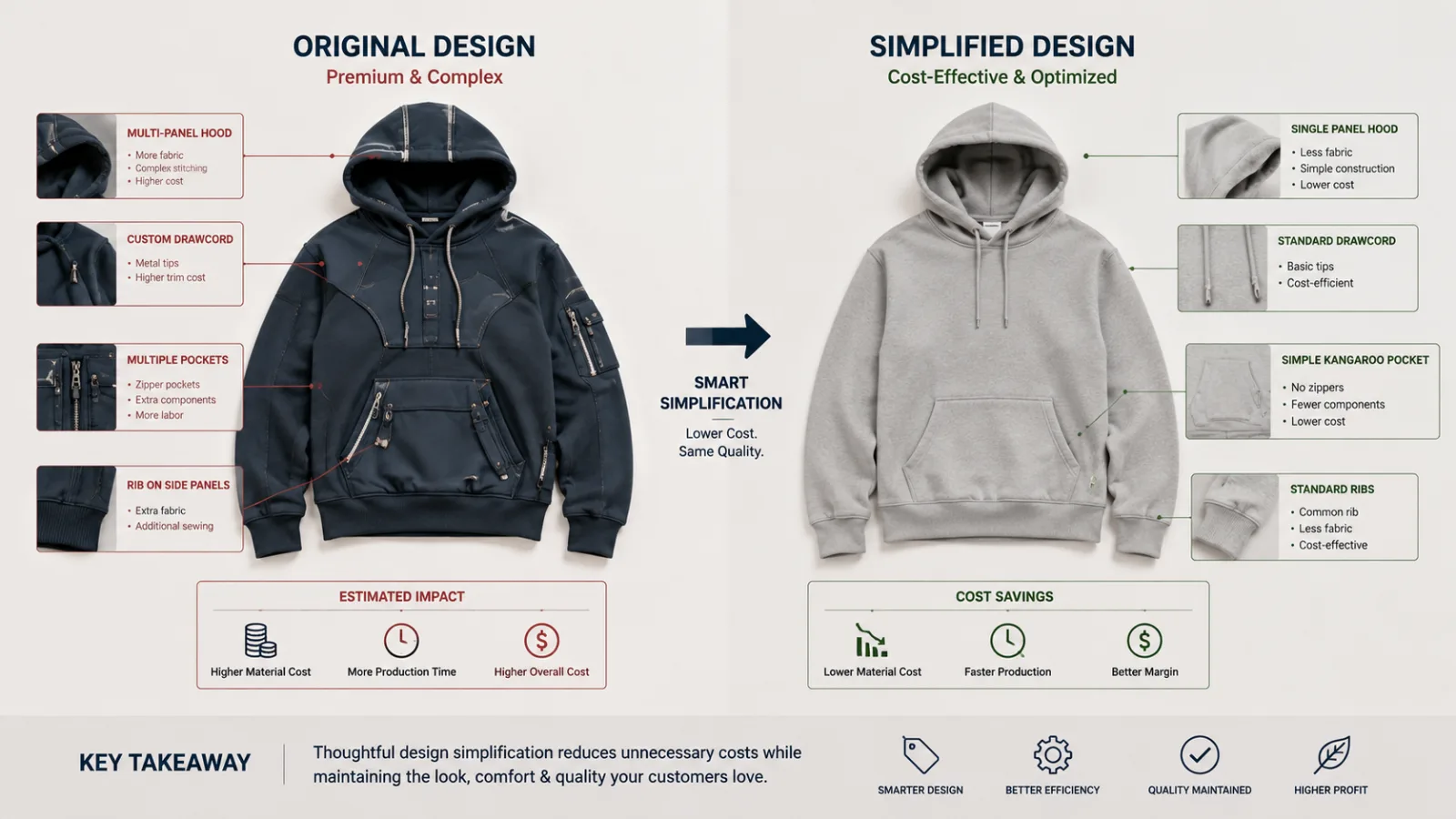
For example, you may reduce cost by using stock fabric instead of developing a custom knit. You may replace a branded metal zipper with a strong standard zipper for the first run. You may simplify the pocket construction, reduce the number of panels, or use common packaging across multiple styles. You may also reduce stitching complexity or switch from premium folding and insert methods to cleaner but simpler packing.
These changes should always be evaluated carefully to protect brand positioning. But many startup brands include features that increase cost without adding meaningful customer value. When a manufacturer explains which elements are making the style expensive, treat that as negotiation insight. It tells you where optimization is possible.
The smartest buyers negotiate through design efficiency. That gives the factory room to lower the quote while preserving margin and production flow.
Negotiate Payment Terms Along With Price
Price is only one part of the commercial deal. Payment terms can significantly affect your cash flow and total sourcing risk. Sometimes a manufacturer may not reduce the price much, but they may offer more flexible payment terms that improve your business outcome.
Common clothing manufacturing payment terms include deposit plus balance before shipment, deposit plus balance against shipping documents, letter of credit, or milestone-based payment for larger orders. Startups often face stricter terms because they are new customers, but there is still room for discussion.
For example, you may ask whether the deposit can be reduced on repeat orders. You may request that the final balance be paid after inspection rather than before. You may also negotiate sample charges separately from bulk production. If you are offering better payment reliability or faster approval turnaround, mention that as part of the best way to negotiate in the commercial discussion.
Factories care about cash flow and risk. If you can reduce uncertainty for them, they may be more willing to support your pricing goals.
How to Negotiate Sampling Charges
Many new brands are surprised by sample costs and try to negotiate them aggressively. Sampling is different from bulk production. Sample making is labor-intensive, slower, and less efficient because the factory is developing, adjusting, and testing rather than repeating a finished process. That is why sample prices are usually higher.
Still, there are smart ways to negotiate sample charges. You can ask whether the sample fee will be adjusted against the bulk order if production moves forward. Many factories offer this. You can also reduce sampling cost by submitting a complete tech pack, clear measurements, and approved artwork at the beginning. Fewer revisions reduce the factory’s time and risk, which is crucial when negotiating fair terms.
If you need multiple sample rounds, ask the manufacturer to explain what each round is intended to achieve. This keeps the process efficient. Avoid negotiating sample cost in a way that makes the factory feel development work is undervalued. A better approach is to discuss how sample cost fits into a long term production relationship.
Use Long-Term Potential as a Negotiation Tool
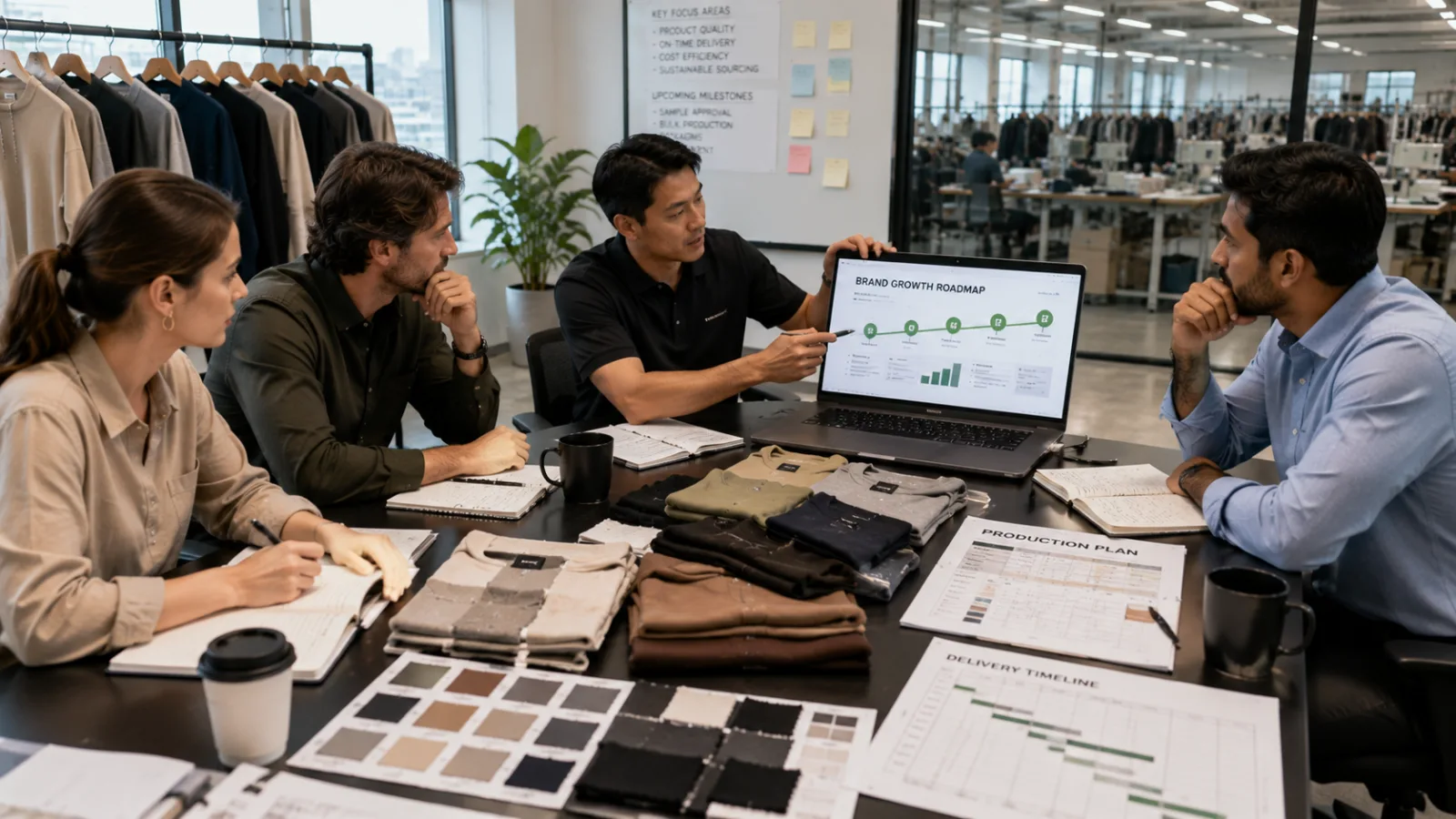
Manufacturers care about repeat business. A factory may be less flexible for a one-time order and more flexible for a brand that shows consistent long-term growth potential. That is why you should present your business clearly during negotiations.
You do not need to exaggerate. But if you have a collection roadmap, expected reorder plan, or growth strategy, share it. If you plan to start with one style and expand into more SKUs, say so. If you want to build a long-term sourcing relationship instead of chasing the lowest price every season, say that too.
Factories are more willing to support competitive pricing when they believe the account can grow. They may accept a lower margin on the first order if they see future volume, better planning, and lower operational friction. This is especially helpful for startup brands negotiating first production runs. The key is credibility. Do not promise unrealistic volumes. Present realistic potential backed by a clear product plan.
 Be Careful When Using Another Supplier’s Quote in Negotiation
Telling a manufacturer that another factory is cheaper can work, but it can also damage trust if handled poorly. The safest way to use quote comparison is respectfully and without confrontation.
Instead of directly saying another supplier offered a lower price and demanding a match, explain that you are comparing options and want to understand whether there are adjustments that could make the offer more competitive. That invites discussion. It does not force a defensive reaction.
Also be careful not to share too much about other suppliers’ pricing structure. That can feel unethical and make the factory less comfortable working with you. Focus on your cost target and business reality rather than turning the conversation into a bidding war.
If a factory cannot match a lower quote, ask why. They may offer stronger quality control, better compliance standards, faster lead time, or more reliable communication. Sometimes the higher quote is justified. Your job is to decide whether the value difference matters.
Negotiate More Than Just Unit Price
Many apparel buyers leave money on the table because they focus only on unit price. In reality, several other terms can improve your commercial results.
You can negotiate sample fee credits, reduced MOQ, better payment terms, faster lead time for repeat orders, lower packaging charges, flexible color splits, lower surcharge on custom labeling, or better pricing on repeat orders after the first run. You may also negotiate quality checkpoints, defect handling rules, or timeline commitments that reduce risk and protect margin later.
For example, a manufacturer may not reduce the initial price much but may agree to hold the same price for a second order if quantities increase. Or they may include basic packaging at no extra cost. Or they may waive certain development charges once production is confirmed. Good negotiation looks at the full commercial picture. A better overall deal is often more valuable than a slightly lower unit price.
What to Say When the Manufacturer Says the Price Cannot Go Lower
At some point, many factories will say the price is already final. This does not mean the conversation is over. It means you need to shift the discussion.
A strong response is to ask which components are preventing further reduction and whether there are alternate ways to reach your target through design simplification, quantity adjustment, or commercial terms. You can also ask what volume level would unlock better pricing in the future. That helps you understand the next threshold.
If the manufacturer truly cannot move, respect that. Pushing too aggressively can hurt the relationship. Instead, decide whether the quote still works for your margin and positioning. If not, review the style. Sometimes the product needs to be redesigned to fit your business model. Professional buyers know when to keep negotiating and when to refocus on the structure of the deal. That is much more effective than repeating the same request.
Red Flags to Watch During Price Negotiation
Not every low quote is a good sign. Sometimes an unusually cheap price signals risk rather than opportunity. If a manufacturer seems eager to win the order at any price without asking detailed questions, be careful and consider their motives. Good factories usually want to understand the fabric, quality level, trims, packaging, delivery date, and approvals before confirming a final number.
Other warning signs include vague answers about what is included, refusal to discuss MOQ logic, unrealistic lead times, unclear sample process, or aggressive price cuts without any explanation. These can signal instability, poor planning, or future hidden costs, making it essential to test the market before committing.
Another red flag is when a supplier says yes to every request without discussing tradeoffs. In apparel manufacturing, everything has a cost, time, or quality impact. A professional factory should be able to explain those relationships clearly.
Trustworthy negotiation is transparent. Even if the price is not the lowest, a supplier who explains the quote honestly is often the safer long-term choice.
Build a Relationship, Not a One-Time Transaction
The strongest apparel negotiations are relationship-based. Clothing manufacturing is rarely a one-order business if your brand succeeds. You will need sample revisions, repeat orders, urgent adjustments, quality support, and production flexibility over time. That is much easier when the factory sees you as a serious long-term partner.
Relationship-based negotiation does not mean accepting poor pricing. It means being professional, prepared, respectful, and commercially realistic. It means paying on time, giving clear approvals, and reducing chaos in the process. Factories remember good buyers. They prioritize them, support them, and often become more flexible over time.
If your negotiation style is aggressive, inconsistent, or purely price-driven, you may win a small discount now but lose production reliability later. That is a bad trade. A healthy sourcing relationship usually delivers more value than a one-time price victory.
In apparel manufacturing, long-term trust often becomes a cost advantage of its own because it reduces errors, improves speed, and creates smoother scaling.
Key Factors You Can Negotiate With a Clothing Manufacturer
When negotiating with a clothing manufacturer, the discussion usually involves more than just the unit price. Several commercial factors can influence the final cost of production and the overall business agreement.
Understanding these negotiation factors helps clothing brands focus on practical cost improvements rather than unrealistic price pressure.
Experienced buyers often negotiate by optimizing product design, production planning, and order structure, which allows factories to offer better pricing without compromising quality.
A Simple Step-by-Step Process to Negotiate Prices With a Clothing Manufacturer
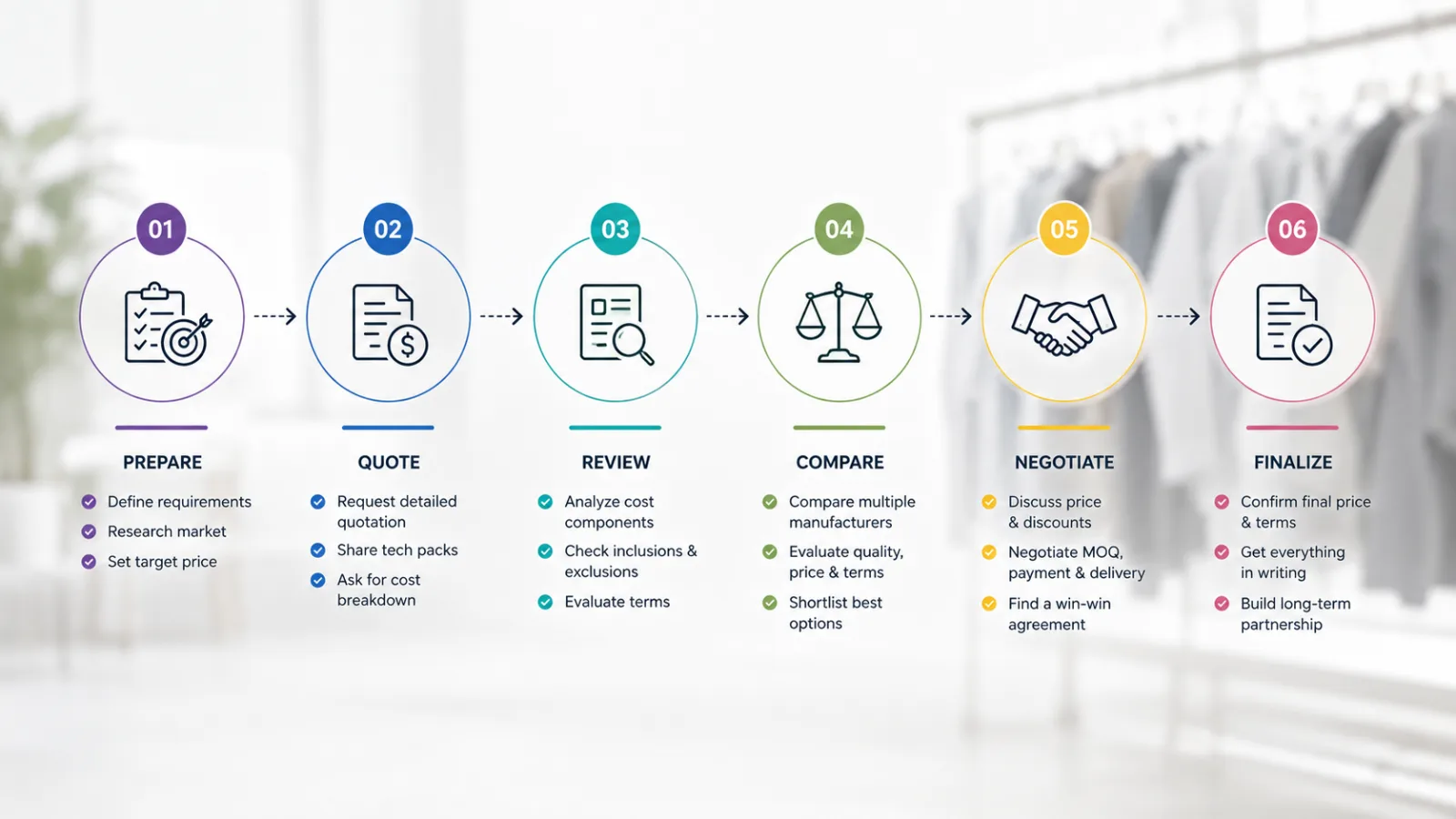
The easiest way to stay professional is to follow a structure. Start by preparing complete product information, target margin, and target cost. Request a detailed quote and clarify what is included. Review the major cost drivers and identify whether fabric, trims, labor, MOQ, or packaging is making the price high. Compare the offer with other qualified factories using the same specifications. Then discuss specific adjustments, not vague discount requests.
After that, explore broader commercial terms such as MOQ flexibility, sample fee credits, payment structure, repeat order pricing, and packaging simplification. Once the factory gives its best position, decide whether the product still fits your business model. If not, revise the style or choose another supplier.
This process helps you negotiate logically instead of emotionally. It also signals professionalism to the manufacturer, which improves the quality of the conversation.
Practical Negotiation Phrases You Can Use
Sometimes the biggest challenge is simply knowing what to say. A few professional phrases can make the conversation smoother.
You can say that you are reviewing the style for long term production and would like to understand the main cost drivers. You can ask whether there are more efficient fabric or trim options that would help reach a better target. You can say that your first run is small, but you are planning repeat orders and would like to discuss MOQ flexibility. You can ask whether the sample cost can be adjusted against bulk production if the order moves forward. You can ask what volume would open better pricing in future orders.
These phrases keep the conversation collaborative. They sound commercial, not confrontational. That matters in sourcing, especially across cultures and time zones. The tone of negotiation affects the result more than many buyers realize. Respectful wording often leads to more honest and useful answers.
Build a Relationship with Your Supplier
Building trust is the best way to negotiate when negotiating with manufacturers—whether you’re finding a manufacturer on Alibaba or meeting local clothing manufacturer requires. For a fledgling fashion brand, start small and test the market with smaller orders or a low MOQ so you can learn the manufacturing process, from garment construction to qc and quality standards. Honest, clear communication and a realistic forecast help you establish rapport and a successful partnership that can help you secure a better deal and help you secure better price per unit or cost per yard. Offer a win-win situation—don’t lowball suppliers; instead, negotiate fair terms that reflect true cost of production. By doing so you streamline ordering, maintain quality, and make it easier for brand owners to scale from per-yard quotes to full production.
How Startups Should Negotiate Differently From Established Brands
Startups need a different negotiation mindset than large retailers. Big brands may pressure suppliers based on volume, long contracts, and strong payment history. Startups usually do not have those advantages yet. That means your leverage comes from clarity, preparation, growth potential, and ease of collaboration.
As a startup, negotiate for realistic support. Focus on MOQ flexibility, workable first-order pricing, efficient sampling, clear quality expectations, and room for better pricing as volume grows. Avoid trying to act like a major brand if your order size and planning do not support it. Factories can usually sense that quickly.
At the same time, do not undervalue yourself. If your concept is strong, your branding is clear, and your product plan is professional, you can still negotiate effectively. Many factories are open to growing with smaller brands when they believe the relationship is serious and structured. Your goal as a startup is not to win the absolute lowest quote. It is to secure a manufacturer deal that gives you a realistic path to launch, learn, reorder, and scale.
How To Build A Partnership For Long-Term Cost Optimization?
Building a long-term partnership for cost optimization starts with clear communication and a willingness to start small. Brand owners should forecast demand so that a clothing manufacturer requires realistic MOQs and avoids the temptation to lowball pricing on smaller orders. A supplier who can specialize in your garment construction and the full manufacturing process will help you secure a specific price per unit rather than vague quotes on Alibaba, whether calculated per yard or as a price per finished piece. Mutual trust, regular qc, and building rapport lead to a successful partnership where suppliers scale from smaller to large orders and can help you secure better terms and upfront concessions. Streamline communication and be transparent about needs to create a win-win situation that aligns incentives and reduces long-term costs.
ApparGlobal
Many apparel brands negotiate better manufacturing prices when they work with partners that understand garment costing, production planning, and sourcing structure in detail. Companies such as ApparGlobal help clothing brands align product development, material decisions, manufacturing workflows, and quality expectations so cost discussions become more transparent, practical, and scalable for long-term production.

Key Takeaways
- Clothing manufacturing price negotiation requires preparation and cost structure knowledge.
- Fabric is often the largest cost component in garment production.
- Negotiation should focus on value, efficiency, and long-term partnership, not only the lowest price.
- MOQ, payment terms, and production planning can influence overall costs.
- Building strong supplier relationships often leads to better pricing over time.
FAQ: Negotiating Prices With Clothing Manufacturers
How much can you negotiate with a clothing manufacturer?
Negotiation flexibility depends on order size, product complexity, and long-term potential. Many manufacturers may adjust prices by 5–15% if order quantities increase or production becomes more efficient.
What is the biggest cost factor in clothing manufacturing?
Fabric is typically the largest cost component in garment production, often accounting for 50–70% of total production cost, especially for low moq orders..
Should startups negotiate aggressively with manufacturers?
Startups should negotiate professionally rather than aggressively. Building a long-term partnership with manufacturers often leads to better pricing and production support over time.
Can a lower manufacturing price affect quality?
Yes. Extremely low pricing can sometimes result in reduced material quality, weaker stitching standards, or delayed production if factories struggle to maintain profit margins.
Conclusion
Negotiating prices with a clothing manufacturer is not about pushing as hard as possible for the lowest number. It is about understanding what drives garment cost, preparing properly, asking smart questions, and improving the total commercial structure of the deal. The strongest buyers negotiate through clarity, product efficiency, MOQ planning, payment terms, and long-term relationship value.
If you want better pricing, start by understanding the garment, not just the quote. Know what is making the style expensive. Know what can be simplified. Know what terms matter beyond unit price. Then negotiate in a way that protects both your business model and the manufacturer’s ability to deliver quality consistently.
When you approach price negotiation professionally, you do more than save money. You build a stronger sourcing system, better supplier relationships, and a more profitable clothing brand over time.