
Have you ever approved a sample that looked perfect, but the bulk order came back with inconsistent sizing, wrong stitching details, or a fit that feels slightly different across the same style in the fashion design? That usually happens when production is built on assumptions instead of a clear technical blueprint.
In apparel manufacturing, the tech pack is that blueprint. It is the document that translates your design into exact production instructions so the factory can build the same garment again and again with consistent sizing, stable quality, and fewer errors. If you are serious about quality, on-time delivery, and scalable production, tech packs are not optional. They are the foundation of apparel production accuracy.
This guide explains what a tech pack is, what should be included, how tech packs reduce mistakes, how they improve communication between brands and manufacturers, and how to build tech packs that increase production efficiency and reduce costly sampling and bulk defects.
What Is a Tech Pack in Apparel Manufacturing?
A tech pack, short for technical package, is a detailed document used in apparel production to communicate exactly how a garment should be made. It includes all construction details, measurements, fabric specifications, trims, stitching instructions, labeling, packaging requirements, and pricing in the tech pack.
Designers often think in visuals. Manufacturers need specifics. The tech pack bridges that gap by converting design ideas into measurable instructions that a factory can follow.
In practical terms, a tech pack helps a factory answer questions like:
- What are the exact measurements for each size?
- Which fabric and GSM should be used?
- How should the seams be stitched and finished?
- Where should labels be placed?
- What type of thread and needle should be used?
- What packaging standard should be followed?
Without this clarity, production becomes guesswork. Guesswork increases defects, delays, and costly rework.
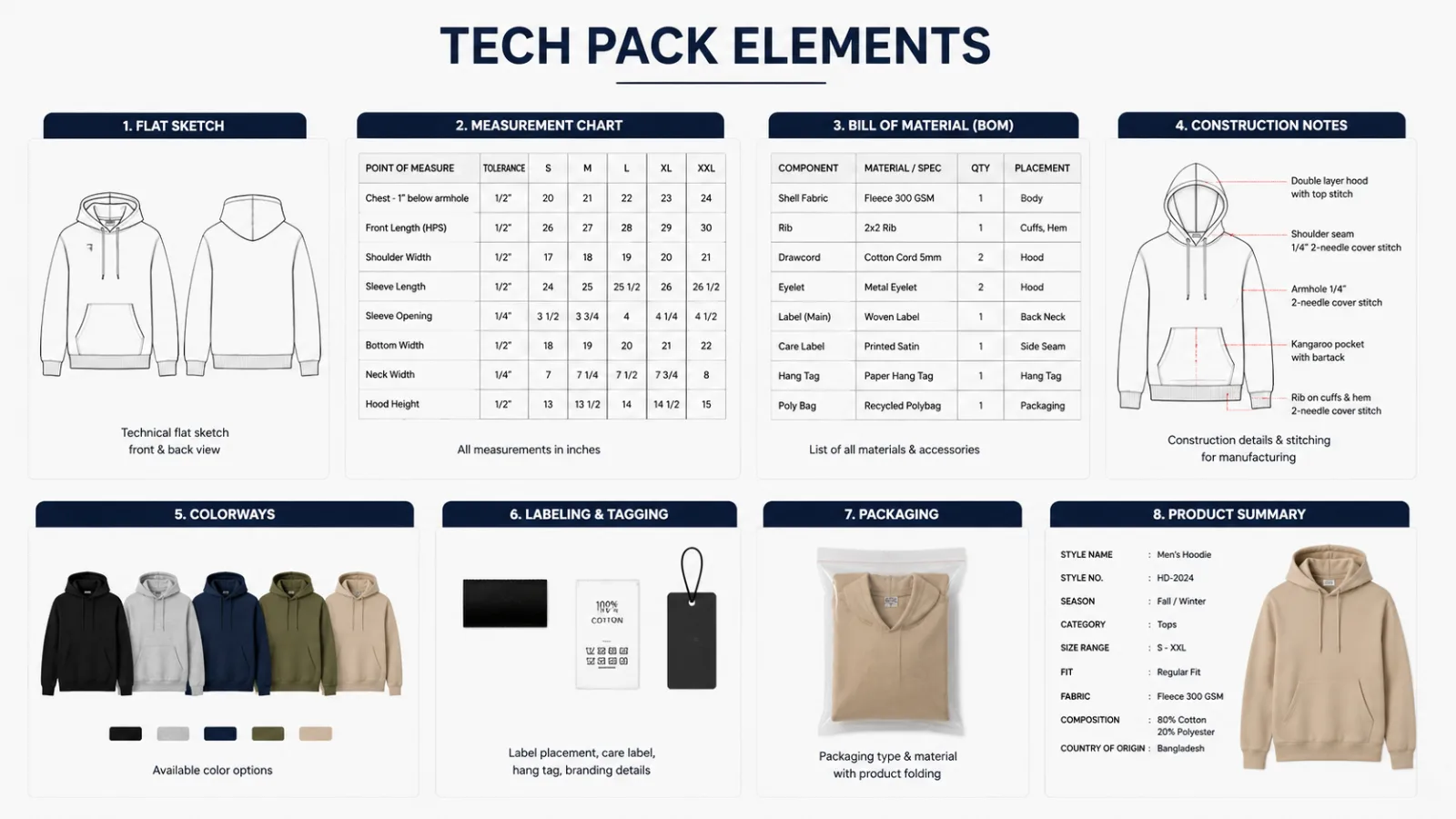
How Tech Packs Are Used
In the clothing and fashion industry, tech packs are used as a comprehensive document to communicate every design detail and component required for mass production. A tech pack template or professional tech pack created in Adobe Illustrator or exported as a PDF helps fashion designers, freelancers, and retailers coordinate assembly, packing information, and pricing. The template includes a size chart, bill of materials, colorways, and a measurement column so factories can accurately assemble and refine samples.
Because the fashion design process demands consistency, tech packs can automatically populate fields from master files, enabling teams to finalize specifications quickly. This comprehensive approach reduces errors, speeds up production timelines, and ensures designs move smoothly from studio concept to mass production in the global fashion industry.
How Much Does A Tech Pack Cost?
Estimating how much a tech pack will cost depends largely on its complexity and the level of detail required. For a simple style with basic measurements and a single view, prices can start from around $50–$150 if using templates or lower-cost services; more detailed packs prepared by experienced freelancers or studios often range from $200–$800.
If you require multiple views, detailed construction notes, custom materials, graded sizes, and BOMs (bill of materials), expect higher designer fees and possibly hourly charges; comprehensive packs for technical outerwear or performance wear can reach $1,000–$2,500.
Other factors that affect the cost include the number of revisions, the timeline, and whether the manufacturer needs CAD or pattern-ready files. In short, set a realistic budget based on the intended use and remember that a more detailed tech pack can reduce production errors and lower the overall final price of manufacturing.
Why Apparel Production Accuracy Matters for Brands
Production accuracy is not just about perfection. It is about repeatability.
If your first bulk order is inconsistent, it creates:
- Higher return rates
- Bad reviews and damaged brand trust
- Increased cost from rework and rejects
- Delayed launch timelines
- Inconsistent sizing that kills repeat purchase
- Difficulty scaling production and reordering best sellers
A tech pack improves accuracy by reducing ambiguity. It gives the factory one standard to follow.
This is especially important for brands selling online, where sizing accuracy directly impacts returns. It is also critical for sustainable fashion brands, because production mistakes create waste, scrap, and unnecessary shipments.

Common Apparel Production Problems Without Tech Packs
Many apparel production mistakes happen because factories receive incomplete instructions. When a tech pack is missing or too basic, manufacturers have to fill in the gaps using assumptions, previous orders, or “standard” methods. The problem is that what feels standard to one production team may be completely different from what your brand expects. That is how small misunderstandings turn into expensive bulk problems.
Inconsistent Sizing and Fit Across the Same Style
Sizing errors are one of the most common production issues when brands do not provide clear points of measure and tolerances. A factory might measure chest width from a different point, or use a different method for taking body length. Even a 1–2 cm shift can change how the garment fits, especially in products like t-shirts, leggings, and fitted tops.
Without a clear measurement spec sheet, you may receive a bulk order where:
- Small and medium feel almost the same
- Body length varies across cartons
- Sleeve lengths differ from sample to bulk
- Fit changes between production batches
A tech pack prevents this by defining points of measure, size grading, and tolerance rules so every size is produced consistently.
Wrong Fabric Weight, Hand-Feel, or Finish
Factories often source fabric based on general descriptions unless you specify exact requirements. A classic example is the “heavyweight hoodie” problem. If you only say heavyweight, the factory might select a fleece that is lighter than you intended, or a fabric that feels rougher, less brushed, or less structured than the sample you approved.
This can lead to:
- Hoodies that feel thin and lose shape after washing
- T-shirts that feel too light, too sheer, or too stiff
- Fabric that pills quickly because yarn quality is different
- The color and dye outcome that looks inconsistent
A tech pack solves this by specifying fabric composition, GSM, width, finish type, shrinkage expectations, and even reference swatches so the factory cannot guess.
Incorrect Stitching, Seam Construction, and Durability Issues
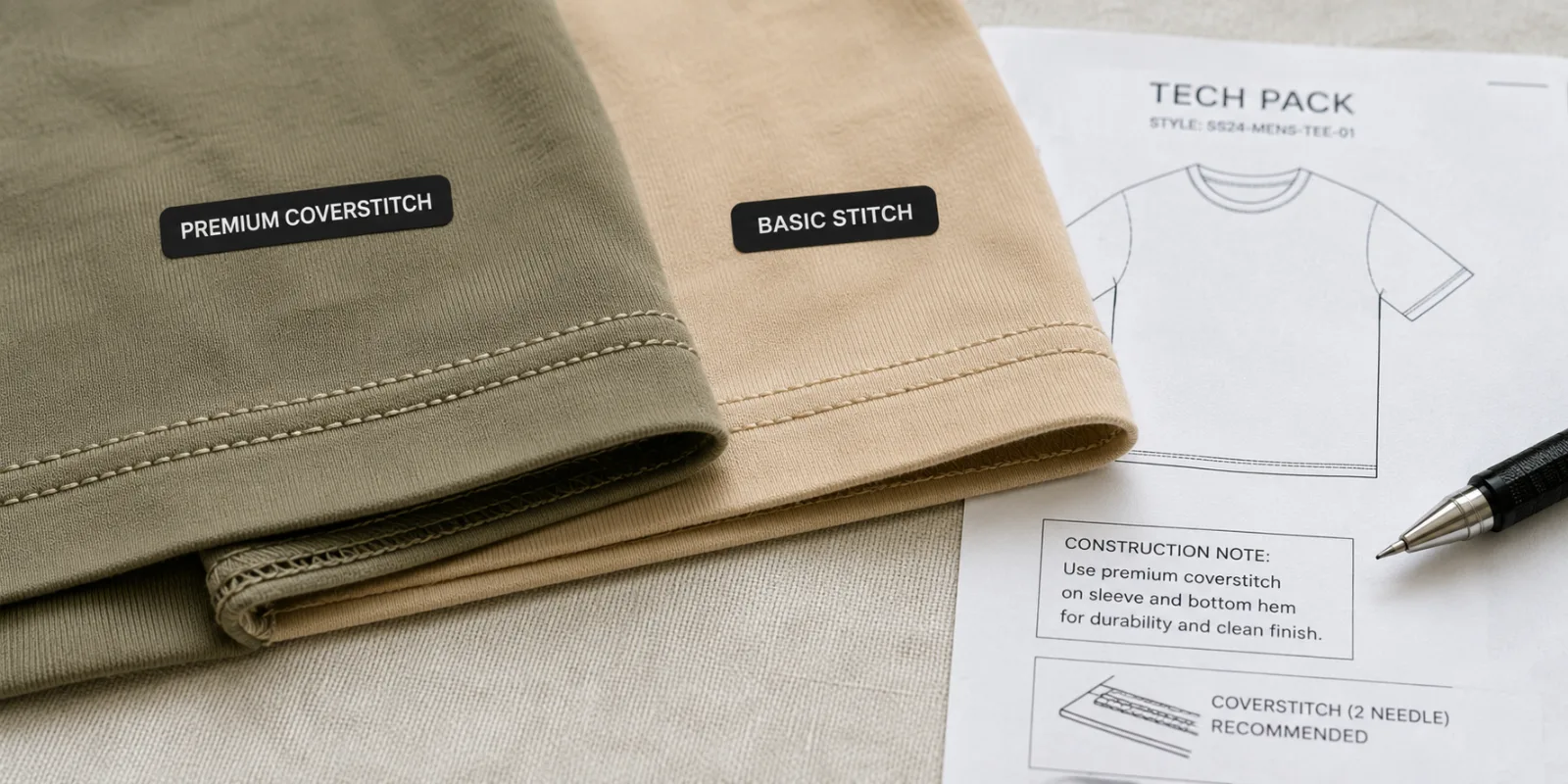
Without construction instructions, factories may choose faster or cheaper sewing methods. The garment may look fine on day one, but quality problems show up after wear and washing. For example, a brand may expect coverstitch hems on a premium t-shirt, but the factory uses a simpler hem finish that does not match the intended look and durability.
Common issues include:
- Seams are popping because the stitch type is too weak
- Uneven topstitching that reduces product quality perception
- Wrong seam allowance causing shape issues
- Missing reinforcement, like bar tacks at stress points
- Necklines are stretching out because the stitch method is not defined
A tech pack prevents this by specifying stitch types, seam allowances, reinforcement points, and finishing standards, so the production line follows one consistent construction method.
Misplaced Labels, Wrong Branding Placement, and Packaging Errors
Branding details are often treated as “small,” but they directly impact how premium your products feel. Without clear labeling and packaging instructions, factories may place size labels incorrectly, attach hangtags in the wrong area, or use packaging that does not match your e-commerce or retail requirements.
This can cause:
- Neck labels stitched too high or crooked
- Care labels are placed in the wrong seam
- Hangtags attached to the wrong point
- The wrong folding method leads to poor presentation
- Incorrect polybag size or missing barcode stickers
A tech pack removes confusion by specifying label size, placement measurements, attachment method, folding style, and packaging requirements.
Sample Looks Right, But Bulk Does Not Match
This is the most painful situation for a brand. You approve a sample, but bulk production looks slightly different. The root cause is usually that the factory used different materials, different trims, or different construction methods in bulk because the sample standard was not documented clearly. A tech pack locks the approved product into a repeatable standard by documenting the exact fabric, trims, measurements, and construction rules that bulk production must follow.
This is what keeps your bulk consistent and protects your brand as you scale.

How Tech Packs Improve Apparel Production Accuracy
Tech packs improve production accuracy in multiple ways. Each one reduces a specific type of error that causes production problems.
They eliminate vague communication
Factories receive hundreds of instructions from brands. If your instructions are vague, your order becomes risky. A tech pack ensures the factory does not interpret your design differently from what you intended.
They create a consistent measurement standard
Sizing issues are one of the biggest reasons apparel brands lose money. Tech packs define measurements, tolerances, and grading rules so each size stays consistent.
They standardize construction methods
A tech pack specifies seam types, stitch counts, reinforcements, edge finishing, and trims. This ensures consistent construction quality across production lines.
They reduce sampling rounds
Without a tech pack, sampling becomes trial and error. With a detailed tech pack, factories can produce accurate samples faster, which saves time and cost.
They make quality control measurable
QC teams cannot “inspect design.” They inspect measurable standards. A tech pack provides measurable standards for QC checkpoints.
Image Prompt: Quality inspector measuring a garment while referencing a tech pack document, factory environment, clean realistic photography, 16:9
What a Strong Tech Pack Should Include
A strong tech pack is detailed but organized. It must be clear enough that a production team can execute without constant questions.
Here are the most important elements.
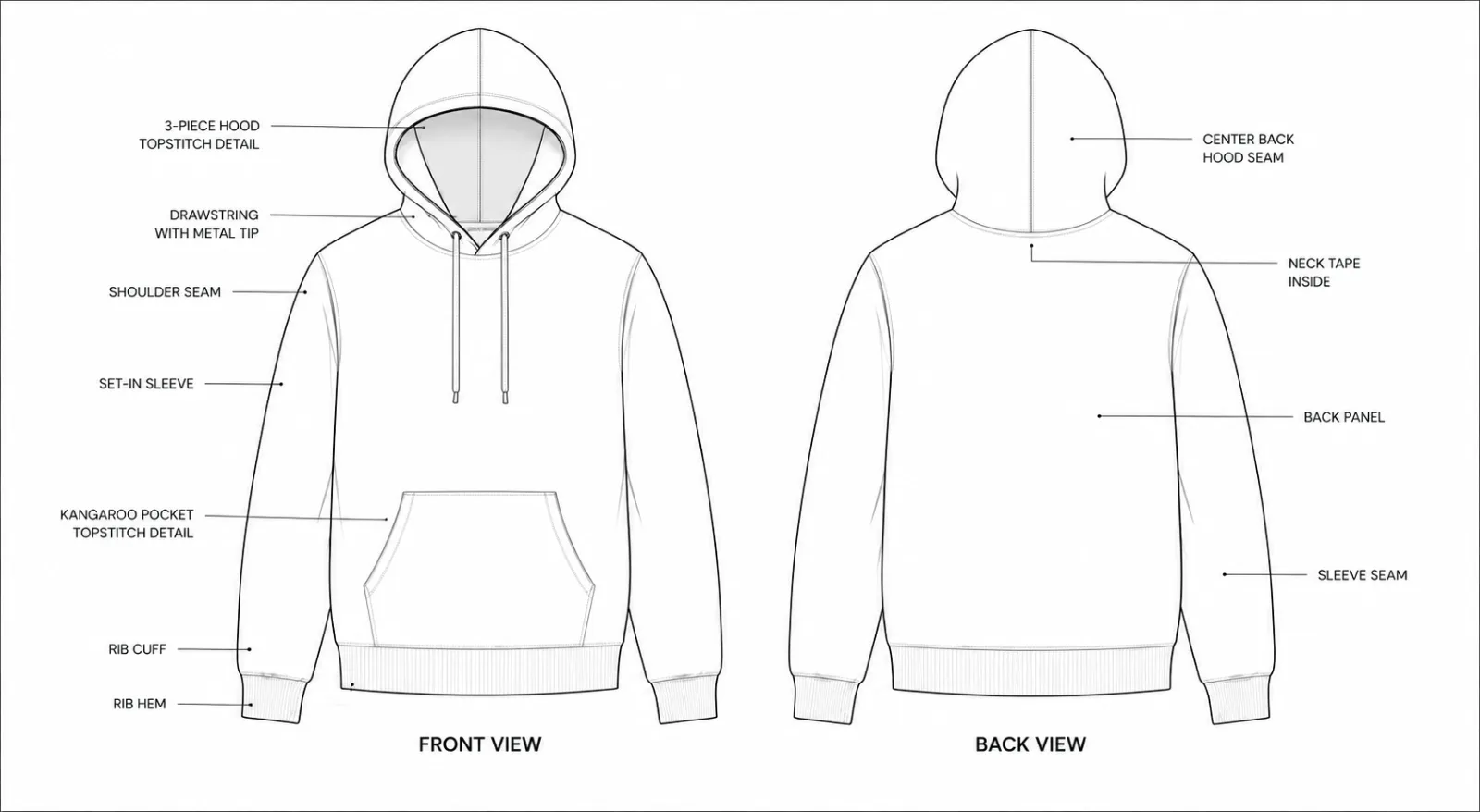
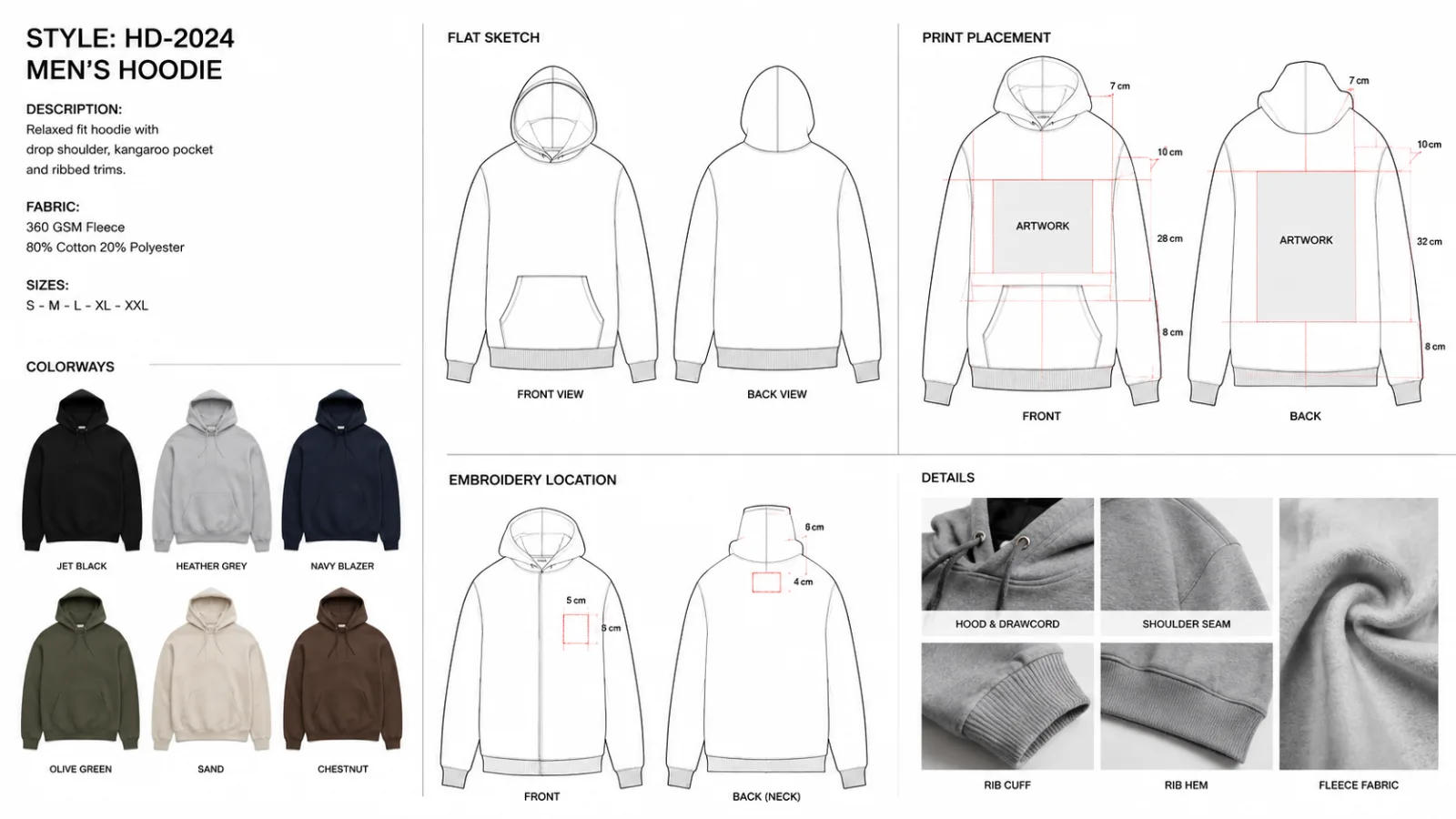
Flat Sketches and Technical Drawings
Flat sketches show the garment from the front and back. These sketches should clearly highlight design details in the tech pack.
- Seam lines
- Paneling
- Pocket shapes
- Collar and cuff details
- Stitching locations
- Hardware placement
Technical drawings are more useful for production than fashion illustrations because they emphasize construction, not styling.
Measurement Spec Sheet and Points of Measure
The measurement spec sheet is the core of production accuracy.
It should include:
- Points of measure with clear definitions
- Measurement chart for all sizes
- Tolerance range for each measurement
- Notes on how measurements are taken (flat, relaxed, stretched)
Points of measure must be precise. For example, “chest width” can be measured in different ways. The tech pack should define exactly how.
This prevents bulk production size drift.
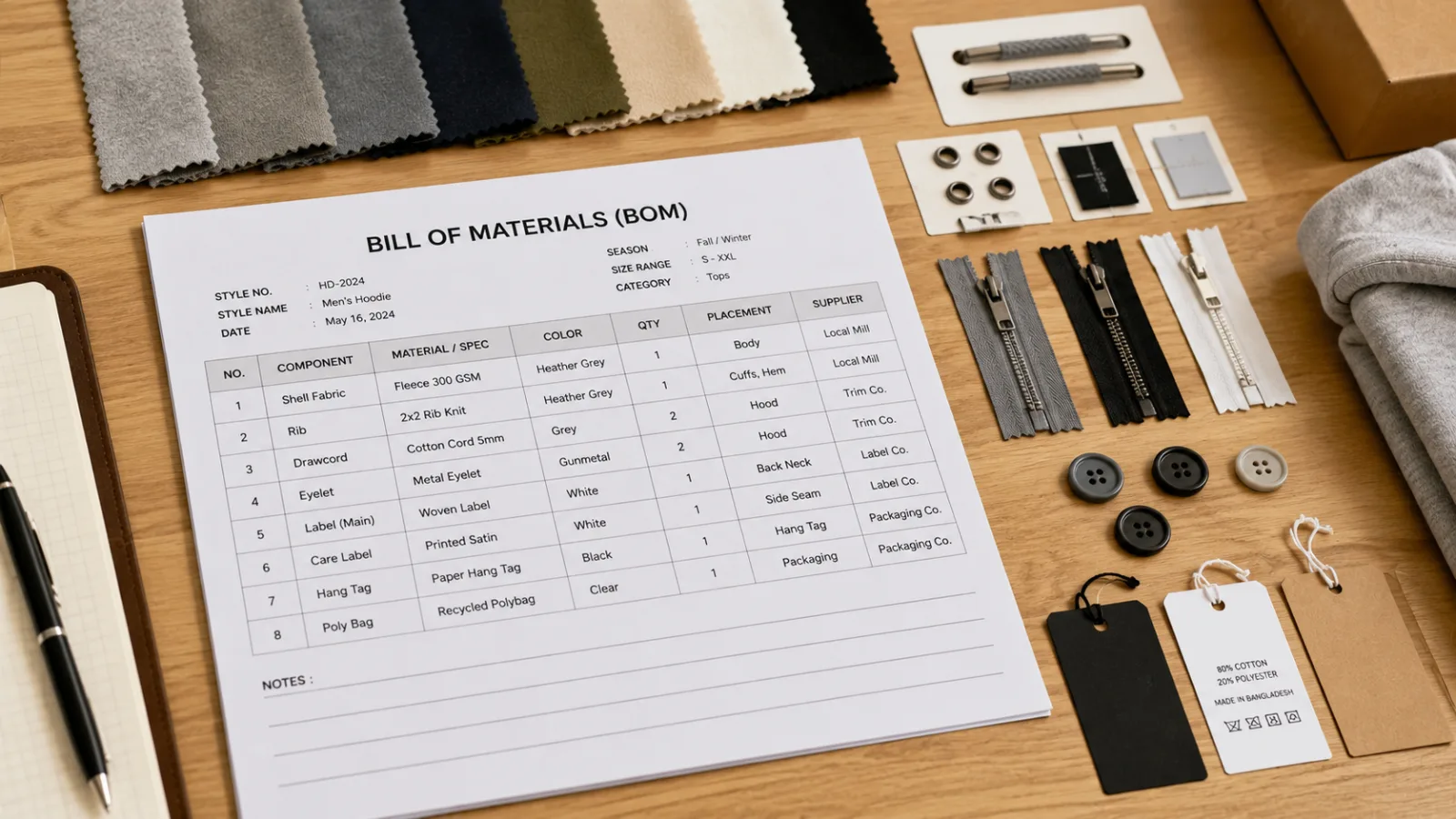
Bill of Materials (BOM)
A BOM is the complete list of materials needed to produce the garment.
It includes:
- Main fabric name, composition, GSM, width, finish
- Rib, lining, pocketing fabric details
- Thread type and color
- Labels: main label, size label, care label
- Trims: buttons, zippers, snaps, drawcords
- Packaging: polybag, carton, stickers, hangtags
The BOM prevents mistakes like wrong trim selection or missing materials, which can delay production.
Construction Details and Sewing Instructions
This section defines how the garment should be sewn.
Include details like:
- Stitch type (single needle, overlock, coverstitch)
- Seam allowance requirements
- Stitch density guidelines
- Reinforcement points such as bar tacks
- Hem finishing method
- Topstitch placement
Without these notes, factories may choose easier methods that reduce durability or change the garment look.
Colorways and Artwork Placement
If your garment includes multiple colors or prints, the tech pack should include:
- Color codes or lab dip references
- Placement diagrams for prints and embroidery
- Artwork file requirements
- Size and position measurements
- Pantone references, if needed
This prevents print misplacement, wrong color matching, and inconsistent logo sizing across sizes.
Labeling and Packaging Instructions
Many brands forget this part. But packaging errors create fulfillment issues and bad customer perception.
Tech packs should define:
- Neck label size and placement
- Care label content and placement
- Hangtag attachment method
- Folding requirements
- Polybag size and warning label
- Carton packing ratio, carton labeling, and tech pack template
This ensures consistent unboxing experience and reduces warehouse confusion.
Fit, Function, and Performance Notes
If the garment has specific performance expectations, include them clearly.
Examples:
- Shrinkage target after wash
- Stretch recovery expectation
- Softness or brushing requirement for fleece
- Anti-pilling treatment requirement
- Water repellency requirement for outerwear
This helps mills and factories choose the correct finishing and ensures consistent bulk performance.
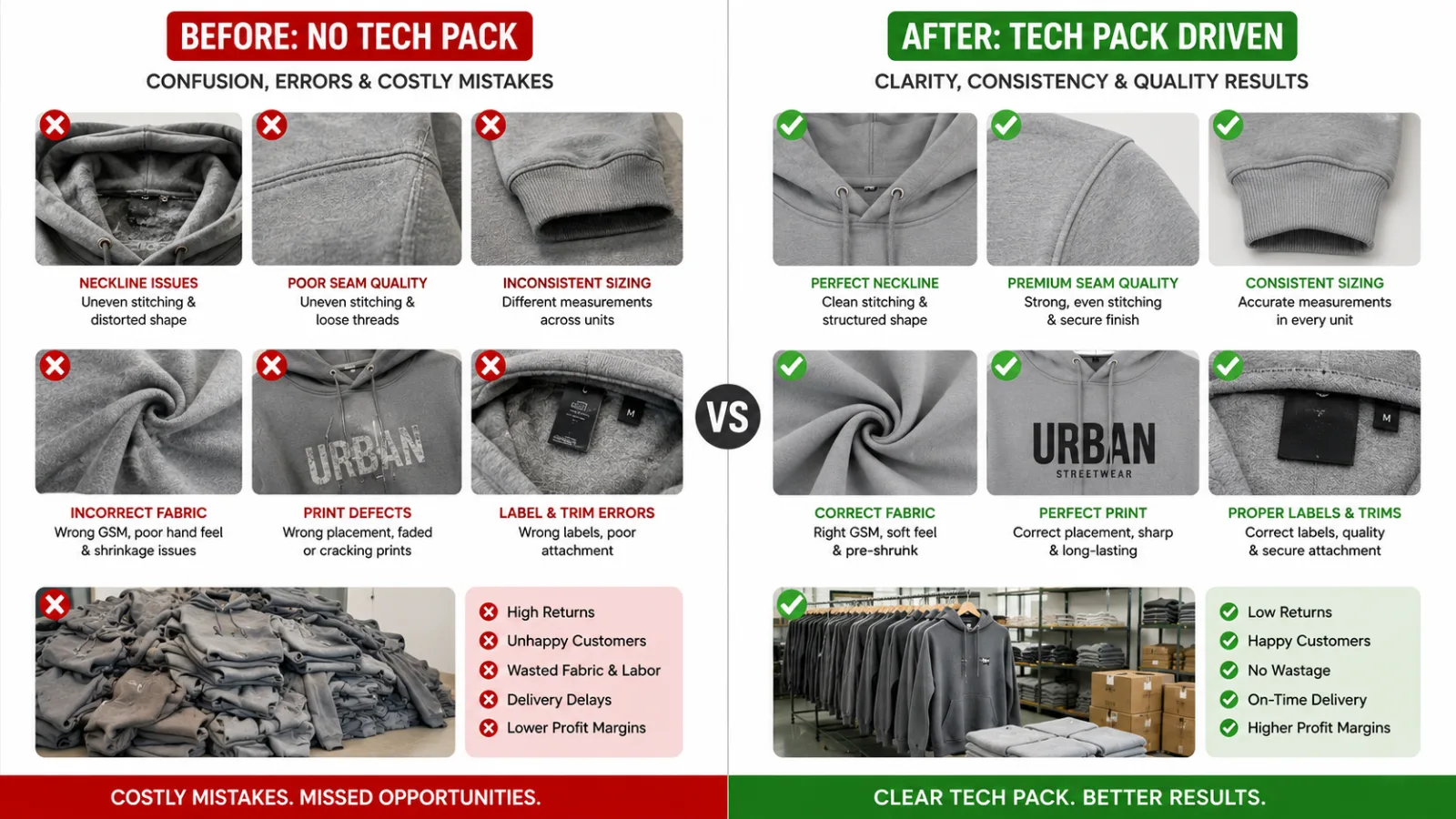
Tech Packs Reduce Production Errors Brands See Most Often
Here are the common production problems tech packs prevent.
Wrong measurements and inconsistent sizing
Tech packs create a clear spec standard and tolerance rules.
Incorrect fabric or GSM issues
The BOM defines exact fabric requirements.
Wrong stitching and seam finish
Construction notes define the exact seam type and finishing.
Label placement errors
Labeling instructions prevent placement and compliance mistakes.
Print and embroidery misplacement
Placement diagrams eliminate confusion.
Repeated questions from the factory team
A strong tech pack answers most questions before production begins.
Each avoided mistake reduces waste, cost, and time.
Tech Packs Improve Communication Between Brands and Manufacturers
Manufacturing communication often fails because brands and factories speak different languages.
A brand may say:
- “Make it more premium.”
- “Fix the fit” using the tech pack for design details.
- “Make the neckline tighter.”
Factories need measurable instructions:
- Change the neck opening by 1 cm
- Add double needle coverstitch at hem
- Increase GSM to 220
Tech packs convert feedback into measurable changes for fashion designers. They reduce misunderstandings and improve trust between brand and supplier. This is especially important in overseas manufacturing, where language differences can cause small misunderstandings that become big bulk problems.
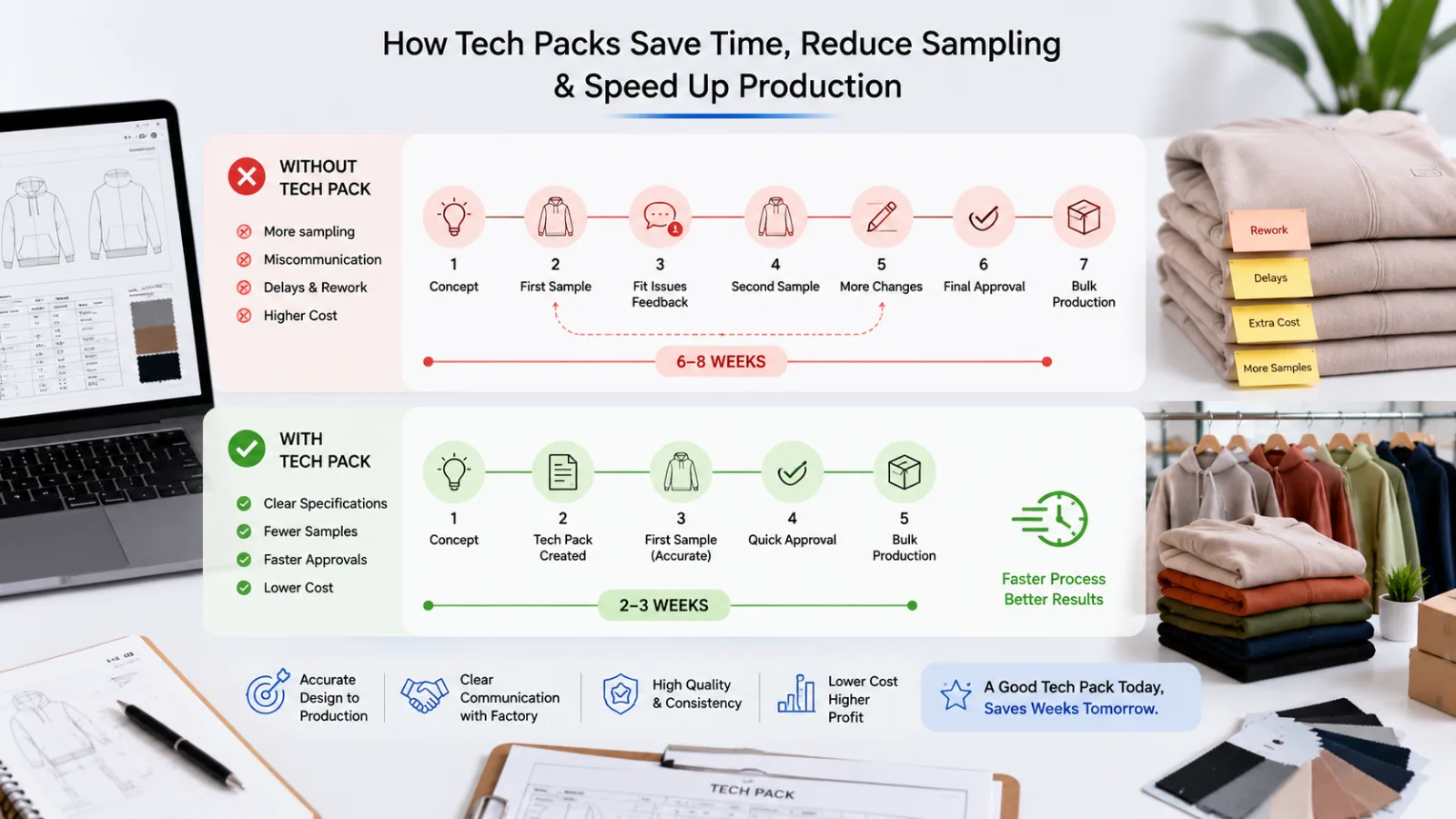
How Tech Packs Improve Speed to Market
Speed to market is not only about faster sewing. It is about fewer mistakes and fewer revisions.
With a strong tech pack:
- Sampling becomes more accurate
- Revisions are clearer and faster
- Materials are booked correctly
- Production planning becomes smoother
- QC is aligned early with the use of a tech pack template.
- Bulk approvals happen faster
This reduces lead time and helps brands hit seasonal launch windows by utilizing comprehensive tech packs.
Apparel Manufacturing Partners That Use Structured Tech Packs
In modern apparel production, experienced manufacturing partners rely heavily on structured tech packs to maintain consistent product quality and production accuracy. Detailed tech packs allow manufacturers to clearly understand a brand’s design specifications, material requirements, construction details, and packaging standards before bulk production begins. This structured approach significantly reduces production errors and improves communication between brands and factories.
Many apparel brands work with manufacturing partners that integrate tech packs into every stage of product development. Companies such as ApparGlobal support clothing brands with product development, fabric sourcing, sampling, and scalable apparel manufacturing processes where tech packs play a central role in maintaining production consistency. By using structured technical documentation, manufacturers can translate design concepts into repeatable production standards that help brands maintain consistent sizing, materials, and finishing quality across multiple production runs.
For growing clothing brands, working with a manufacturing partner that values detailed technical documentation can make a major difference in production efficiency. When tech packs are integrated into the development and sampling process, it becomes easier to manage revisions, maintain quality control standards, and ensure that bulk production matches approved samples.
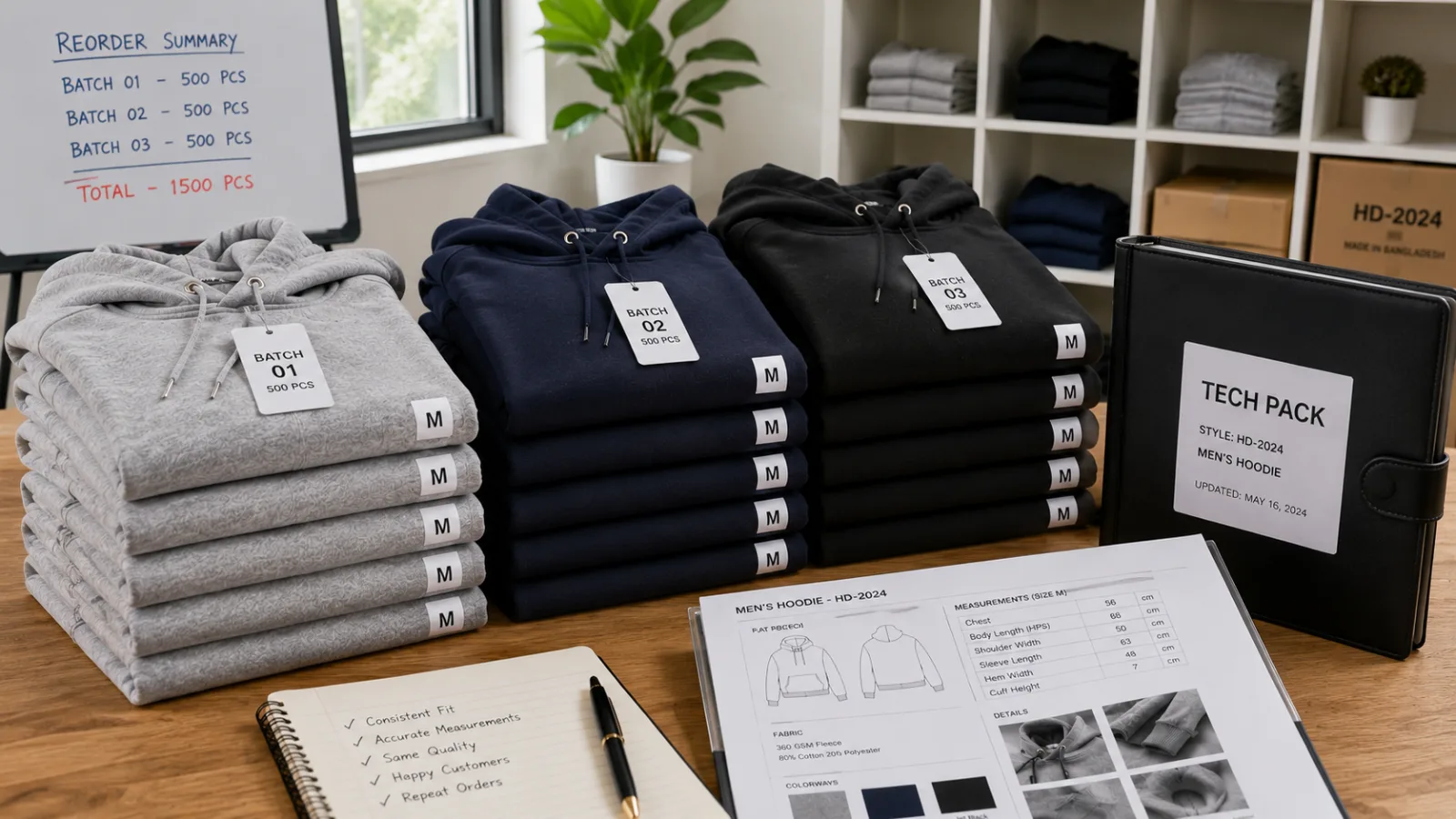
Tech Packs Are Essential for Scaling and Reorders
Scaling is where many brands fail. They launch once successfully, then struggle when they reorder.
Reorders require repeatability. A tech pack creates a reference standard that remains consistent even if:
- The factory team changes
- production line operators change
- Fabrics are sourced again
- New QC staff inspect the product
Without a tech pack, the reorder becomes a new project every time. With a tech pack, it becomes repeatable production. This is one of the most important reasons tech packs improve production accuracy long-term.
Tech Packs Support Sustainable Apparel Manufacturing
Sustainability is not only fabric choice. It is also waste reduction. Production mistakes create waste.
Tech packs support sustainability by:
- Reducing sampling waste through fewer revisions
- Reducing rejects and rework in bulk
- Improving cutting efficiency through clear patterns
- Improving material planning to avoid excess trims and fabric waste
- supporting traceability documentation through BOM clarity
A brand that uses strong tech packs often has fewer defects and fewer returns, which reduces environmental impact across the supply chain and supports fashion designers.
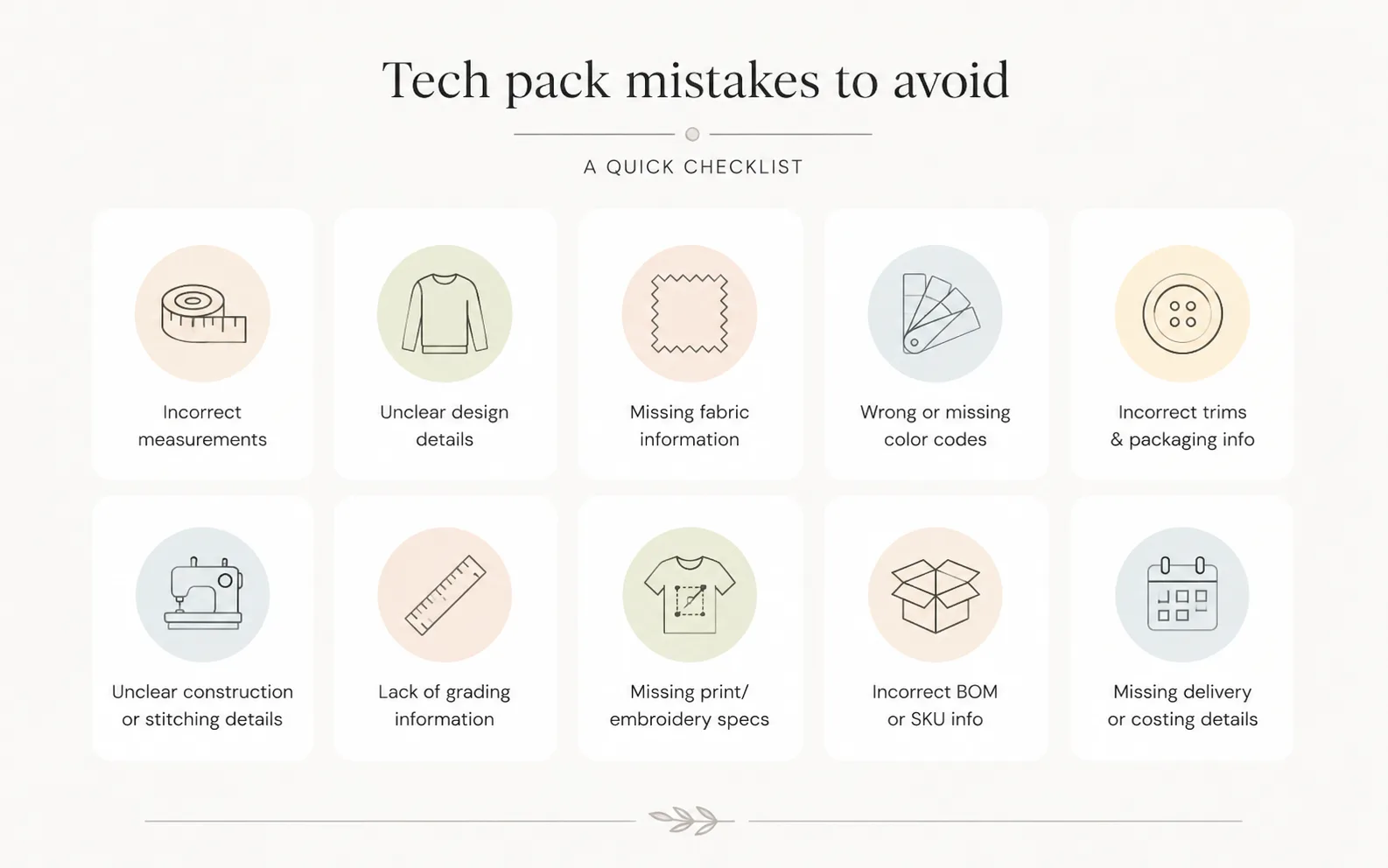
Common Tech Pack Mistakes to Avoid
Even brands that use tech packs sometimes make them weak. Avoid these mistakes:
- Missing measurement tolerances
- Unclear points of measure definitions
- No BOM detail for fabric finish and GSM
- Vague construction notes without stitch types
- Missing label, packaging instructions, and design details
- Not updating tech pack after sample changes
- Not including artwork placement measurements
- Sending low-quality sketches or unclear diagrams
Tech packs must be treated as living documents. Every approved change must be updated before bulk production.
Best Practices for Creating Tech Packs That Factories Love
If you want factories to produce accurately, make your tech pack easy to follow.
Best practices include:
- Use clear page structure and consistent formatting
- Add reference photos for tricky construction points
- Label everything in simple production language
- Include tolerances and measurement instructions
- Include stitch type references or diagrams
- Provide artwork files in the correct formats and sizes
- Confirm fabric and trim availability early
- Keep version control, so the factory always uses the latest pack
When factories love your tech pack, production becomes easier for everyone.
Tech Pack FAQ for Apparel Brands
Do small brands need tech packs?
Yes, tech packs are used to streamline the process. Startups need tech packs even more because they cannot afford costly mistakes. Tech packs reduce risk and protect small budgets.
Can a factory create my tech pack?
Some factories can help, but brands should still own and control the tech pack. It defines your product standard.
What software is used for tech packs?
Many brands use templates, spreadsheets, and design tools. The key is clarity, not the software.
How detailed should a tech pack be?
It should be detailed enough that a factory can produce without guessing. More clarity means fewer mistakes.
When should I update a tech pack?
Update it after every approved change during sampling. The final tech pack should match the approved pre-production sample.

Streamline Your Design Process With Our Free Tech Pack Template
Streamline your design process with our free professional tech pack, a comprehensive document that brings clarity to your design specifications and helps you refine ideas from concept to execution. This ready-to-use template includes detailed measurements, material callouts, and a clear column layout so every stakeholder sees the same information and you can finalize decisions faster.
Whether you’re a freelancer working with independent labels or a team preparing samples for a major retailer, the pack covers construction, assembly, and packing information required to move designs into mass production. Smart fields in the file automatically populate across pages to reduce errors and save time. Adopting this tech pack empowers the modern fashion industry professional to communicate precisely, reduce costly revisions, and accelerate the path from prototype to production.
Final Thoughts: Tech Packs Are the Key to Production Accuracy
Tech packs improve apparel production accuracy because they turn design into measurable instructions. They reduce guesswork, shorten sampling cycles, improve communication, strengthen QC, and make production repeatable. For brands, tech packs are not paperwork. They are a system for consistent quality and long-term scalability. If you want fewer mistakes, fewer delays, and better bulk production outcomes, start with a strong tech pack.