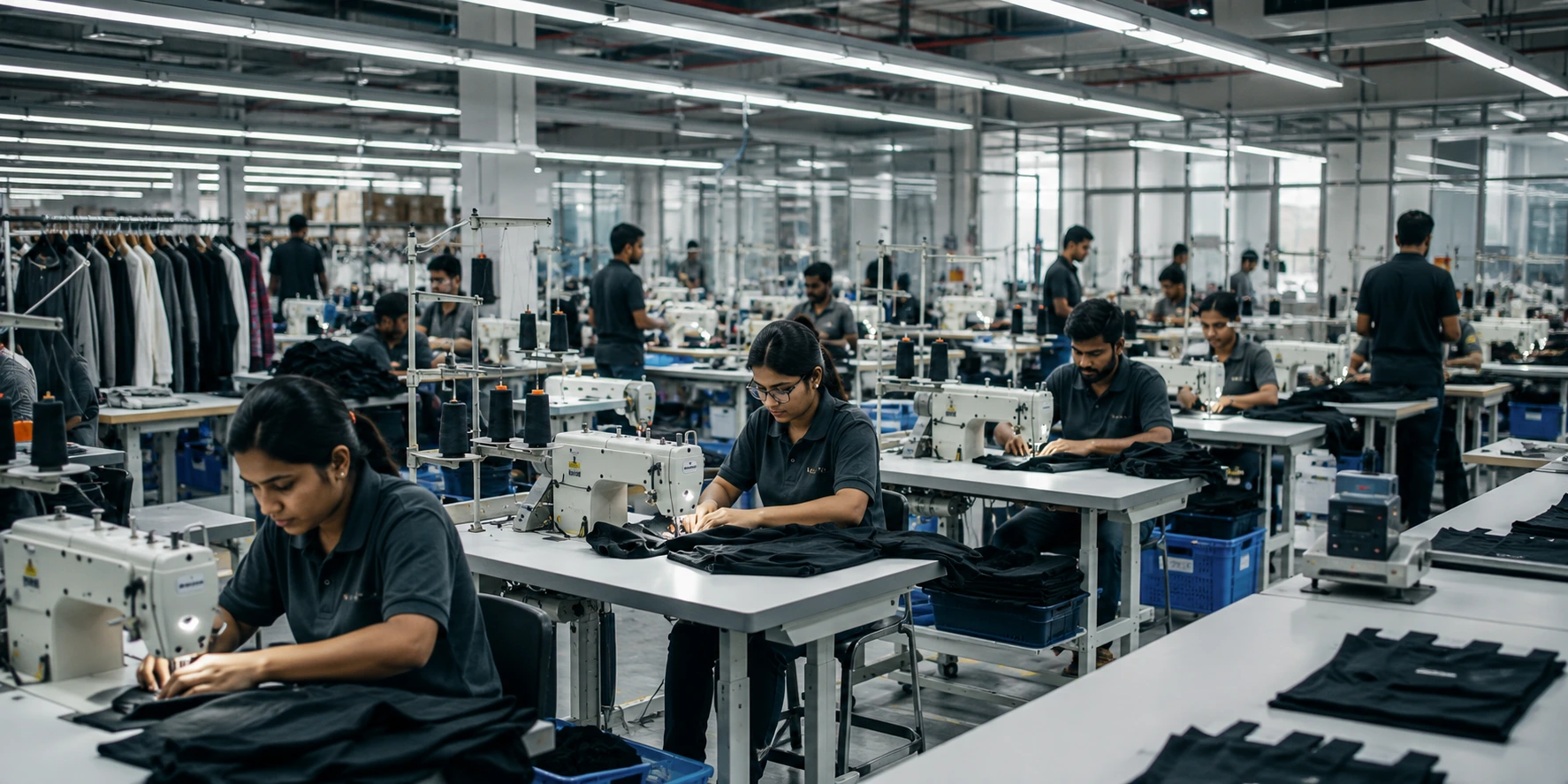
A comprehensive guide to CMT (Cut, Make, Trim) manufacturing. Learn how this production model works, what you need to provide, and how to manage your supply chain effectively.
A Cut, Make, Trim (CMT) manufacturer is a garment factory that primarily provides the labor and production services to cut fabric, sew garments, and finish them for shipment. In most CMT setups, the buyer provides the fabric and trims, along with the tech pack, patterns, grading, and production instructions. The factory focuses on execution, efficiency, and workmanship, rather than sourcing materials. If you are building an apparel brand, sourcing team, or buying-house operation, you will quickly hear terms like CMT, FOB, OEM, and full package manufacturing. These models look similar on the surface, but they change everything about your costs, lead times, quality responsibility, and supply chain control.
This guide explains what a CMT manufacturer is, how it works, what you must provide, how pricing is calculated, when CMT makes sense, and how to avoid common mistakes when working with CMT factories in Bangladesh and other manufacturing hubs.
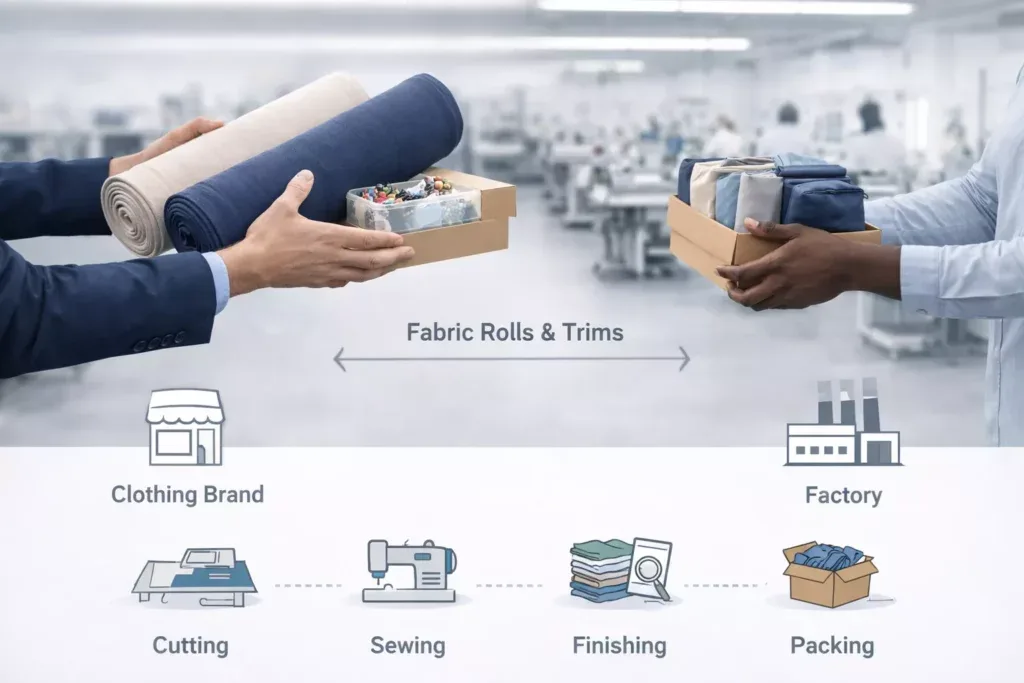
What Is a Cut, Make, Trim (CMT) Manufacturer? (Definition)
A Cut, Make, Trim (CMT) manufacturer is a garment factory that produces clothing using buyer-supplied fabrics and trims, focusing on cutting fabric, sewing garment components together, attaching trims such as labels or buttons, and finishing the product for shipment according to the buyer's technical specifications.
Unlike full-package or FOB manufacturers that source materials themselves, CMT factories mainly provide production expertise and labor, while the buyer maintains control over the material sourcing process.
This manufacturing model is widely used by apparel brands that want greater control over fabric quality, trim sourcing, and overall product cost.
Global Apparel Manufacturing and the Role of CMT
The apparel industry operates at an enormous global scale. Industry estimates suggest that more than 100 billion garments are produced worldwide every year, making clothing manufacturing one of the largest industrial sectors in the global economy.
At the same time, modern fashion supply chains involve multiple specialized partners including textile mills, trim suppliers, garment factories, washing facilities, and logistics providers. Within this complex network, Cut, Make, Trim (CMT) manufacturers play an important role by focusing specifically on garment assembly and production efficiency rather than raw material sourcing.
In major manufacturing hubs such as Bangladesh, Vietnam, China, and India, thousands of factories operate using the CMT model. This allows international apparel brands to control fabric sourcing directly from textile mills while relying on experienced factories to manage cutting, sewing, finishing, and packing operations.
Because garment production operates at such large volumes, even small improvements in manufacturing efficiency or quality control can have a significant impact on costs, delivery timelines, and overall supply chain performance.
Core Stages of CMT Production
A CMT manufacturer is a garment production partner that handles three core stages:
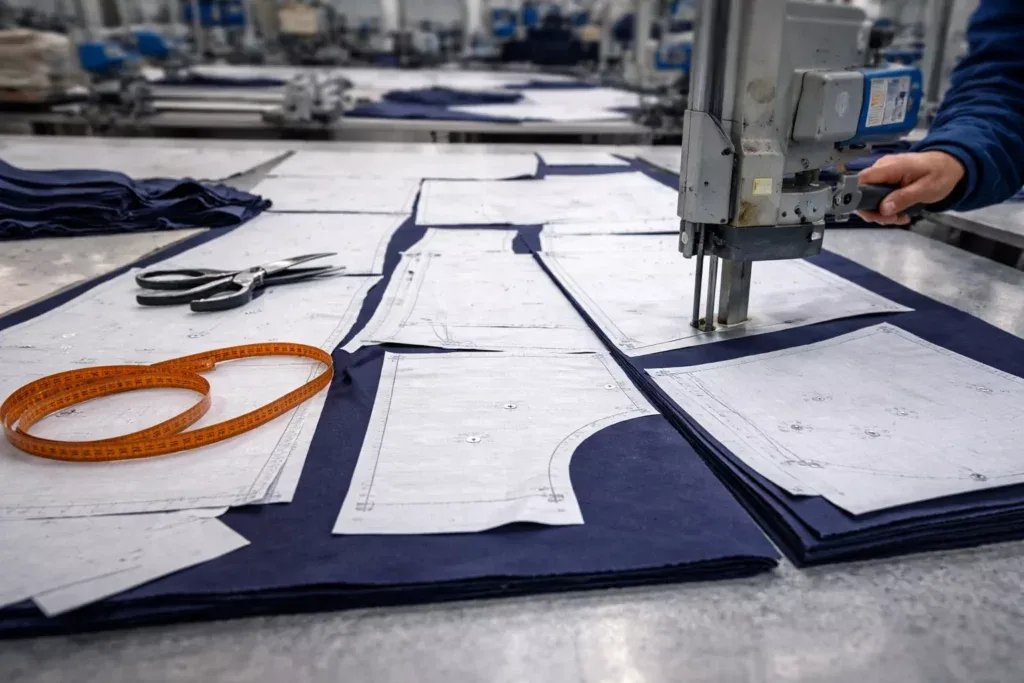
- Cut: Cutting fabric into pattern pieces
- Make: Sewing the garment panels into finished products
- Trim: Attaching trims and completing finishing details, then preparing garments for packing
In many CMT arrangements, the factory does not source fabric, trims, labels, packaging, or wash chemicals. Instead, it works from buyer-supplied materials and follows the buyer’s approved specifications.
CMT is often described as a “labor-only” or “production-only” manufacturing model, but in practice, it can still include additional services like quality control checks, washing coordination (as a service), pressing, packing, and export carton preparation. The key difference is material responsibility: in CMT, the buyer controls sourcing.
Defining CMT Clothing Manufacturing
A CMT garment operation refers to a cut-make-trim approach where the manufacturer handles the make and trim stages of the manufacturing process after receiving fabric and patterns. CMT clothing manufacturing is ideal when your manufacturer for your brand focuses on pattern making, technical execution, and clothing production without providing raw materials. In the fashion industry, the difference between CMT and full production or full package production (FPP clothing) revolves around whether fabric selection and freight are included.
A reliable CMT clothing manufacturer requires clear specs, minimum order quantities, and effective communication. Brands with a small order or who want us as your CMT benefit from flexible production model options: choose CMT or FPP depending on budget and control. For help choosing a partner or arranging freight, contact us.
The Importance of “Trim” in Apparel
In apparel production, “trim” is a broad term that can include:
- Buttons, zippers, snaps, rivets
- Labels and hangtags
- Threads and elastics
- Drawcords and stoppers
- Interlining and fusing materials
- Packaging items like polybags, stickers, tissue paper
In CMT, trims are usually supplied by the buyer or nominated suppliers. The factory is responsible for correct attachment, placement, and workmanship based on your tech pack and approvals.
The “trim” part of CMT matters because trims often create the most visible and expensive production errors, like wrong labels, incorrect zipper color, missing spare buttons, or incorrect barcode stickers.
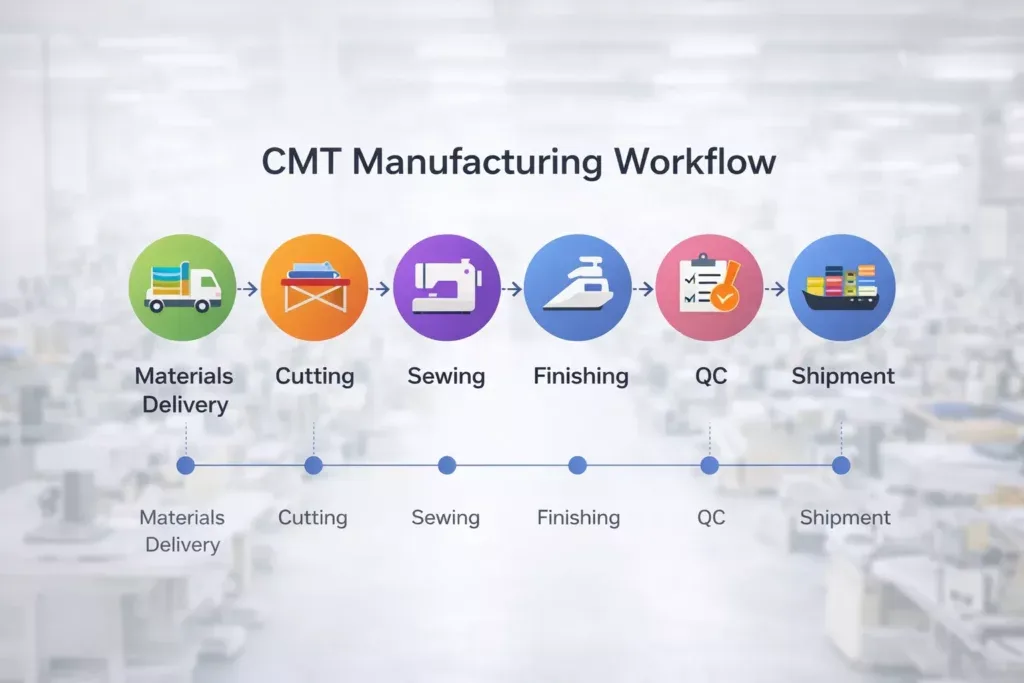
How CMT Manufacturing Works: The Real Production Flow
Even though the factory mainly provides cut, sew, and finish, CMT production still follows a structured flow. Understanding this flow helps you prevent delays and avoid blaming the factory for responsibilities that belong to the buyer.
Production Flow in a Typical CMT Setup
- Buyer finalizes tech pack, size specs, and approved samples
- Buyer arranges fabric and trims and delivers them to the factory
- Factory performs fabric inspection (often 4-point system) and reports issues
- Factory creates markers and cutting plan based on approved patterns and sizes
- Cutting section prepares cut panels and bundles for sewing lines
- Sewing lines assemble garments and attach trims
- Inline quality checks catch workmanship issues early
- Finishing handles thread trimming, pressing, measurement checks, and packing
- Final inspection confirms AQL or buyer QC standard
- Garments are packed in export cartons and prepared for shipment
The factory’s strength in CMT is execution: production efficiency, sewing quality, finishing discipline, and packing accuracy. Your strength as the buyer is planning: materials, specifications, approvals, and supply chain timing.
What You Must Provide to a CMT Manufacturer
This is where many brands struggle. With CMT, you must be prepared with complete production inputs. If anything is missing or late, production pauses.
Essential Buyer Inputs for CMT Production
- Approved tech pack with construction details
- Patterns, grading, and marker rules (or arranged through a pattern service)
- Size specs and measurement tolerances
- Bill of materials (BOM) and trim approvals
- Fabric rolls with shade continuity plan
- Trims and labels (main label, care label, size label)
- Artwork approvals (print placement, embroidery files)
- Packaging requirements (polybags, stickers, carton marks)
- Inspection standard (AQL level or brand-specific QC rules)
- Production timeline and shipment plan
Practical Reality
CMT factories can often help you identify missing elements, but they cannot guess your brand standards. The more complete your package is, the smoother the execution will be.
CMT vs. White-Label Clothing
The main difference between a CMT clothing manufacturer and white-label clothing lies in the production process and who controls fabric selection and design. Cut-make-trim, pattern making, and technical execution are core to CMT clothing production, where a CMT clothing factory makes and trims components provided by a brand, while full production or full package production (often called FPP) means the manufacturer handles everything from fabric sourcing to freight and shipping the final product.
For fashion brands and streetwear labels choosing a manufacturer for your brand, deciding between CMT or FPP models depends on production capabilities, minimum order requirements, and overall clothing production needs. Working with a CMT clothing partner lets designers retain control while leveraging well-established clothing factories. If you want guidance, contact us to align your production model with your needs.
What a CMT Manufacturer Typically Provides
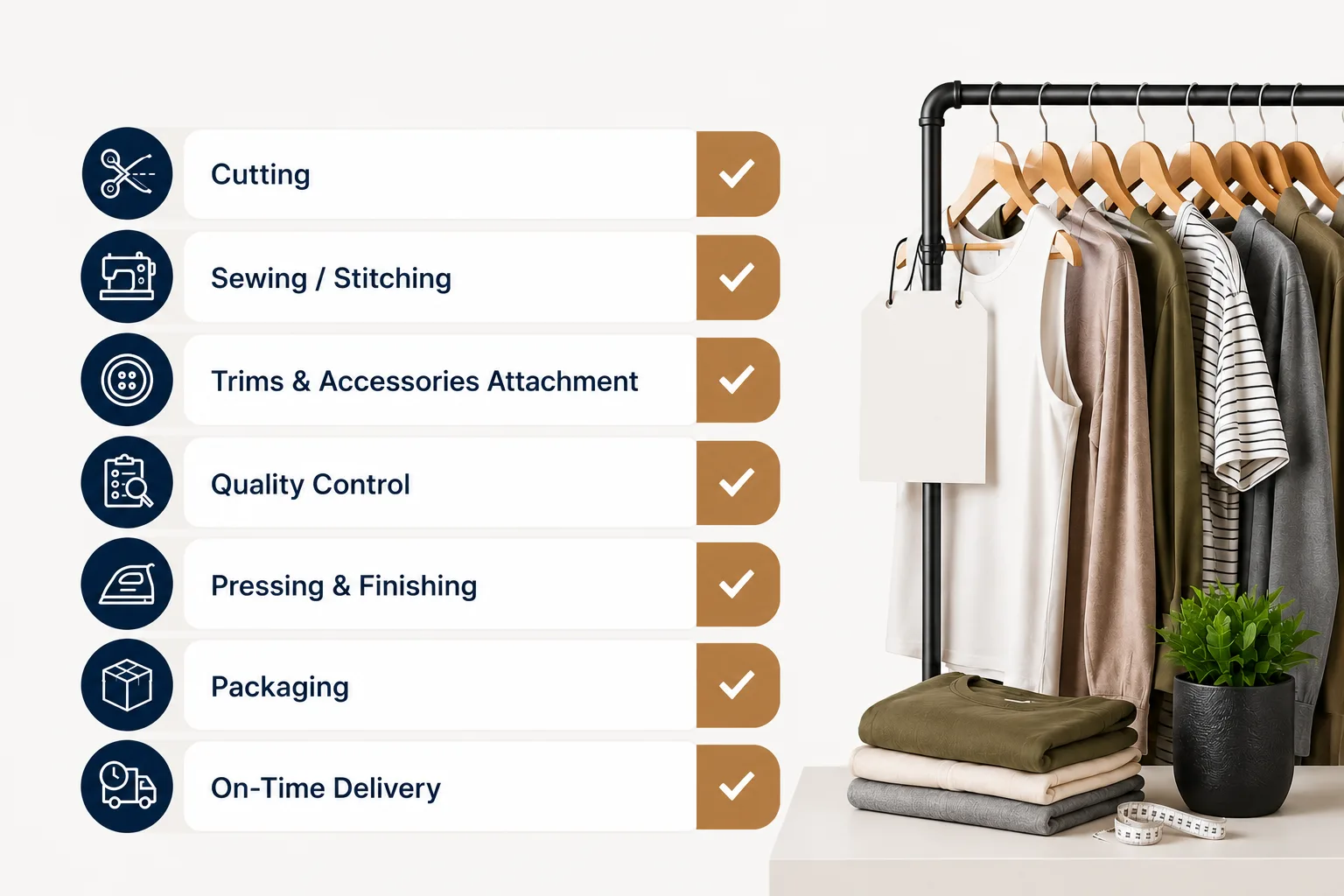
CMT factories focus on production services. Depending on the factory and negotiation, the scope may include:
Standard CMT Services
- Cutting and bundling
- Sewing and assembly
- Trim attachment (buttons, zippers, labels)
- Thread trimming and finishing
- Pressing and folding
- Basic packaging and carton packing (using buyer materials)
- In-line and final QC based on agreed standard
Optional Add-On Services
- Sample development support
- Washing coordination through partner laundries
- Embellishment coordination (print, embroidery) as a service
- Third-party inspection coordination
- Warehousing and shipment coordination support
The important point is clarity. Always define what “CMT cost” includes, because one factory may include packing labor and another may charge separately.
Who Typically Works with CMT Clothing Suppliers?
Designers, small brands, and startups often partner with CMT clothing suppliers when launching a clothing line, because these suppliers handle cutting, sewing, and finishing while allowing creative teams to retain control. Independent designers, private-label retailers, and boutique owners value the ability to specify fabric options and request bespoke fittings; sports brands and sportswear manufacturers also use CMT shops to scale prototypes into runs without ceding design ownership.
Technical designers, pattern makers, and production managers work closely with CMT partners, providing detailed tech packs and samples and overseeing production so garments are made according to your instructions. Sourcing agents and brand operations leads coordinate timelines, quality checks, and logistics, making CMT an efficient solution for anyone who needs expert sewing and finishing while keeping design, materials, and compliance control.
CMT vs. FOB vs. Full Package
These three models are often confused. They are not the same.
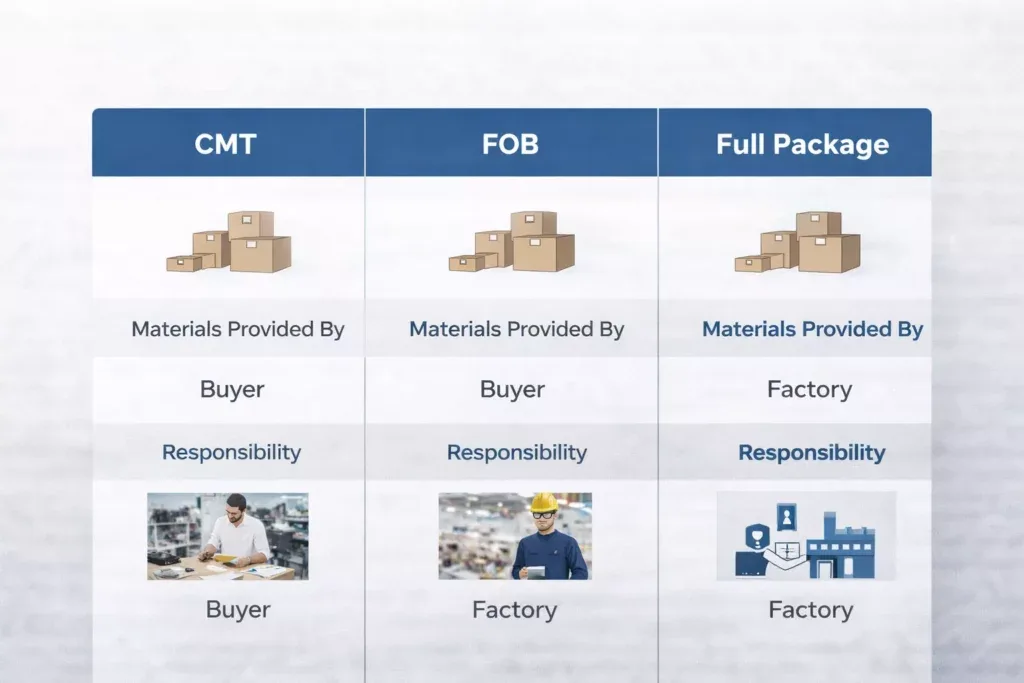
CMT Manufacturing
- Buyer supplies fabric and trims
- Factory supplies labor, production execution, and finishing
- Buyer controls sourcing and materials risk
FOB Manufacturing
- Factory (or vendor) sources fabric and trims and delivers finished goods “free on board”
- Vendor manages materials supply chain
- Buyer pays a single price that includes materials and production
Full Package Manufacturing
- Factory handles product development, sourcing, production, QC, packing, and often shipping coordination
- Best for brands that want one accountable partner across the chain
In simple terms: CMT = you bring materials; FOB/full package = the factory brings materials.
Difference between CMT and FPP
CMT and FPP refer to different methods used in trading and order execution. CMT emphasizes executing orders at prevailing market prices with a focus on speed and liquidity, often suited for active traders seeking immediate fills; FPP (Fixed Price Protocol) sets a predetermined execution price, prioritizing price certainty and minimizing slippage for investors who prefer predictable outcomes over instantaneous execution.
In practice, CMT can result in variable execution prices due to rapid market movements, while FPP locks the trade at the agreed price but may require waiting for matching counterparties or accepting limited availability.
When CMT Manufacturing Makes Sense
CMT is not “better” or “worse” than FOB. It is a strategic choice based on your supply chain maturity.
CMT is a good fit if:
- You have reliable fabric and trim suppliers
- You want tighter control over material quality and cost
- You are producing special fabrics that factories cannot source easily
- You have strict brand standards and prefer nominated suppliers
- You are scaling and want to reduce material markups
- You already have patterns, grading, and production specs ready
Many larger brands prefer CMT because it gives them purchasing power and deeper control over materials, which can improve consistency across multiple factories.
When CMT Is Not the Best Option
CMT can become risky if you are not prepared. It pushes more responsibility onto the buyer.
CMT may not be ideal if:
- You do not have sourcing experience for fabric and trims
- You cannot manage lead times, shade continuity, and MOQ issues
- Your tech pack and patterns are incomplete
- You are running your first production order and need guidance
- You want one party accountable for material defects
- You are producing complex outerwear requiring specialized sourcing
For new brands, full package or FOB is often easier because the vendor handles materials and manages upstream complexity. But if your goal is long-term control and scale, CMT can become powerful once your systems mature.

How CMT Pricing Works
CMT pricing is usually quoted as a straightforward estimate, but it can vary based on the complexity of the final product. CMT is charged per piece. Since fabric is excluded, the price focuses on labor and factory overhead.
What drives CMT cost per piece?
- Garment complexity and number of operations
- Stitch type and seam finishing requirements
- Number of pattern pieces and panels
- Trim count and trim attachment time
- Embellishments (prints, embroidery) if handled by the factory
- Washing processes (enzyme wash, stone wash, garment dye)
- Quality standard level and inspection workload
- SMV (Standard Minute Value) and line efficiency
- Order quantity and production schedule urgency
- Packing complexity
A simple basic t-shirt has fewer operations than a denim jacket, so its CMT cost is lower. A technical jacket with multiple pockets, lining, and zippers requires more minutes and higher skill, so its CMT cost increases.
The Role of SMV in CMT Manufacturing
Many factories calculate CMT using SMV, which stands for Standard Minute Value. It is the estimated number of minutes required to produce one garment based on its operations. Higher SMV means more labor minutes per piece, which influences the final quote.
Quality Responsibilities in CMT
This is one of the most important parts of the CMT model.
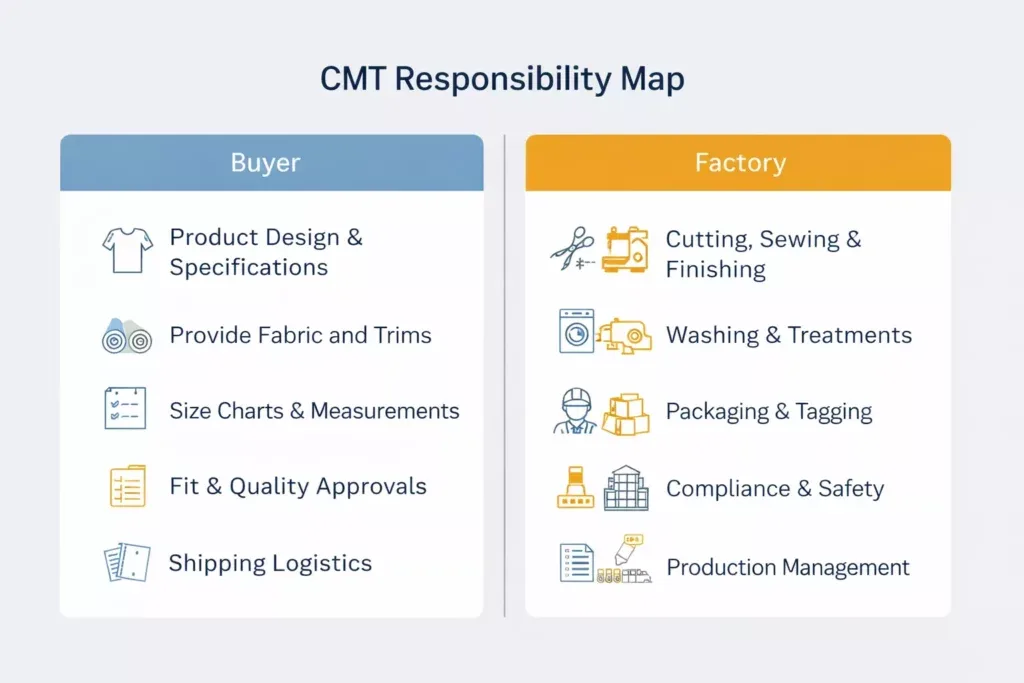
Buyer is responsible for:
- Fabric quality, defects, shrinkage risk
- Shade continuity between rolls and lots
- Trim quality and compatibility
- Label compliance accuracy
- Artwork file correctness and approvals
- Timely material delivery
Factory is responsible for:
- Cutting accuracy and pattern adherence
- Sewing workmanship and seam durability
- Correct trim attachment and placement
- Measurement compliance based on provided specs
- Finishing cleanliness and packing accuracy
A common mistake is assuming the factory will “solve” fabric problems. In CMT, the clothing factory can support inspection and reporting, but the buyer owns sourcing decisions.
CMT Manufacturing in Bangladesh
Bangladesh is one of the world’s biggest garment manufacturing hubs, especially for knitwear, denim, and basic apparel categories. CMT is common because many factories specialize in production execution at scale, and large buyers often manage fabric sourcing through nominated mills.
Reasons CMT is common in Bangladesh
- Strong sewing capacity and production scale
- Specialization in specific product categories
- Established compliance and audit readiness
- Access to trim and accessory ecosystems
- Experienced merchandising and production planning talent
For buyers, Bangladesh CMT can be highly competitive when your material supply chain is already organized.
Common Risks When Working With a CMT Factory
CMT can work extremely well, but most problems come from planning gaps.
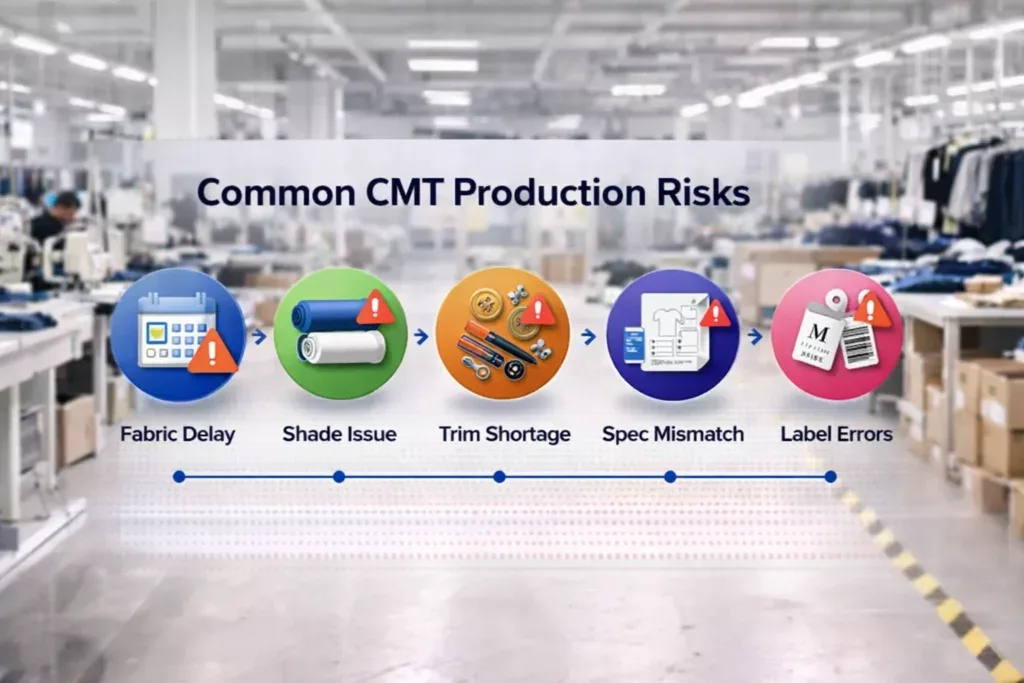
Frequent CMT risks
- Late fabric arrival delaying cutting schedule
- Shade variation due to mixed fabric lots
- Trim shortages stopping finishing and packing
- Incomplete tech packs causing production confusion
- Pattern or grading errors causing measurement issues
- Incorrect label data leading to compliance problems
- No clear agreement on rework responsibilities
- Weak inspection reporting until it is too late
The best way to reduce risk is to create a pre-production readiness checklist and confirm all materials and approvals before the factory starts cutting.
How to Choose the Right CMT Manufacturer
Not every factory that offers CMT will be a good match. You need to evaluate capabilities and systems, not just price.
Key factors to evaluate
- Product specialization (knit, woven, denim, outerwear)
- Quality systems (inline QC, final QC, defect tracking)
- Cutting accuracy and marker planning capability
- Sewing skill level and operator training
- Finishing quality and cleanliness standards
- Production capacity and realistic lead time promises
- Communication clarity with merchandisers
- Willingness to work with buyer-supplied materials responsibly
- Transparency in reporting issues early
- Compliance and workplace standards
A practical method
Ask the factory to explain how they handle fabric defects discovered during cutting, trim shortages during sewing, and measurement variation during inline inspection. Their answers will tell you if they operate with discipline or improvisation.
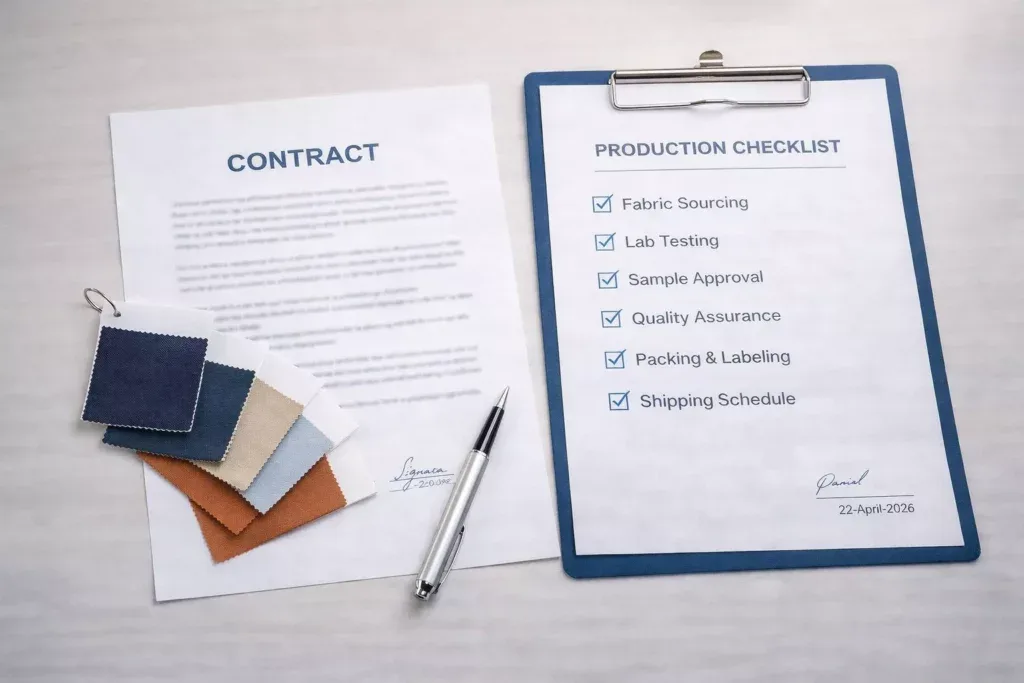
What to Include in a CMT Agreement
If you want fewer disputes, you need a clear scope agreement. Many issues happen because the buyer and factory assume different responsibilities.
CMT agreement checklist
- Exact product scope and construction reference
- Who provides fabric and trims and by what date
- Fabric inspection approach and reporting timeline
- Allowances for fabric defects and wastage
- Cutting approval process and marker utilization rules
- Sewing workmanship standards and QC standard
- Measurement tolerances and pass-fail rules
- Rework policy and who pays for rework labor
- Packing instruction details and who provides packaging
- Shipment timeline and late delivery consequences
- Inspection requirements (third-party, AQL level)
- Communication timeline for issues
Strong agreements reduce “surprise costs” during finishing and shipment weeks.
CMT vs. OEM vs. ODM
These terms overlap and confuse many buyers.
OEM (Original Equipment Manufacturer)
- Factory produces based on your design/spec
- Can be CMT or FOB depending on material responsibility
ODM (Original Design Manufacturer)
- Factory provides design options and produces
- Often full package or FOB because design and sourcing are integrated
CMT is not a design model. It is a production responsibility model. You can work with an OEM factory under CMT, but you still must supply materials.
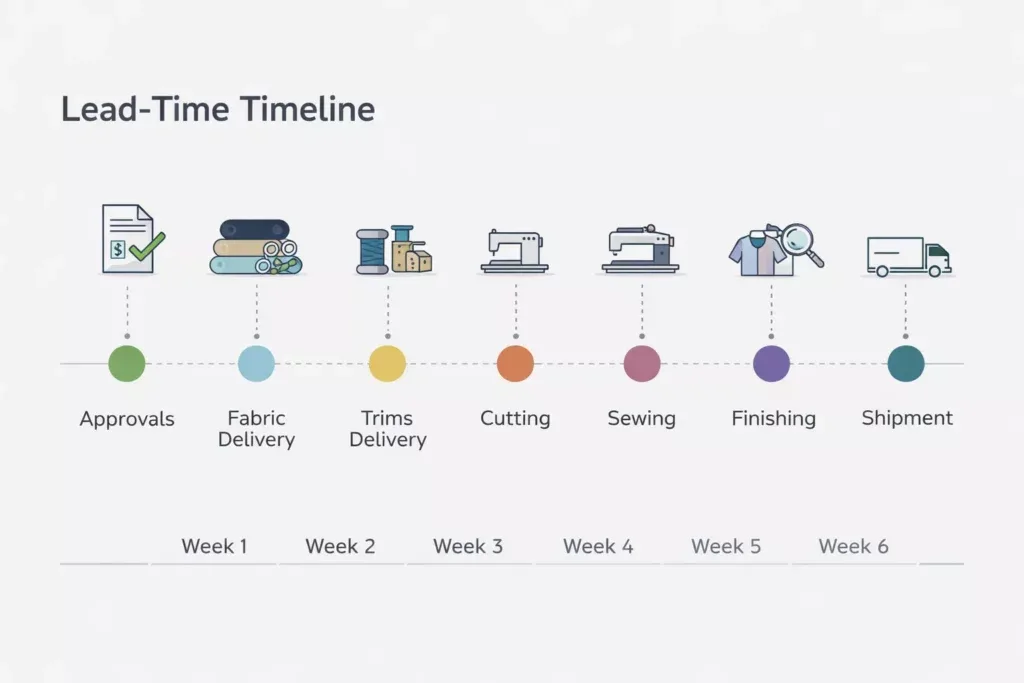
How CMT Impacts Lead Time
Many buyers assume CMT is always faster. It can be faster only if your materials are ready on time. Lead time is affected by fabric and trim lead times, approval timelines, production line booking, washing/embellishment, and inspection scheduling.
How Brands Reduce Risk in CMT Orders
Successful CMT buyers typically use the same discipline across every order. Best practices include pre-production meetings, locked delivery schedules, shade band approvals, inline measurement checks, and clear defect classification rules. This is how buyers keep control without creating tension.
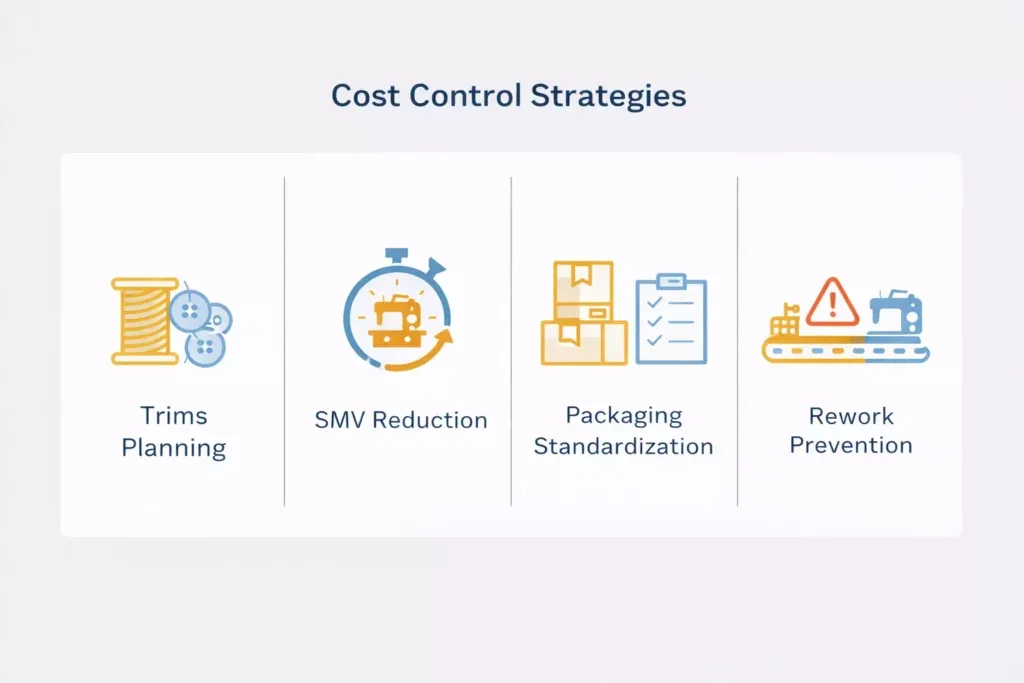
Cost Control Tips for CMT Buyers
CMT pricing can look simple, but hidden costs often appear when inputs are not planned. Strategies include consolidating trims early, using standardized labels, reducing unnecessary operations, and confirming packing methods early to avoid repacking labor.
Apparel Quality Control in CMT
Because you supply materials, you need stricter checkpoints. Focus QC on fabric inspection at receipt, trim verification, measurement control, label accuracy, and final random inspections. If you use a strong pre-shipment QC checklist, CMT can produce consistent results, even at large volumes.
ApparGlobal Internal Link Section
Many clothing brands start with FOB or full package, then move into working with a CMT clothing factory once they build stronger control over fabric and trim sourcing. Working with experienced manufacturing partners can make that transition smoother by aligning your tech pack, production planning, and quality systems before bulk cutting begins. Companies such as ApparGlobal support apparel brands with structured production workflows, clear quality checkpoints, and scalable manufacturing coordination designed for global buyers.

FAQs about CMT Garment Manufacturers
1. What is a CMT clothing manufacturer?
A CMT clothing manufacturer operates on the cut-make-trim model: you supply the fabric, trim, and designs, and the factory performs the cutting, sewing, and trimming. This differs from full package production (FPP), where the manufacturer handles sourcing.
2. When should a startup choose CMT over FPP?
Choose CMT when you want to retain control over fabric and trim selection, protect proprietary materials, or already have established suppliers. Choose FPP if you want a single point of contact for sourcing, production, and logistics.
3. What should be included in a tech pack for CMT?
Include detailed spec sheets, graded measurements, construction notes, trim placement, stitch types, tolerances, and clear flat sketches. Be explicit about the fabrics and trims you will source.
4. How do MOQs and lead times work?
MOQs are driven by production line efficiency. Lead times depend on factory capacity and your own procurement timeline. Always plan buffer time for fit iterations and quality checks.
5. What are the key steps in the production process?
Steps include approving patterns, providing materials, cutting, sewing, trimming, quality control, and packing. Clear documentation improves predictability.
6. How do I manage quality control?
Establish a QC plan defining tolerances and inspection frequency. Use standard AQL levels and consider third-party inspectors for impartial reports.
7. How do costs compare between CMT and FPP?
CMT often has lower per-piece costs, but you must account for your own procurement and logistics. FPP bundles these costs. Always run a landed-cost analysis.
8. How does IP protection work?
Use non-disclosure agreements and design ownership clauses. Limit the number of factories you share full design packs with and watermark your documents.
9. How do I choose the right supplier?
Evaluate based on product category experience, capacity, sample turnaround, and quality systems. Request references and verify compliance standards.
10. What are common pitfalls?
Pitfalls include unclear tech packs, underestimating lead times, and poor material quality. Avoid these by investing time in pre-production planning and clear agreements.
Conclusion
A Cut, Make, Trim (CMT) manufacturer is a garment production partner focused on cutting, sewing, finishing, and preparing garments using buyer-supplied fabric and trims. CMT can be a powerful model for brands and sourcing teams who want stronger control over materials, pricing, and consistency, but it also requires better planning, clearer documentation, and tighter supply chain management.
If you have reliable suppliers, complete tech packs, and disciplined approvals, CMT can deliver efficient production and strong workmanship at scale. If you are still building your sourcing system, FOB or full package may be easier until your operations become more mature. The best approach is the one that matches your brand’s current stage while protecting quality, timelines, and buyer expectations.