
Inventory can either help a clothing brand grow or quietly hold it back. When products sell at the right time, inventory turns into revenue, cash flow, customer satisfaction, and brand momentum. But when products sit too long in a warehouse, stockroom, retail store, or fulfillment center, they become a business problem. Unsold garments take up space, tie up cash, lose seasonal relevance, create storage costs, and force brands to make difficult decisions. This is why many clothing brands need to liquidate their inventory.
Inventory liquidation means selling excess, slow-moving, outdated, returned, or overstock products quickly, often at reduced prices or through alternative sales channels. For fashion brands, liquidation can happen through clearance sales, outlet channels, wholesale buyers, off-price retailers, sample sales, bundle deals, resale partners, donation programs, recycling channels, or inventory recovery companies.
Liquidation is sometimes seen as a sign of failure, but that is not always true. In fashion, inventory liquidation is often a necessary business tool. Even strong brands can overbuy, misread demand, face production delays, miss a seasonal window, or end up with products that no longer fit the next collection. The goal is not to avoid liquidation forever. The goal is to use it strategically so unsold stock does not damage the business.
The fashion industry has a serious excess inventory problem. Business of Fashion reported that excess stock in the fashion industry was estimated to be worth between $70 billion and $140 billion in sales in 2023, while other retail inventory resources have also highlighted billions of unsold items as a major industry challenge. This shows that inventory imbalance is not only a small-brand issue. It affects startups, mid-sized labels, retailers, and large fashion companies.
For clothing brands, liquidation is not just about discounting old products. It is about protecting cash flow, reducing waste, improving inventory health, freeing warehouse space, keeping customers engaged, and making better decisions for the next season. In this guide, we will explore seven important reasons why clothing brands need to liquidate their inventory and how to approach the process strategically.

What Does Inventory Liquidation Mean for Clothing Brands?
Inventory liquidation is the process of converting unsold or excess inventory into cash. In the clothing industry, this usually means selling products that are no longer moving at full price or no longer fit the brand’s current selling plan.
A brand may liquidate inventory for many reasons. The products may be seasonal. The size curve may be unbalanced. A color may not perform well. A style may have missed the trend window. A retailer may cancel an order. Returns may pile up. Packaging may change. A brand may rebrand or shift product direction. Or the company may simply need cash quickly.
Liquidation does not always mean selling at a loss. Sometimes it means accepting a lower margin to recover cash, avoid storage costs, and make room for new inventory. In some cases, liquidation can still be profitable if products were made with good margins or if the liquidation strategy is planned early.
Common Types of Clothing Inventory That Get Liquidated
Clothing brands often liquidate:
- Excess seasonal stock
- Old collection pieces
- Returned garments
- Overproduced sizes
- Slow-moving colors
- Discontinued styles
- Samples and showroom pieces
- Cancelled wholesale orders
- Packaging-change inventory
- Slightly imperfect items
- Private label surplus
- Deadstock apparel
- Warehouse clearance items
The key is to identify which inventory still has selling value and which inventory needs to move quickly before it loses more value.
Liquidation vs Clearance vs Markdown
These terms are related but slightly different. A markdown is a price reduction. Clearance is usually a public effort to sell older inventory at a discount. Liquidation is a broader strategy to convert excess stock into cash or remove it from active inventory. Liquidation may include clearance sales, wholesale lots, outlet sales, resale channels, donations, or recycling.

1. To Free Up Cash Flow for New Production
The first and most important reason clothing brands need to liquidate inventory is cash flow. Inventory is money sitting in physical form. Until those garments sell, the money used for fabric, trims, labor, packaging, shipping, warehousing, and marketing is locked inside unsold stock.
For small and growing clothing brands, this can become a serious problem. A brand may have a warehouse full of garments but not enough cash to produce the next collection, pay suppliers, run ads, reorder best sellers, improve packaging, or hire support. This is one of the most common reasons brands get stuck.
Cash flow is especially important in apparel because production often requires upfront investment. Suppliers usually ask for a deposit before production and balance payment before shipment. If too much money is trapped in old inventory, the brand may not have enough funds to develop new products.
Fashion inventory management guides often point out that knowing the true value of inventory helps brands plan purchases, markdowns, and cash flow more effectively. In other words, inventory is not just a warehouse issue. It is a financial management issue.
How Unsold Inventory Hurts Cash Flow
Imagine a brand produces 1,000 hoodies at a landed cost of $18 each. That means $18,000 is invested before the brand earns anything back. If only 400 hoodies sell at full price and 600 remain unsold, a large amount of capital is still trapped. The brand may feel profitable on paper but still struggle to pay for the next drop.
Liquidation helps unlock some of that trapped cash. Even if the brand sells remaining stock at a lower margin, it can recover money and use it for more productive activities.
Why Holding Inventory Too Long Can Be Risky
Some founders avoid liquidation because they do not want to “lose money.” But holding inventory too long can create a bigger loss. Old stock may become harder to sell over time. Trends change. Seasons pass. Sizes become broken. Colors feel outdated. Storage fees continue. The longer inventory sits, the less useful it becomes.
A smart liquidation strategy accepts that cash recovered today may be more valuable than waiting months for a full-price sale that may never happen.

2. To Reduce Storage and Warehousing Costs
Unsold inventory does not sit for free. Whether a clothing brand stores products in its own space, a third-party warehouse, a fulfillment center, a retail stockroom, or a rented storage unit, inventory creates ongoing costs.
Storage costs can include warehouse rent, fulfillment fees, stock handling, inventory management software, insurance, packaging materials, labor, security, and climate control. For eCommerce brands using third-party logistics providers, slow-moving inventory may lead to long-term storage fees or inefficient picking and packing costs.
The problem becomes worse when stock is bulky. Hoodies, jackets, coats, denim, shoes, and winterwear take up more space than lightweight T-shirts or accessories. A few hundred unsold winter jackets can occupy valuable warehouse space that could be used for faster-selling products.
Why Storage Costs Quietly Damage Profit
Storage costs are easy to ignore because they do not always feel connected to a specific product. But every month that inventory sits, its true cost increases. A garment that originally cost $12 to produce may effectively cost more after months of storage, handling, and management. This reduces profit even if the product eventually sells. If a brand waits too long to liquidate, the final recovery value may be lower than expected.
Liquidation Creates Space for Better Stock
Warehouse space should support active sales. If older products are taking up space, they can slow down operations and make inventory management harder. Liquidating old stock creates room for new arrivals, best-seller reorders, seasonal products, and better-organized fulfillment.
For growing brands, space matters. A clean inventory system helps teams pick, pack, count, and replenish more efficiently. A warehouse full of deadstock creates confusion and slows decision-making.
When to Consider Liquidation for Storage Reasons
Consider liquidation when products have been sitting for more than one selling cycle, storage fees are rising, warehouse space is limited, or new inventory is arriving soon. Also review slow-moving items before peak seasons, because warehouse capacity becomes more valuable during high-volume selling periods.

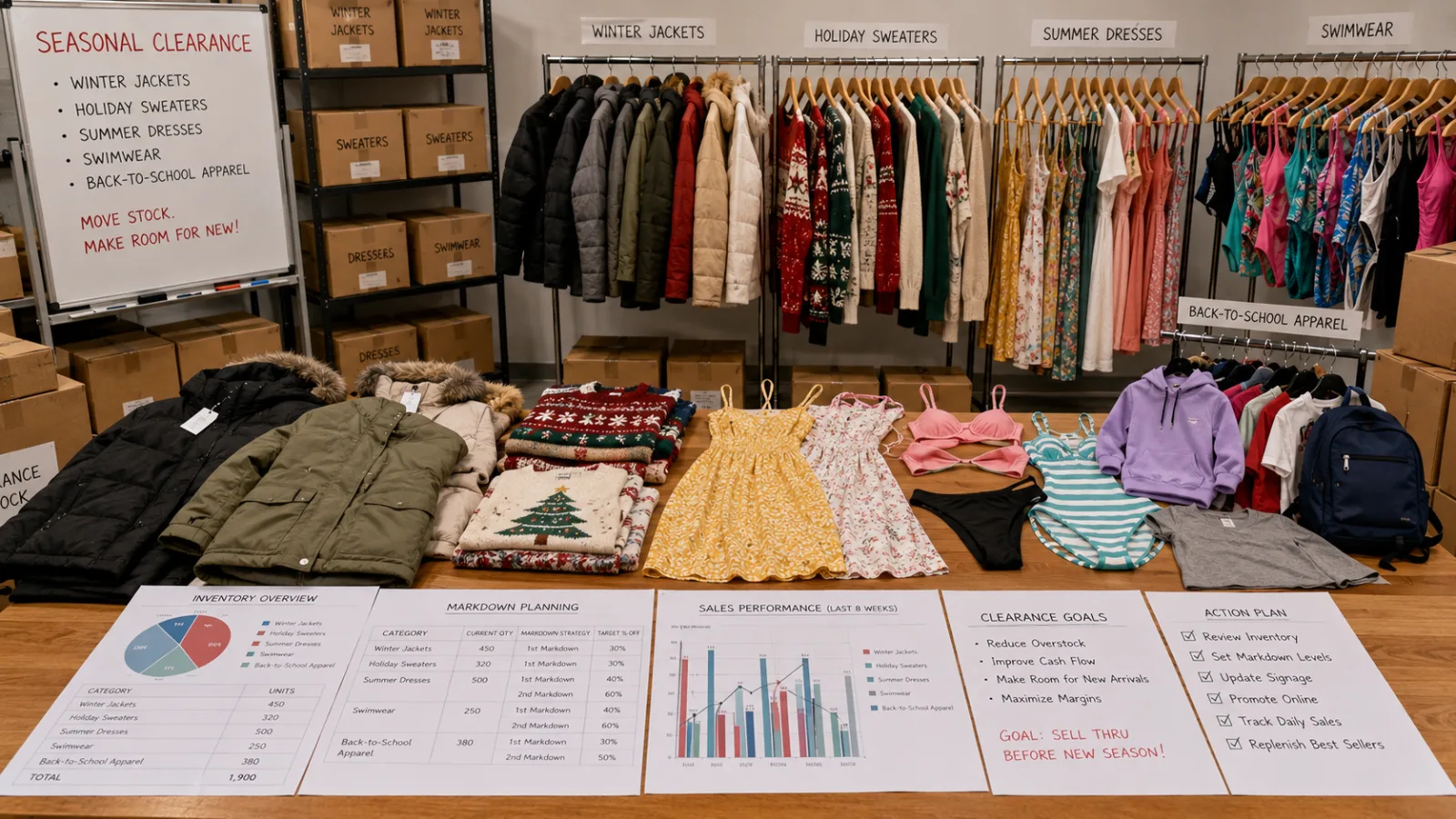
3. To Clear Out Seasonal and Outdated Products
Fashion is strongly connected to seasons, trends, holidays, and buying moments. A product that feels exciting in March may feel outdated by September. A winter coat is much harder to sell in late spring. A holiday-themed sweatshirt loses urgency after the holiday passes. A summer dress may need discounting if it is still sitting in the warehouse when colder weather arrives.
This is why clothing brands need to liquidate inventory before seasonal products lose relevance.
Unlike many other retail categories, clothing has a short emotional selling window. Customers buy based on weather, events, mood, trend, lifestyle, and timing. If the product misses that moment, demand can drop quickly.
Examples of Seasonal Inventory Problems
- A brand launches swimwear too late and still has stock after summer.
- A winter outerwear collection arrives late and misses peak demand.
- Holiday pajamas remain unsold after December.
- Back-to-school apparel is still in stock after the school season.
- Festival clothing loses relevance after the event period.
- Trend-driven prints feel outdated after a few months.
In each case, waiting too long can reduce the chance of selling profitably.
Why Early Liquidation Is Often Better Than Late Liquidation
Many brands wait until products are completely dead before discounting them. This can be a mistake. A product still has stronger value when it is somewhat relevant. A winter jacket may still sell during late winter at a moderate discount. But if the brand waits until summer, it may need a much deeper discount.
The same applies to trend items. A trend may not be at its peak anymore, but it may still have enough demand if discounted early. Once the market fully moves on, liquidation becomes harder.
4. To Protect Brand Image and Product Freshness
A clothing brand’s image depends on what customers see. If the same old products stay on the website for too long, the brand can start to feel stale. Customers may assume the brand is not active, not growing, or not selling well. This is especially risky for fashion brands because freshness is part of the buying experience.
New collections, updated colors, limited drops, seasonal edits, and fresh product photography help keep customers engaged. But if old inventory dominates the website or store, it can weaken the brand’s image. Liquidation helps remove outdated products from the main sales channel so the brand can present a cleaner, more current assortment.
Why Product Freshness Matters
Fashion shoppers often respond to newness. They want to see fresh styles, updated silhouettes, seasonal colors, and relevant product stories. Even if a brand sells basics, the way products are presented still matters. A basics brand can refresh through new colors, updated fits, improved fabrics, or better styling.
Old inventory can make the brand feel stuck. If customers see the same unsold products every time they visit, they may stop checking back.
Liquidation Without Damaging the Brand
Some brands worry that liquidation will cheapen their image. This can happen if discounting is too frequent, too aggressive, or poorly presented. But liquidation can be handled carefully. Brands can separate liquidation from the main collection by using outlet sections, archive sales, private customer events, sample sales, wholesale liquidation, or controlled off-price partnerships. This allows the brand to move old inventory without making the full-price collection feel less valuable.
Keep Core Products Separate
Not every product should be liquidated quickly. Core products that sell consistently may deserve replenishment rather than clearance. The key is to separate true slow-moving inventory from evergreen items. Liquidate products that no longer support the current brand direction, while protecting best sellers and core basics.

5. To Reduce Waste and Support More Responsible Fashion
Inventory liquidation can also support sustainability when it prevents usable clothing from being destroyed, discarded, or forgotten in warehouses. The fashion industry has faced criticism for overproduction, textile waste, and the destruction of returned or unsold goods. The European Environment Agency has reported that returned and unsold textiles have been destroyed in parts of the fashion industry, and it links this problem to online shopping growth, return practices, changing consumer preferences, and fast-fashion strategies.
Liquidation is not a perfect sustainability solution because the best answer is to avoid overproduction in the first place. However, when inventory already exists, moving it into use is usually better than letting it sit unused or sending it directly to waste streams.
Why Unsold Clothing Becomes a Sustainability Problem
Every garment represents resources. Fabric, water, energy, labor, dyes, trims, packaging, shipping, and storage have already been used. If that garment is never worn, those resources are wasted.
Unsold inventory can also lead to additional environmental pressure. Warehousing uses energy. Disposal creates waste. Incineration and landfill options create further concerns. Even recycling is not always simple because many garments contain fiber blends, trims, elastane, coatings, prints, labels, and mixed materials.
Liquidation as Part of Circular Fashion
Inventory liquidation can support circular fashion when products move through resale, outlet sales, donation, upcycling, recycling, or secondary markets. Brands can work with liquidation buyers, off-price retailers, charities, resale platforms, or textile recovery partners to keep products in circulation.
However, brands should be careful. Dumping cheap excess stock into uncontrolled markets can create other problems, including brand dilution and pressure on local resale ecosystems. Responsible liquidation should consider where the products go and how they are sold.
Better Planning Still Comes First
Liquidation should not become an excuse for constant overproduction. The strongest sustainability strategy is better demand planning, smaller production runs, smarter MOQ decisions, better size forecasting, and more accurate inventory management. Liquidation is a recovery strategy, not a replacement for responsible planning.

6. To Improve Inventory Accuracy and Business Decision-Making
Clothing brands need clean inventory data to make good decisions. When old stock stays mixed with active stock, it becomes harder to understand what is really happening in the business. The brand may think it has plenty of inventory, but much of it may be slow-moving, outdated, broken by size, or difficult to sell.
Liquidation forces a brand to review inventory honestly. Which products are selling? Which sizes are stuck? Which colors are dead? Which styles had weak demand? Which categories were overbought? Which products should never be repeated?
This learning is valuable.
Inventory Data Helps Future Production
Every liquidation decision can teach the brand something. If small sizes are always left over, the size curve may be wrong. If bright colors are always discounted, customers may prefer neutrals. If one fabric returns often, quality or comfort may be an issue. If one category sells slowly every season, the brand may need to reduce investment there. Without liquidation and inventory review, brands may keep repeating the same mistakes.
Why Deadstock Confuses Planning
Deadstock can make a brand look larger than it really is. A founder may say, “We have 3,000 units in stock,” but if 1,500 units are old, broken, or slow-moving, the active inventory is much smaller. This can affect buying decisions, cash flow planning, warehouse operations, and marketing.
A healthier approach is to classify inventory into active stock, slow-moving stock, clearance stock, damaged stock, returned stock, and liquidation stock. This helps the business see inventory clearly.
Use Liquidation as a Planning Reset
Liquidation can reset the business. Once old stock is cleared, the brand can plan the next collection based on cleaner data. This supports better forecasting, better buying, and better production decisions.

7. To Make Room for New Collections and Growth
Fashion brands need space to grow. That space is not only physical warehouse space. It is also financial space, creative space, website space, marketing space, and customer attention.
Old inventory can block growth. If a brand keeps focusing on unsold products, it may delay new launches, avoid innovation, and spend too much energy trying to sell what customers already ignored. Liquidation helps the brand move forward.
Why New Collections Need Room
New collections require planning, sampling, production, photography, marketing, packaging, and fulfillment. If old stock is taking up too much space and cash, the brand may not be able to invest properly in the next drop.
Also, a website or retail store should not feel overcrowded with old products. A clean assortment helps customers understand what the brand stands for now. Too many leftover items can make shopping confusing.
Growth Requires Inventory Discipline
A brand that wants to scale needs to understand when to hold, when to discount, when to bundle, and when to liquidate. Holding every product forever is not a growth strategy. Inventory discipline helps the brand focus on what works.
Liquidation can also create room for product improvements. If an old hoodie fit was not perfect, clear it and launch a better version. If an old fabric did not perform well, move it out and introduce improved material. If old packaging no longer matches the brand, liquidate remaining stock and transition cleanly.
Liquidation Can Support Brand Evolution
Brands change. A startup may begin with streetwear and later shift toward premium basics. A kidswear brand may move from playful prints to minimalist essentials. An activewear brand may improve fabric technology. Old inventory may no longer match the new direction. Liquidation helps remove products that no longer represent where the brand is going.

Common Ways Clothing Brands Liquidate Inventory
There is no single way to liquidate clothing inventory. The best method depends on brand positioning, product type, inventory age, quantity, condition, and urgency.
1. Website Clearance Sale
This is the simplest method. Brands can create a sale section on their website and reduce prices on slow-moving products. This works well when the brand still wants to sell directly to customers and keep control of the experience.
2. Private Customer Sale
A private sale for email subscribers, VIP customers, or loyal buyers can feel more controlled than a public discount. It can reward existing customers without making the brand look permanently discounted.
3. Bundle Offers
Bundles can move slow inventory without making discounts feel too aggressive. For example, a brand can offer “buy 2, get 1,” mystery packs, outfit bundles, or seasonal sets.
4. Outlet Channel
Outlet sections or separate outlet stores help brands keep liquidation apart from full-price products. This protects the main collection while still moving stock.
5. Wholesale Liquidation
Brands can sell large quantities to wholesalers, discount retailers, or off-price buyers. This can move inventory quickly but usually at lower margins.
6. Sample Sales
Sample sales work well for prototypes, showroom samples, photography samples, old collection pieces, and limited quantities.
7. Donation or Recycling
If products cannot be sold profitably, donation, upcycling, or textile recycling may be considered. This should be handled responsibly with proper documentation.

When Should a Clothing Brand Liquidate Inventory?
Timing matters. Liquidating too early can reduce profit unnecessarily. Liquidating too late can reduce recovery value. The best time depends on product type, season, sales velocity, and cash flow needs.
A brand should consider liquidation when:
- The product has passed its main selling season.
- Sell-through is much slower than expected.
- Storage costs are rising.
- The style no longer matches brand direction.
- A new collection needs space.
- Sizes are broken and difficult to sell.
- The product has been marked down once but still does not move.
- Cash is needed for new production.
- The item is returned, damaged, or slightly imperfect.
- The product is unlikely to sell at full price again.
A strong inventory review system helps brands make these decisions earlier. Review slow-moving products monthly or at least after each major selling period. Do not wait until the stock has lost nearly all value.
Mistakes to Avoid During Inventory Liquidation
Liquidation can help a clothing brand, but only if it is handled carefully. Poor liquidation can damage margins, confuse customers, or weaken brand value.
Discounting Too Often
If customers see constant sales, they may stop buying at full price. Use liquidation strategically, not as the main selling model.
Waiting Too Long
Old inventory loses value over time. If a product is clearly not moving, act before it becomes completely irrelevant.
Mixing Old Stock With New Collections
Too much old stock on the main website can make the brand look stale. Separate clearance products when possible.
Ignoring Brand Perception
Luxury or premium brands should be careful with public discounting. Outlet, private sale, or wholesale liquidation may be better.
Not Tracking Results
Track which products were liquidated and why. Use that learning to improve future buying.
Liquidating Without Understanding the Cause
Do not only clear the stock. Ask why it did not sell. Was the price wrong? Was the fit poor? Was the fabric weak? Was the product launched late? Was the marketing unclear?

How to Liquidate Inventory Without Hurting Your Brand
Clothing brands can liquidate inventory while still protecting brand value. The key is control.
First, separate liquidation from your main product story. Use a sale page, archive section, outlet collection, or private sale. This prevents old inventory from dominating your brand image.
Second, use clear messaging. Instead of saying “everything must go,” consider phrases like “archive sale,” “end-of-season edit,” “last chance,” or “limited warehouse sale.” This feels more intentional.
Third, avoid training customers to wait for discounts. If you run sales too frequently, your customers may stop trusting full prices. Keep liquidation events limited and purposeful.
Fourth, protect your best sellers. Do not discount strong core products just because you are liquidating slow stock. Keep your pricing architecture clear.
Fifth, use liquidation data to improve future planning. The goal is not just to clear products. The goal is to make better inventory decisions next time.
Apparel Inventory Liquidation Checklist
Before liquidating inventory, use this checklist:
- Identify slow-moving SKUs.
- Review sell-through rate.
- Check size and color imbalance.
- Calculate storage costs.
- Review product age.
- Calculate minimum acceptable recovery price.
- Separate damaged, returned, and sellable stock.
- Decide liquidation channel.
- Protect current full-price products.
- Plan sale timing.
- Create clear customer messaging.
- Track liquidation results.
- Review why products did not sell.
- Use insights for future buying and production.
This checklist helps brands liquidate inventory with more structure instead of reacting in panic.
ApparGlobal
For apparel brands, inventory liquidation often connects back to earlier production and planning decisions. Overstock usually does not happen by accident. It can come from unclear demand forecasting, high MOQ pressure, weak merchandising planning, poor size curves, fabric delays, missed seasonal windows, or product development decisions that were not tested properly before bulk production.
Many clothing brands can reduce liquidation pressure when they work with manufacturing partners that understand tech packs, MOQ planning, fabric sourcing, trim standardization, sample review, production timelines, quality checkpoints, and scalable production workflows. Better planning at the production stage helps brands avoid ordering too much of the wrong product and improves the chance of creating inventory that sells at healthier margins.
Companies such as ApparGlobal help clothing brands align product development, sourcing decisions, supplier coordination, fabric selection, sample approvals, bulk production planning, and quality expectations. For brands developing T-shirts, hoodies, activewear, kidswear, streetwear, uniforms, private label apparel, or custom garments, this kind of production-focused support can make inventory planning more structured and reliable.
When brands connect sourcing and production with merchandising and inventory strategy, they can reduce overstock risk, improve product consistency, and make smarter decisions before moving into bulk manufacturing. This helps protect cash flow and supports a smoother path from product concept to profitable sales.

Final Thoughts
Inventory liquidation is not something clothing brands should fear. It is a practical tool for protecting cash flow, reducing storage costs, clearing seasonal stock, improving brand freshness, reducing waste, cleaning inventory data, and making room for growth.
The real problem is not liquidation itself. The real problem is waiting too long, discounting without strategy, or failing to learn from the inventory that did not sell. Every clothing brand will face slow-moving stock at some point. Trends change. Seasons shift. Customers respond differently than expected. Production quantities may be too high. Sizes may be unbalanced. Returns may build up. That is normal in fashion. What matters is how quickly and intelligently the brand responds.
A strong liquidation strategy helps brands recover value before inventory becomes a bigger burden. It also creates useful lessons for future planning. If you know which products had to be liquidated and why, you can improve your next collection, adjust MOQ, refine your size curve, improve product photography, change pricing, or select better fabrics.
The best clothing brands do not treat inventory as a passive asset. They manage it actively. They know when to hold, when to promote, when to markdown, and when to liquidate. That discipline helps them stay financially healthy and creatively flexible.
In fashion, unsold inventory is not just stock. It is tied-up cash, occupied space, missed opportunity, and business risk. Liquidating it at the right time can give a clothing brand the freedom to move forward, launch better products, and grow with more confidence.