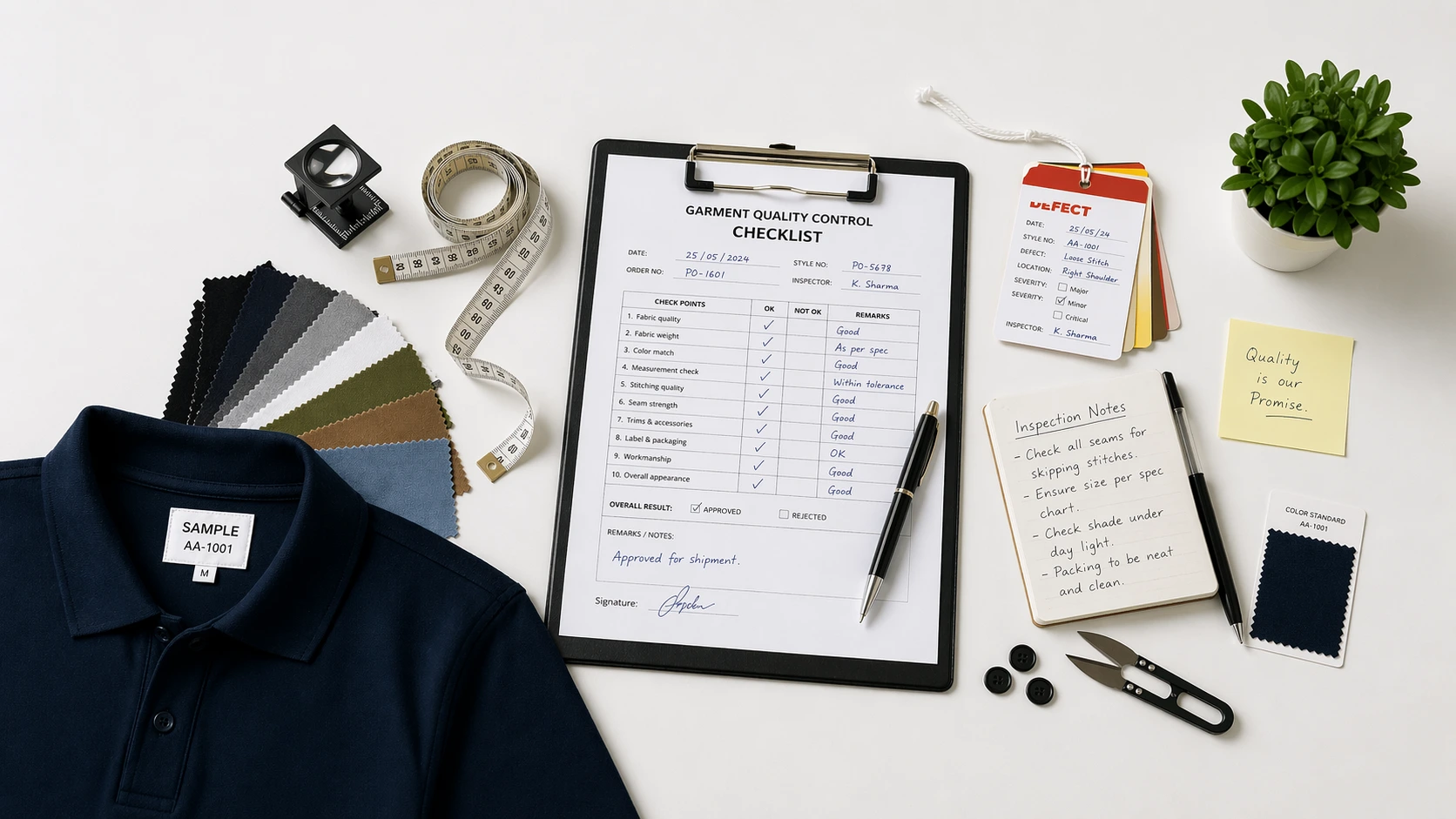
Improve apparel quality control with these 10 essential tips, from setting clear standards to in-line inspections and root cause analysis for better production outcomes.
Quality is one of the most important foundations of successful apparel manufacturing. A factory may offer competitive prices and fast production, but if garment quality is inconsistent, it can still face rejected shipments, expensive rework, missed delivery dates, customer complaints, and damaged buyer relationships.
Apparel quality is not limited to how a finished garment looks. It includes fabric performance, shade consistency, pattern accuracy, measurements, stitching, trims, labels, pressing, packaging, and product safety. Each production stage can either protect the final quality or introduce defects that become more expensive to correct later. That is why quality control should never be treated as a last-minute inspection. Strong manufacturers build quality into the full production workflow—from material approval and cutting to sewing, finishing, packing, and shipment. This guide explains 10 practical ways apparel manufacturers can improve quality control, prevent recurring defects, reduce production risk, and create a more dependable manufacturing system.
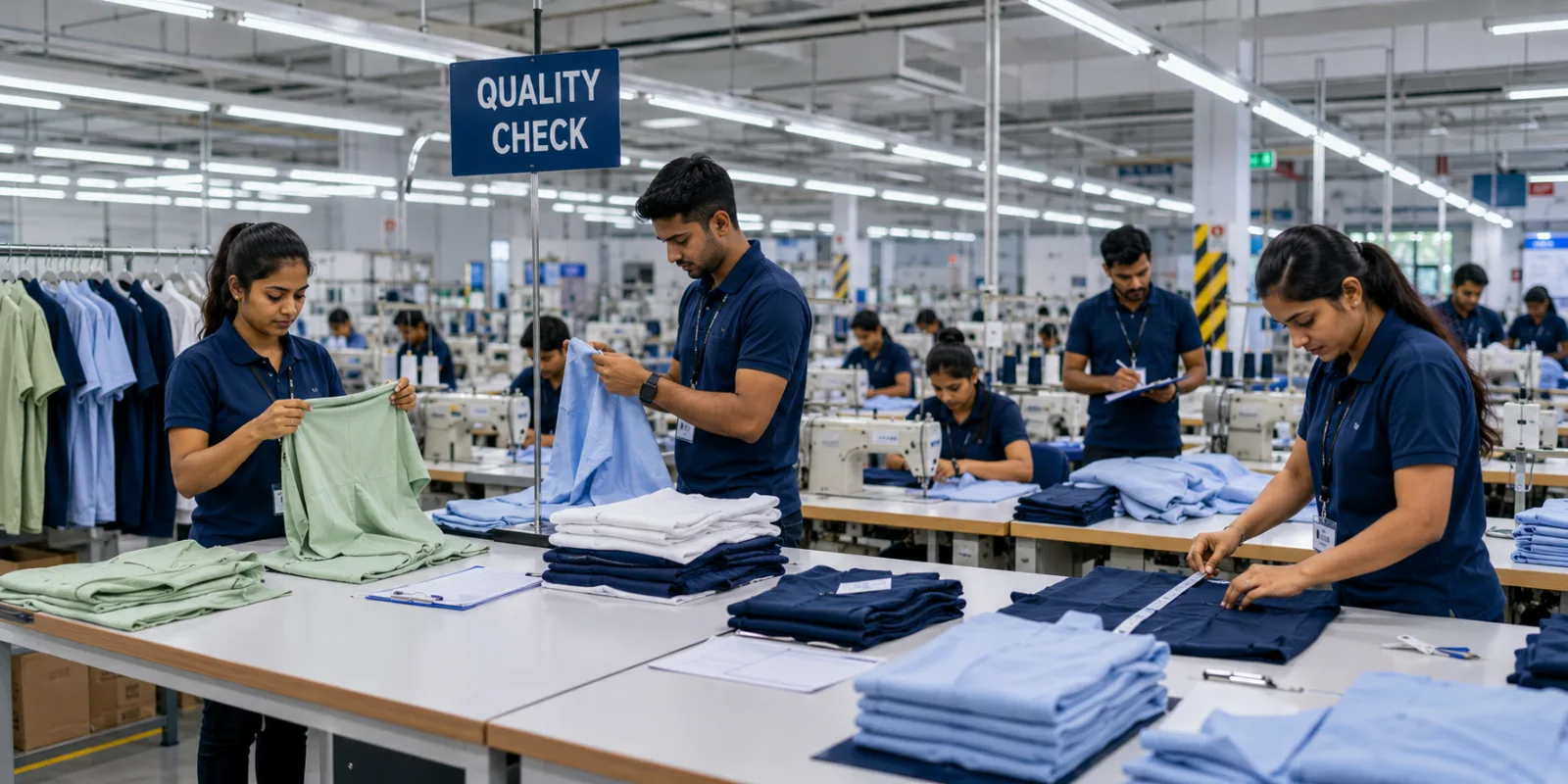
Why Quality Control Matters in Apparel Manufacturing
Quality control in apparel manufacturing is the structured process of checking materials, production methods, garment construction, measurements, finishing, and packaging to ensure products meet approved standards.
It includes more than identifying visible defects. A complete quality control system confirms that garments are:
- Made from the approved fabric and trims.
- Cut according to the correct patterns.
- Sewn using approved construction methods.
- Within measurement tolerances.
- Free from major workmanship defects.
- Correctly labeled and packaged.
- Able to meet required performance tests.
- Consistent with the approved sample.
- Suitable for the intended customer and market.
Quality control is closely connected to quality assurance, but the two terms are not exactly the same.
Quality assurance focuses on building systems that prevent defects. It includes documentation, training, supplier approval, process planning, and standard operating procedures.
Quality control focuses on checking materials and garments to identify whether they meet the required standard.
The strongest apparel factories use both. They prevent quality problems through planning and confirm performance through inspection and testing.
Why Quality Control Matters in Apparel Manufacturing
Even small garment defects can become serious business problems when multiplied across hundreds or thousands of pieces. One uneven seam may be repairable, but the same defect across an entire production line can delay shipment and increase labor costs significantly.
Common apparel quality problems include:
- Uneven or skipped stitches.
- Open seams.
- Seam puckering.
- Wrong garment measurements.
- Incorrect fabric shade.
- Fabric holes or stains.
- Panel mismatching.
- Crooked labels.
- Loose threads.
- Poor pressing.
- Incorrect trims.
- Print or embroidery placement errors.
- Missing accessories.
- Wrong packaging.
- Carton quantity mistakes.
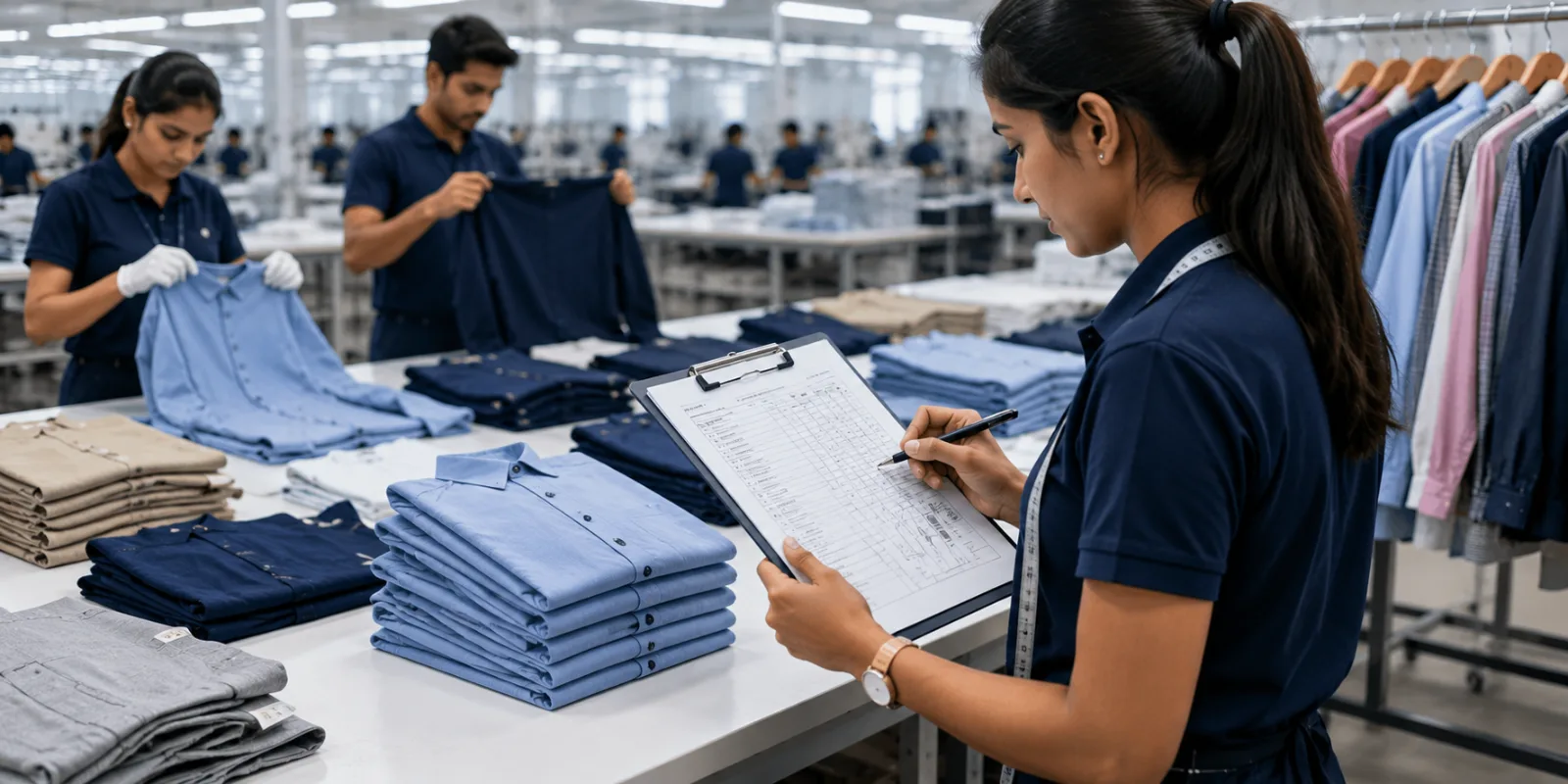
Effective quality control helps manufacturers:
- Reduce rework: Defects are detected before large quantities are affected.
- Improve shipment acceptance: Products are more likely to pass buyer inspection.
- Protect profit margins: Less time and material are spent correcting preventable mistakes.
- Maintain production schedules: Fewer quality problems mean fewer delays.
- Strengthen buyer confidence: Consistent quality encourages repeat orders.
- Reduce customer complaints: Better products create stronger end-user satisfaction.
- Improve factory reputation: Reliable quality makes a manufacturer more attractive to new buyers.
- Support long-term growth: Repeatable systems make it easier to increase production volume.
For apparel factories, quality control is not only a technical requirement. It is a commercial advantage.
The Three Main Stages of Apparel Quality Control
A reliable quality system usually includes three connected stages.
1. Quality Planning
Quality planning happens before production begins. The factory confirms product standards, approves materials, reviews technical documents, identifies risks, and prepares production teams.
2. In-Process Quality Control
In-process control happens during cutting, sewing, finishing, and packing. Inspectors monitor production to identify problems before they spread across large quantities.
3. Final Quality Inspection
Final inspection takes place after production is completed and garments are packed or ready for packing. The factory confirms that the shipment meets the required workmanship, measurement, labeling, packaging, and quantity standards. Factories that control all three stages usually perform better than factories that depend mainly on final inspection. Final inspection can identify a problem, but it may be too late to correct it without delaying shipment.
1. Set Clear Quality Standards Before Production Starts
Many garment defects begin before sewing starts. If the buyer, merchandising team, production department, and quality inspectors do not share the same expectations, production teams may interpret instructions differently.
A complete quality file should give every department a clear reference point.
It should include:
- Approved pre-production sample.
- Complete tech pack.
- Measurement chart.
- Measurement tolerances.
- Fabric specifications.
- Approved fabric shade or color standard.
- Trim approval records.
- Stitch and seam details.
- Stitch-per-inch requirements where relevant.
- Print and embroidery placement.
- Label placement instructions.
- Washing or finishing requirements.
- Folding and packaging instructions.
- Carton assortment.
- Workmanship expectations.
- Defect classification guidelines.
The approved sample should be available to production and QC teams throughout manufacturing. It should not remain only in the merchandising office.
Quality teams should also confirm that the latest approved documents are being used. Old tech packs, outdated measurements, and unapproved changes can create avoidable mistakes.
Practical Improvement
Create a controlled quality pack for every style. Give each document a version number and approval date. When a change is made, update all relevant teams and remove outdated documents from the production floor.
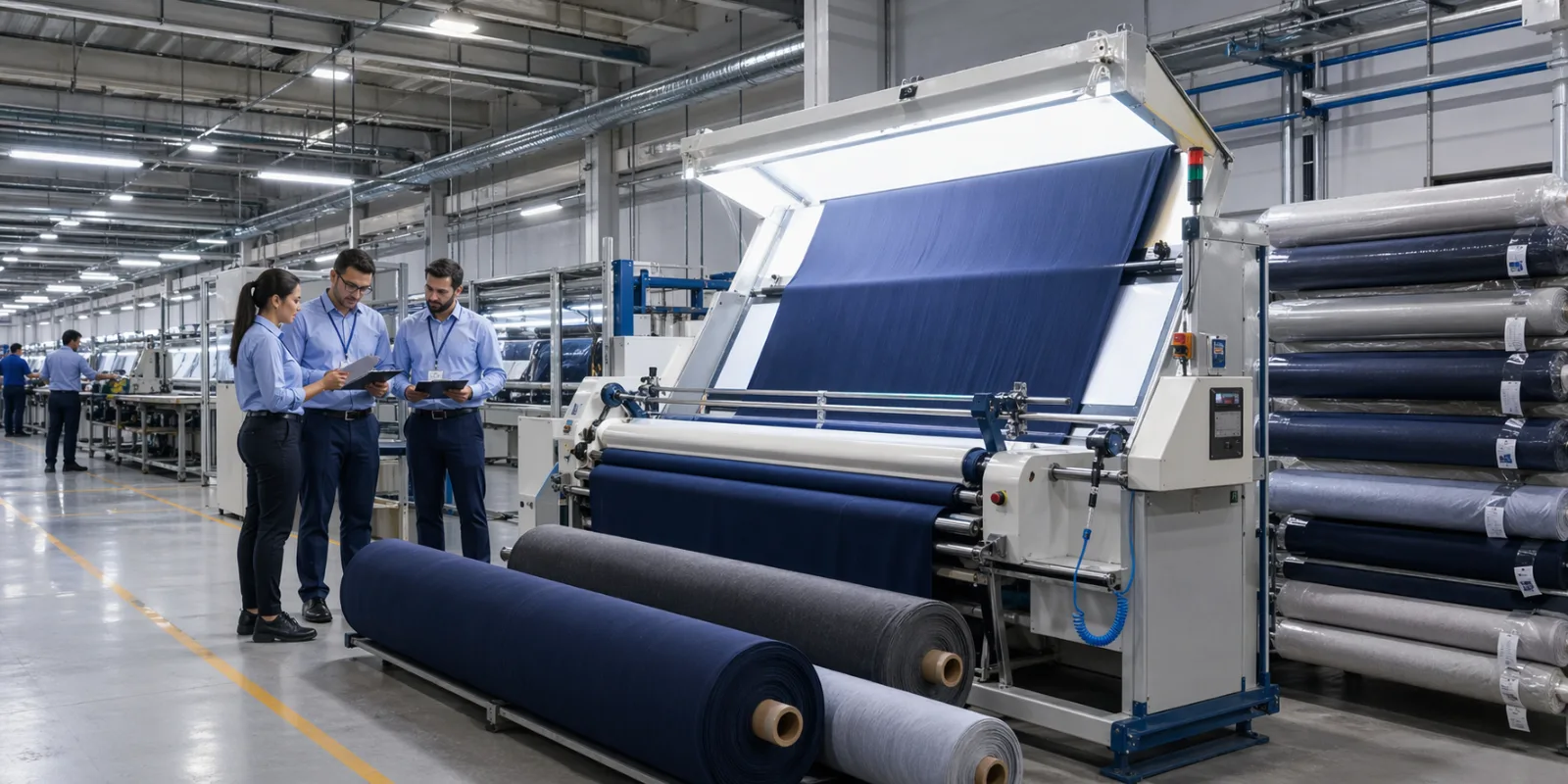
2. Inspect Fabric and Trims Before Cutting
High-quality garments cannot be produced consistently from defective or incorrect raw materials. Fabric and trim problems should be identified before they reach the cutting floor.
Fabric inspection should cover:
- Fabric shade variation.
- Holes, stains, and weaving defects.
- Knitting faults.
- Width consistency.
- Fabric weight or GSM.
- Shrinkage.
- Bowing and skewing.
- Colorfastness when required.
- Surface appearance.
- Print alignment.
- Fabric hand feel.
- Roll-to-roll variation.
- Usable fabric quantity.
Factories should separate fabric rolls by shade group. Mixing different shades within one garment or shipment can create visible inconsistency.
Trims should also be checked carefully.
Trim inspection may include:
- Correct color.
- Correct size.
- Logo accuracy.
- Zipper function.
- Button strength.
- Elastic recovery.
- Snap performance.
- Label information.
- Thread color.
- Drawcord length.
- Packaging quality.
- Attachment suitability.
Finding a trim or fabric issue after sewing begins can affect the entire order. Early material inspection gives the factory time to replace, repair, segregate, or report unsuitable materials.
Practical Improvement
Use a raw-material approval checklist and quarantine any unapproved fabric or trims. Do not allow materials to enter bulk cutting or sewing until the responsible team signs the inspection record.
3. Hold a Detailed Pre-Production Meeting
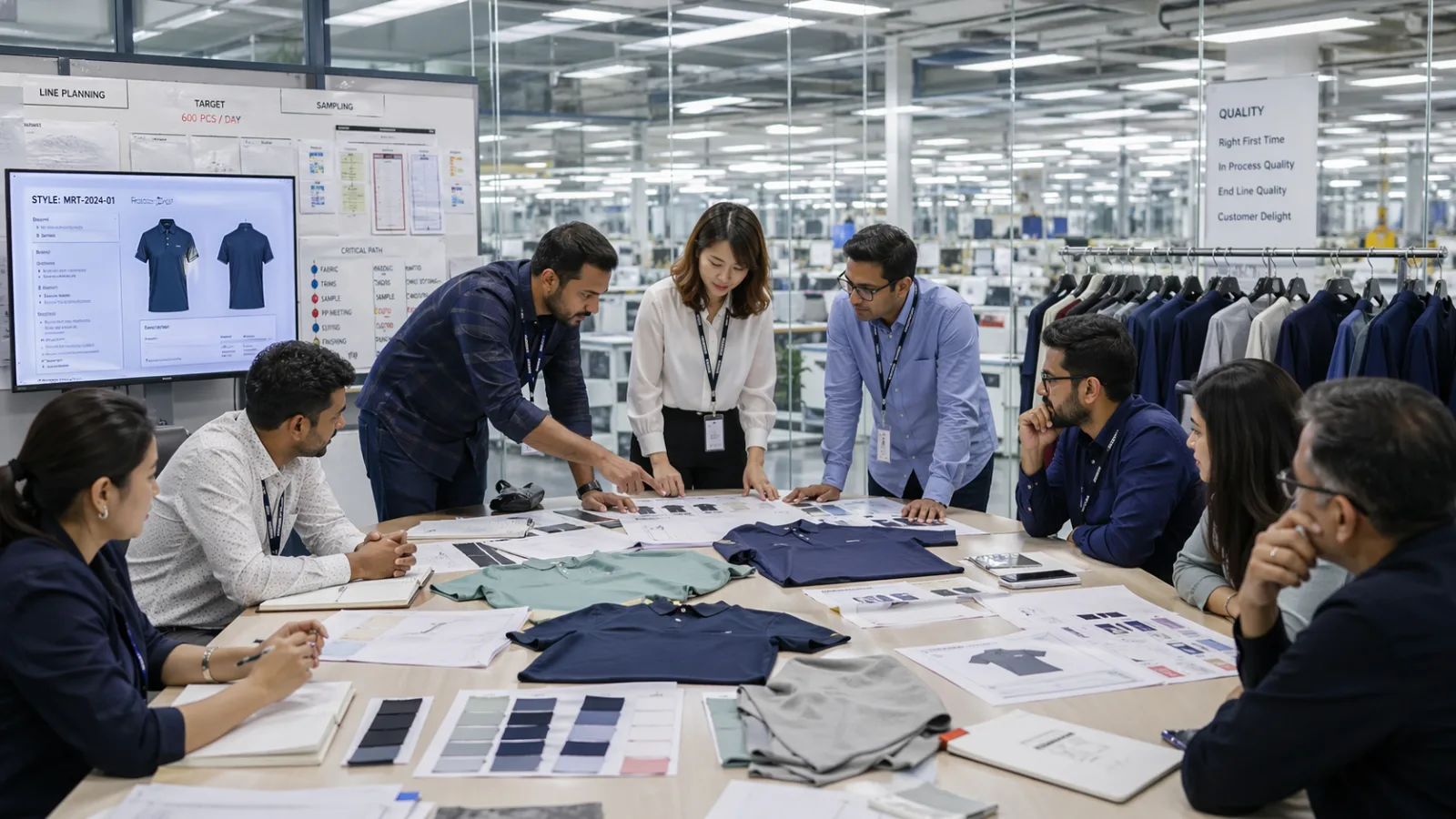
A pre-production meeting aligns all departments before the first bulk garment enters the sewing line. It creates an opportunity to identify risks, explain construction details, and confirm buyer requirements.
Participants may include:
- Merchandising team.
- Production manager.
- Quality assurance team.
- Cutting manager.
- Sewing supervisor.
- Industrial engineering team.
- Finishing department.
- Washing department where applicable.
- Printing or embroidery representatives.
- Packing department.
- Maintenance or technical staff for complex operations.
The meeting should review:
- Approved sample.
- Tech pack.
- Critical measurements.
- Pattern and grading details.
- Fabric characteristics.
- Shade control plan.
- Trim usage.
- High-risk sewing operations.
- Needle and thread selection.
- Machine requirements.
- Print or embroidery placement.
- Pressing expectations.
- Finishing standards.
- Packing method.
- Inspection procedure.
- Reporting responsibilities.
The team should identify likely quality risks before production begins. For example, slippery satin may need special handling, stretch fabric may require adjusted machine settings, and striped fabric may need careful panel matching.
Practical Improvement
Create a written pre-production meeting report that lists each identified risk, the responsible department, required action, and deadline. Review unresolved items before bulk production starts.
4. Approve a Pilot Run Before Full Bulk Production
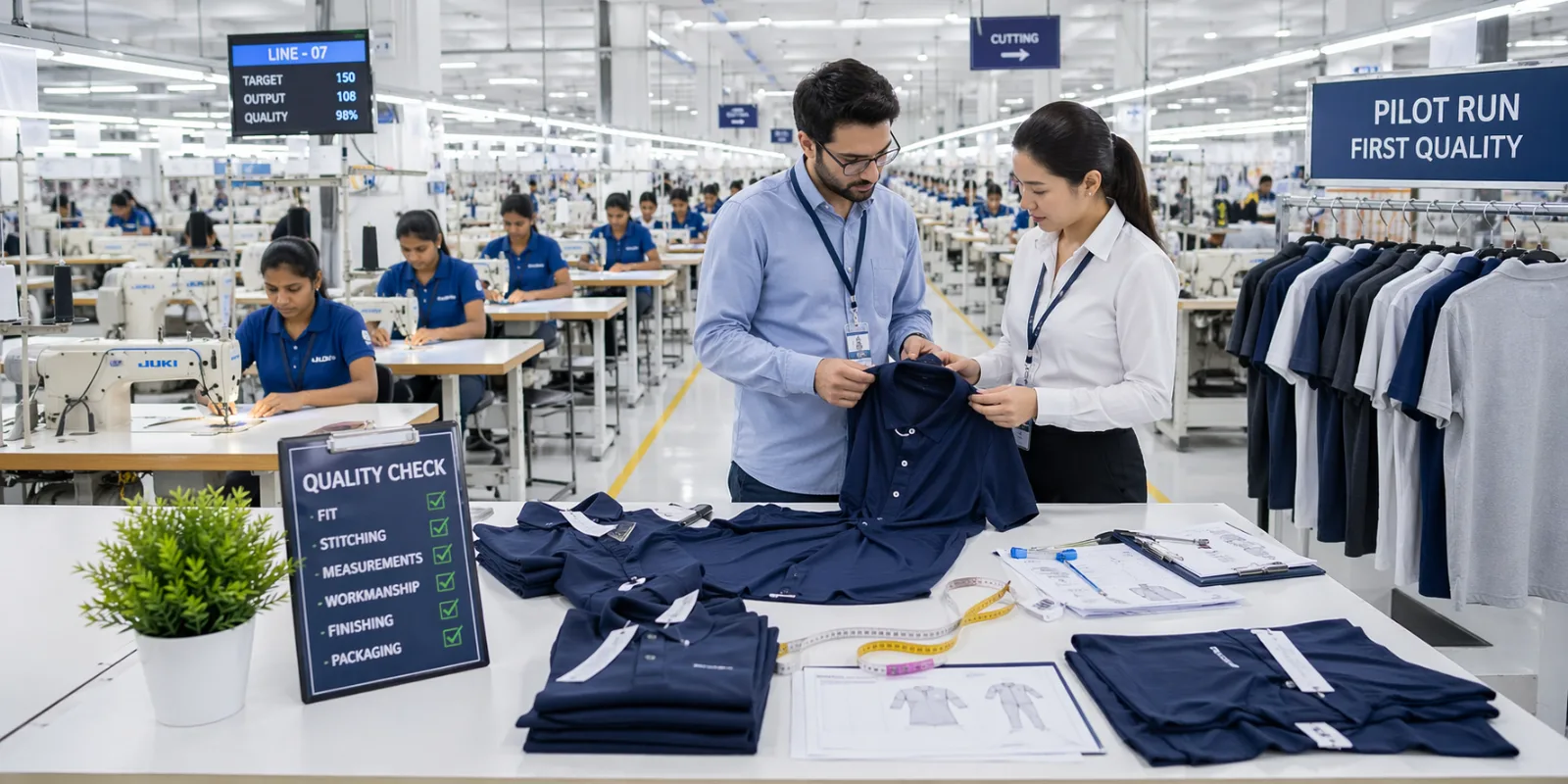
A pilot run is a small production quantity made using the intended bulk-production process. It helps the factory confirm that the style can be manufactured correctly before the line reaches full output.
The pilot run should use:
- Approved fabric.
- Approved trims.
- Bulk patterns.
- Intended machinery.
- Planned operators.
- Actual production methods.
- Approved labels and accessories.
The pilot review should check:
- Garment measurements.
- Pattern balance.
- Fit consistency.
- Stitching quality.
- Seam appearance.
- Machine settings.
- Needle damage.
- Fabric handling.
- Trim attachment.
- Print or embroidery placement.
- Pressing results.
- Shade control.
- Folding and packing flow.
A pilot run may reveal problems that were not visible in a single development sample. For example, a seam may look acceptable in one piece but become difficult to control at production speed.
Skipping pilot approval can allow one small technical mistake to spread across hundreds of garments.
Practical Improvement
Do not increase the line to full production until pilot defects have been corrected and approved. Keep an approved pilot garment at the line as a visual standard.
5. Use In-Line Quality Control During Sewing
Relying only on final inspection is one of the most expensive quality mistakes a factory can make. By the time a defect reaches the final stage, hundreds of garments may already contain the same problem.
In-line quality inspectors check garments while sewing is still in progress.
They may identify:
- Skipped stitches.
- Broken stitches.
- Open seams.
- Uneven seam allowance.
- Seam puckering.
- Incorrect stitch density.
- Twisted panels.
- Notch misalignment.
- Uneven topstitching.
- Wrong label placement.
- Incorrect trim attachment.
- Measurement drift.
- Needle cuts.
- Oil marks.
- Panel shade mismatch.
In-line inspection gives supervisors time to correct machine settings, retrain operators, repair patterns, or stop incorrect production before the defect spreads.
Inspectors should not only remove defective pieces. They should report the defect location, operator, operation, quantity, cause, and corrective action.
Traffic-Light Control System
Some factories use a simple visual system:
- Green: Operation is under control.
- Yellow: Defect trend is increasing and needs attention.
- Red: Production should stop until corrective action is completed.
The exact system can vary, but quick communication between QC inspectors and line supervisors is essential.
Practical Improvement
Use hourly or scheduled defect reports to identify the top three problems on each line. Supervisors should respond to rising defect trends before the end of the shift.
6. Use AQL Properly, but Do Not Depend on It Alone
AQL stands for Acceptable Quality Limit. It is commonly used during final inspection to determine a sample size and acceptance or rejection criteria for a production lot.
Defects are often classified into categories such as:
- Critical defects: Problems that may create a safety risk, legal issue, or serious product failure.
- Major defects: Problems that may affect appearance, function, fit, or customer acceptance.
- Minor defects: Smaller workmanship issues that may not significantly affect product use but still fall below the expected standard.
AQL can provide a shared inspection framework for buyers and factories. However, it only evaluates a sample from the shipment. It does not guarantee that every garment is defect-free.
A factory can technically pass a sampled inspection while still having process weaknesses. That is why AQL should be used together with:
- Raw-material inspection.
- Pilot approval.
- In-line control.
- End-line checks.
- Measurement monitoring.
- Operator training.
- Product testing.
- Root cause analysis.
- Corrective action systems.
The real goal should not be to manufacture defects up to an acceptable number. The goal should be to prevent defects and maintain stable processes.
Practical Improvement
Confirm the required inspection level, defect classification, and acceptance criteria with the buyer before production. Do not wait until final inspection to understand how the shipment will be evaluated.
7. Train Operators and Supervisors to Prevent Defects
Quality is not only the responsibility of the QC department. Every person who handles a garment can affect the final result.
This includes:
- Fabric inspectors.
- Spreaders.
- Cutters.
- Bundling teams.
- Sewing operators.
- Line supervisors.
- Pressing staff.
- Thread trimmers.
- Wash technicians.
- Labeling teams.
- Packers.
Training should cover:
- Approved workmanship appearance.
- Stitch density and consistency.
- Seam allowance.
- Correct fabric handling.
- Panel matching.
- Notch alignment.
- Needle selection.
- Machine tension.
- Measurement awareness.
- Trim positioning.
- Defect identification.
- Safe product handling.
- Reporting procedures.
Visual defect boards can be highly effective. They show real examples of acceptable and unacceptable workmanship, making standards easier to understand.
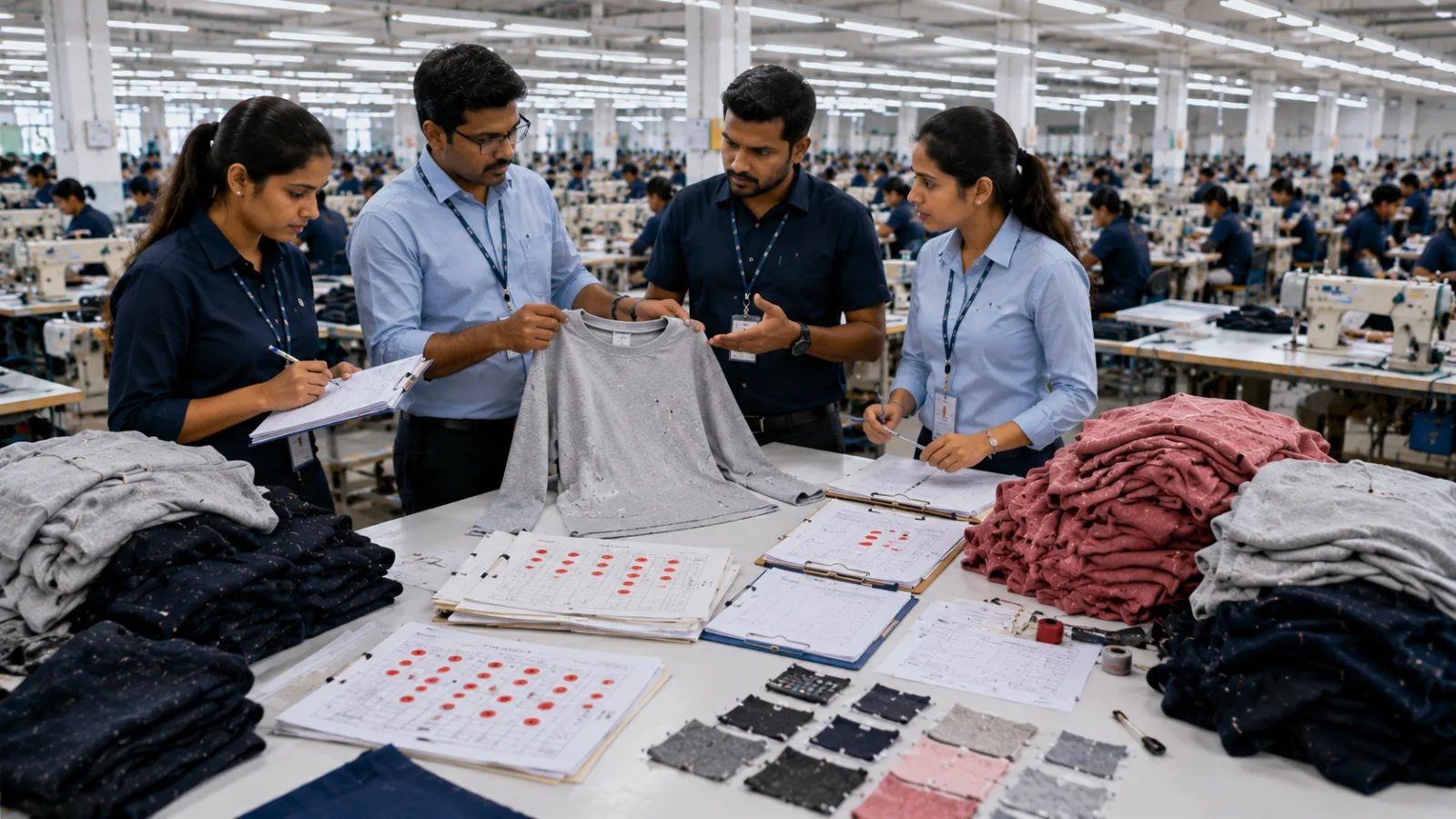
Factories should also train line supervisors to identify early warning signs. If one operator repeatedly produces a defect, the supervisor should investigate the method, machine, materials, and workload rather than sending every piece for repair.
Practical Improvement
Run short style-specific training sessions before line loading. Focus on the most difficult operations and use actual approved and rejected samples.
8. Use Root Cause Analysis Instead of Repeating Repairs
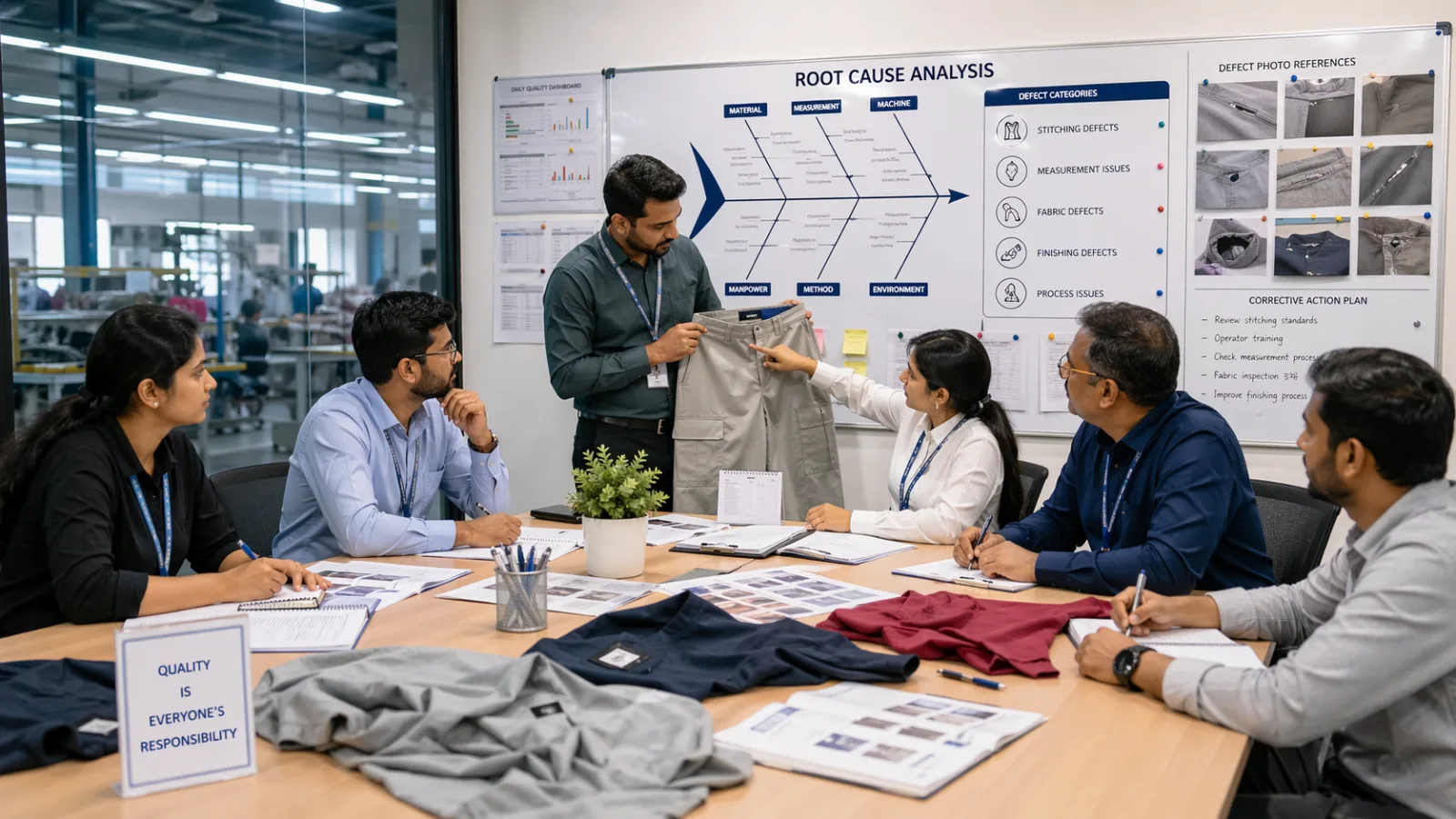
Repairing a garment corrects one defective piece. Root cause analysis prevents the same problem from happening again.
When the same defect appears repeatedly, the factory should investigate:
- What happened?
- Where did it begin?
- When did it begin?
- Which operation was involved?
- Which material or machine was involved?
- Why was it not detected earlier?
- What change can prevent recurrence?
For example:
Repeated seam puckering may result from incorrect thread tension, unsuitable feed settings, fabric instability, operator handling, or an incompatible needle.
Repeated measurement variation may come from incorrect cutting, inaccurate seam allowance, fabric shrinkage, inconsistent pressing, or operator technique.
Repeated shade variation may come from mixing fabric rolls, incorrect bundle control, different dye lots, or poor panel segregation.
Repeated label misplacement may result from unclear markings, missing templates, incorrect instructions, or inadequate operator training.
Common root cause tools include:
- Five Whys
- analysis.
- Fishbone or cause-and-effect diagrams.
- Pareto analysis.
- Corrective and preventive action reports.
- Process observation.
- Machine and method checks.
Practical Improvement
Record each major recurring defect with its root cause, immediate correction, preventive action, responsible person, and completion date. Review whether the action actually reduced the defect rate.
9. Add Product Testing for Performance and Safety
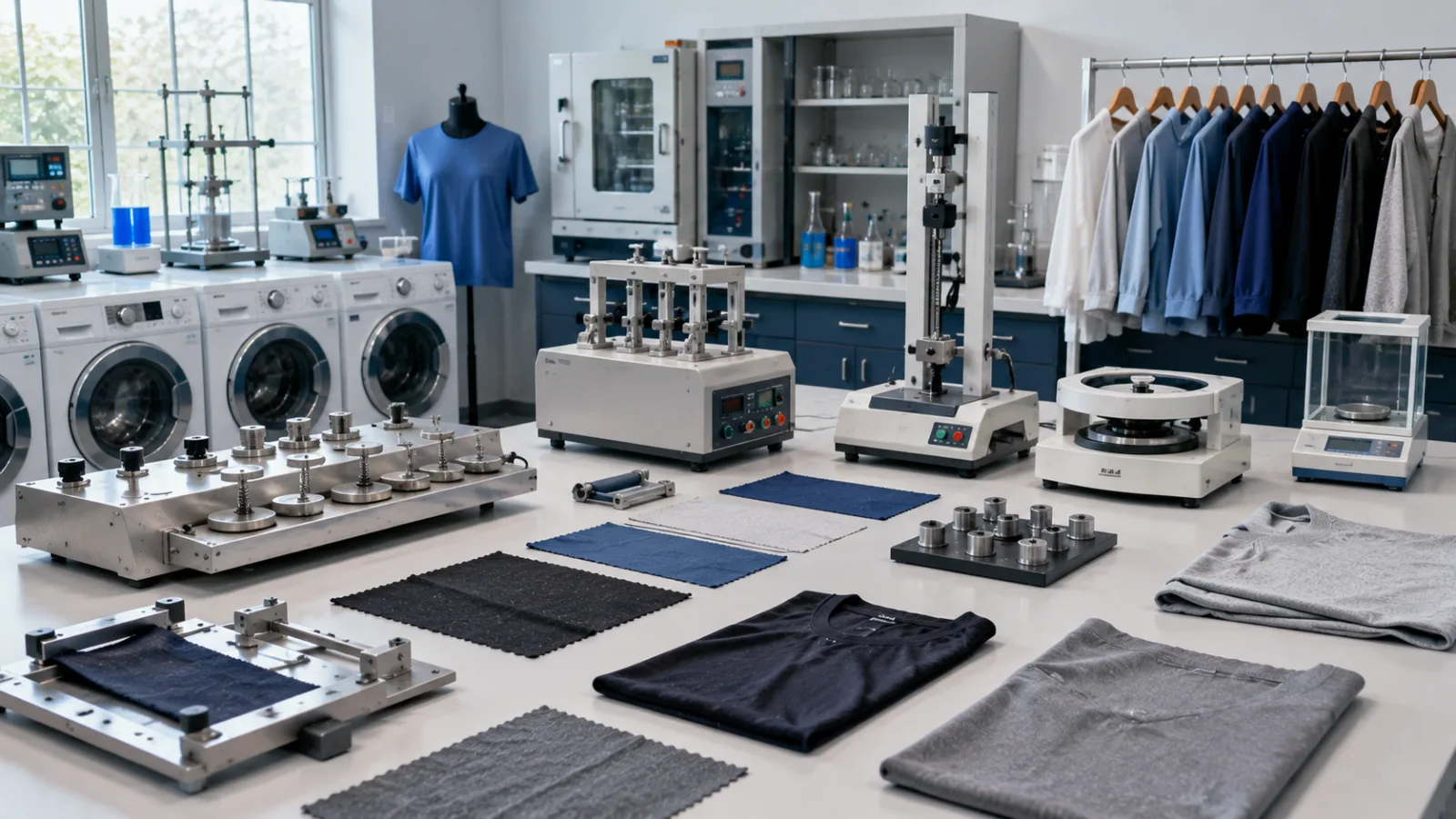
A garment can look acceptable during visual inspection and still fail after washing, stretching, rubbing, or normal use. Product testing helps confirm that garments perform as intended.
Common apparel tests may include:
- Shrinkage.
- Dimensional stability.
- Colorfastness to washing.
- Colorfastness to rubbing.
- Colorfastness to perspiration.
- Seam strength.
- Fabric tensile or bursting strength.
- Pilling resistance.
- Abrasion resistance.
- Stretch and recovery.
- Print durability.
- Zipper performance.
- Button or snap attachment strength.
- Fabric weight.
- Water resistance.
- Moisture-management performance.
- Flammability testing where required.
- Chemical or product-safety testing where applicable.
Testing requirements depend on the product, market, material, buyer, and intended use.
Testing is especially important for:
- Babywear and children’s clothing.
- Activewear
- Swimwear.
- Underwear.
- Workwear.
- Uniforms
- Protective clothing.
- Outdoor apparel.
- Performance garments.
- Export orders with strict buyer standards.
A product that looks good when packed but loses shape after one wash is still a quality failure.
Practical Improvement
Create a product-specific test plan during development. Complete required tests before bulk production whenever possible, then repeat key tests if materials or suppliers change.
10. Track Quality Data and Build Continuous Improvement
Factories improve faster when quality decisions are based on data rather than general impressions.
Useful quality metrics may include:
- Defect rate.
- Defects per hundred units.
- Rework percentage.
- Rejection percentage.
- First-pass yield.
- End-line pass rate.
- Measurement failure rate.
- Top recurring defects.
- Defects by operation.
- Defects by production line.
- Defects by the supplier.
- Final inspection pass or fail rate.
- Customer complaint rate.
- Return or claim rate.
- Repair cost.
- Quality-related delay time.
Data allows management to identify patterns.
For example:
- One line may repeatedly produce sleeve-setting defects.
- One fabric supplier may create frequent shrinkage failures.
- One operator group may struggle with zipper attachment.
- One product category may have repeated packing errors.
- One shift may show higher defect levels than another.
A Pareto chart can help teams focus on the small number of defect types causing the largest share of quality problems.
Quality meetings should not only review the numbers. They should assign corrective actions and check whether performance improves over time.
Practical Improvement
Create a simple daily quality dashboard for each production line. Review weekly trends with production, merchandising, quality, and management teams.

A Simple Apparel Quality Control Workflow
A practical apparel quality control workflow can be divided into clear stages.
Before Production
- Approve the development and pre-production samples.
- Confirm tech packs and measurement charts.
- Set workmanship and defect standards.
- Approve fabric, trims, labels, and packaging.
- Identify production risks.
- Complete required product tests.
Before Cutting
- Inspect fabric rolls.
- Confirm shade groups.
- Test shrinkage.
- Verify fabric width and weight.
- Check patterns and markers.
- Confirm relaxation requirements.
- Inspect trims.
Before Bulk Sewing
- Hold the pre-production meeting.
- Train operators and supervisors.
- Confirm machine settings.
- Approve the pilot run.
- Display approved samples and defect standards.
During Production
- Conduct in-line inspection.
- Monitor critical measurements.
- Use end-line checks.
- Track recurring defects.
- Apply corrective actions.
- Review machine and operator performance.
During Finishing and Packing
- Check stains, loose threads, pressing, and appearance.
- Confirm labels, tags, and accessories.
- Verify folding and packaging.
- Check size and color assortment.
- Confirm carton markings and quantities.
Before Shipment
- Conduct final inspection using the agreed sampling method.
- Review measurements and workmanship.
- Confirm packing and quantities.
- Complete any required final tests or documentation.
- Approve shipment release.
After Production
- Review buyer feedback.
- Record claims and complaints.
- Analyze recurring problems.
- Update quality procedures for repeat orders.
- Share learning with relevant departments.
Common Quality Mistakes Apparel Manufacturers Should Avoid
Many factories weaken quality by repeating the same mistakes:
- depending only on final inspection
- skipping pilot approval
- ignoring incoming fabric issues
- failing to train operators
- repairing defects without solving root causes
- separating compliance from quality control
Avoiding these mistakes often improves quality faster than simply adding more inspectors.
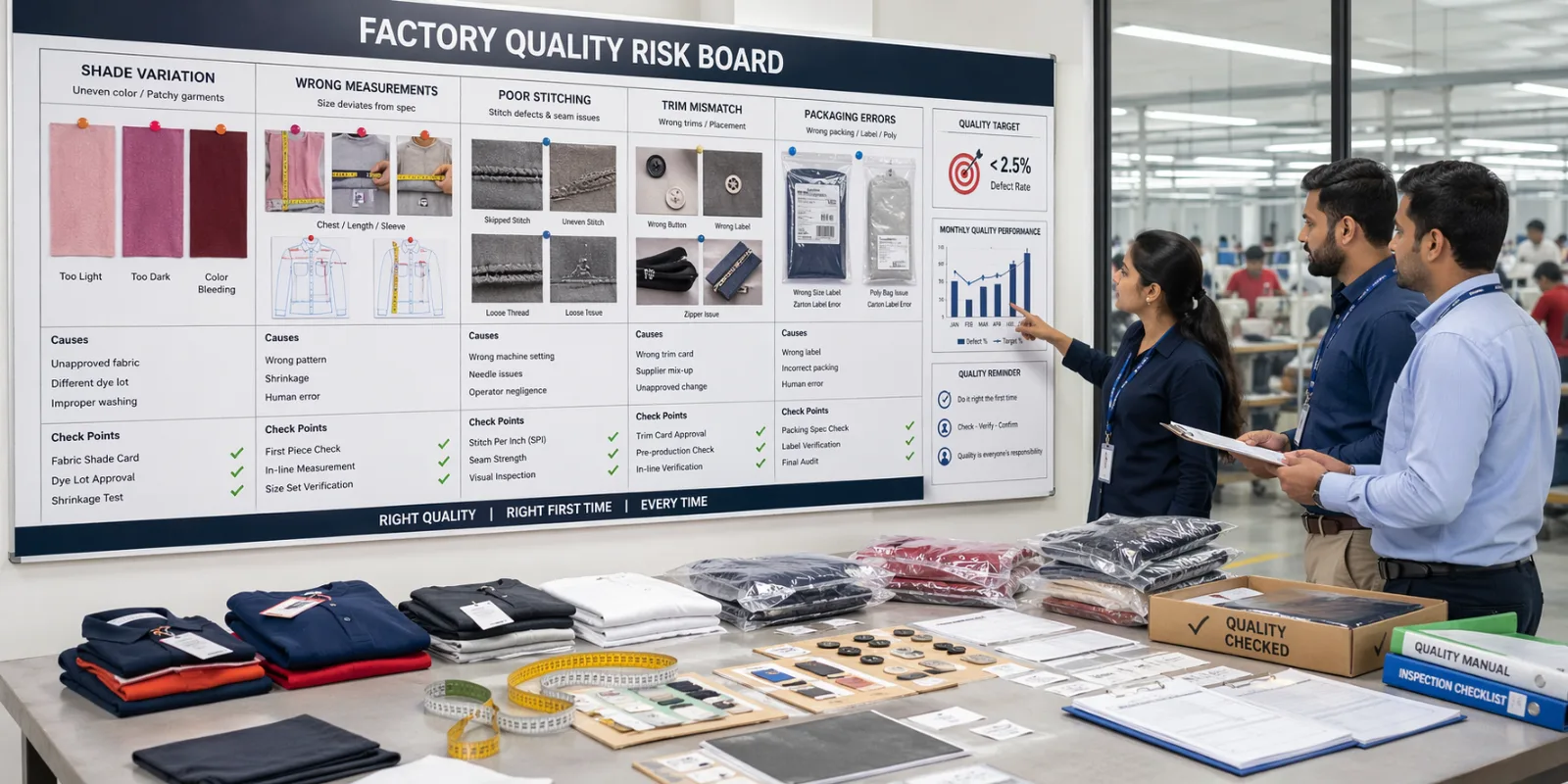
Common Apparel Defects and Their Possible Causes
Understanding why defects happen helps factories prevent them.
Common Quality-Control Mistakes Apparel Manufacturers Should Avoid
Some factories try to improve quality by adding more final inspectors. However, more inspection does not automatically create a stronger system if the underlying process remains weak.
Common mistakes include:
Depending Only on Final Inspection
Final inspection may identify defects after production, but it cannot efficiently prevent them. Factories need quality controls during material handling, cutting, sewing, and finishing.
Skipping Pilot Approval
Moving immediately into high-volume production can multiply an unnoticed technical problem.
Ignoring Fabric and Trim Problems
Raw-material defects cannot always be repaired after sewing. Early inspection is essential.
Using Outdated Technical Documents
Production teams may follow old measurements, construction methods, or packaging instructions if document control is weak.
Failing to Train Operators
Workers cannot consistently meet standards they do not fully understand.
Repairing Without Root Cause Analysis
Repeated repair increases labor cost without stopping the defect from returning.
Separating Quality From Production
Quality teams and production teams should work together. Treating QC as a policing department can reduce cooperation and delay corrective action.
Hiding Defects Until Final Inspection
Supervisors should report quality problems early rather than trying to protect daily production numbers.
Ignoring Data
Without reliable records, management may focus on the loudest complaint instead of the most frequent or expensive problem.
Treating Compliance and Product Quality as Unrelated
Product safety, labeling accuracy, material restrictions, and workplace processes may all affect buyer acceptance and brand trust.
Benefits of a Strong Apparel Quality Management System
A structured quality system can improve more than garment appearance. It can strengthen the full manufacturing operation.
Key benefits include:
- Fewer defects.
- Less rework.
- Lower material waste.
- Faster production flow.
- Better operator performance.
- More stable shipment dates.
- Higher first-pass yield.
- Fewer buyer complaints.
- Stronger factory reputation.
- Better supplier accountability.
- More reliable costing.
- Easier production scaling.
- Improved customer satisfaction.
- Greater potential for repeat orders.
A strong quality system also gives management better visibility. Instead of reacting to problems after they become serious, factory teams can identify trends and make improvements earlier.
ApparGlobal
Many apparel brands improve quality more effectively when they work with manufacturing partners that understand tech packs, material approvals, trim standardization, measurement control, in-line inspection, corrective action systems, and scalable production workflows. Companies such as ApparGlobal help clothing brands align product development, sourcing decisions, factory quality systems, and bulk production expectations so apparel manufacturing becomes more structured, more consistent, and more reliable as order volumes grow.
Conclusion
Strong quality control in apparel manufacturing does not come from one final inspection alone. It comes from a full system that starts with clear standards, checks raw materials early, controls production during sewing, trains operators, investigates recurring defects, tests performance, and uses data for continuous improvement.
For apparel manufacturers, better quality means more than fewer visible defects. It means stronger buyer trust, fewer shipment delays, lower rework cost, and more reliable long-term growth. Factories that build quality into the process usually scale more successfully than those that depend only on last-minute correction.
Frequently Asked Questions About Apparel Quality Control
1. What is the most important step in apparel quality control?
Setting clear quality standards before production begins is one of the most important steps. The factory needs an approved sample, updated tech pack, measurement chart, tolerances, fabric and trim approvals, workmanship requirements, and packaging instructions. Without clear standards, inspectors and production teams cannot evaluate garments consistently.
2. Why is in-line garment inspection important?
In-line inspection helps identify defects while production is still running. It prevents repeated problems such as skipped stitches, open seams, measurement variation, puckering, or incorrect label placement from affecting large quantities. Early correction is usually faster and less expensive than final-stage repair.
3. What is AQL in garment inspection?
AQL, or Acceptable Quality Limit, is a sampling method used during inspection to determine whether a production lot meets an agreed quality level. Inspectors examine a selected number of units and classify defects according to their seriousness. AQL is useful, but it should support—not replace—strong production controls.
4. What is DHU in garment manufacturing?
DHU usually refers to defects per hundred units. It helps factories measure how many defects are found relative to the number of garments inspected. Tracking DHU by line, operation, style, or defect type helps management identify recurring quality problems.
5. Why should factories use root cause analysis?
Root cause analysis helps factories identify why a defect happened instead of repeatedly repairing affected garments. By correcting the source—such as machine tension, pattern accuracy, fabric handling, training, or bundle control—the factory can prevent the same problem from returning.
6. Does apparel quality control include product testing?
Yes. Apparel quality includes performance as well as appearance. Depending on the product, testing may include shrinkage, colorfastness, seam strength, pilling, abrasion, stretch recovery, print durability, zipper performance, water resistance, and product-safety checks.
7. What is the difference between in-line and end-line inspection?
In-line inspection checks garments during individual sewing operations or while the product is still being assembled. End-line inspection checks completed garments when they leave the sewing line. Both are useful, but in-line inspection generally gives the factory more opportunity to prevent defects from spreading.